Power Source for self-cleaning litter boxes is measured in Watts and represents the electrical power draw required to operate the motor and internal components. You need to select a Wattage that balances your home’s available power supply with the mechanical requirements of the specific litter weight and volume you intend to process.
Which Power Source Suits Your Home?
| If this is you | The Power Source that suits you | Why |
|---|---|---|
| You live in a small apartment with limited outlets | Lower Wattage (under 150W) | Lower power draw reduces the risk of tripping a circuit breaker in shared living spaces. |
| You have multiple large cats and heavy litter usage | Higher Wattage (200W to 400W) | Higher wattage provides the torque necessary to move larger volumes of waste and heavy litter clumps. |
| You want to run the unit on a portable power station | Low to Mid Wattage (under 200W) | Lower Wattage preserves the limited battery capacity of portable power units for longer operational cycles. |
| You have a standard household power grid and no space limits | Standard Wattage (150W to 300W) | This range provides a balance of reliable motor performance without excessive heat generation. |
Self-Cleaning Litter Boxes covered by our own reviews
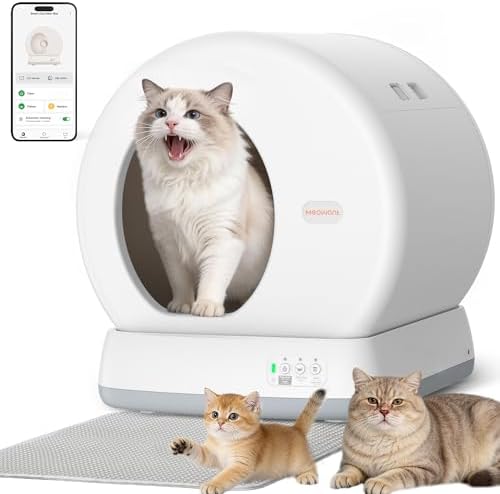
3 options shown here, $109.99 to $329.99, each with its own full review behind its name.


How do I measure the Power Source of a self-cleaning litter box?
To measure the Power Source of a self-cleaning litter box, you must locate the Wattage rating on the manufacturer’s technical specifications or the physical product label. Manufacturers usually list this as a “Power Rating” or “Power Consumption” value followed by a number and the letter “W” for Watts.
Calculating the Wattage of a self-cleaning litter box from specifications
You can find this number in the “Technical Specifications” section of the product listing. It is often grouped with the voltage requirements, such as 110V or 220V. If the listing only provides Amps (A) and Volts (V), you can calculate the Watts by multiplying the Amps by the Volts. For example, a device using 1.5 Amps on a 120V circuit draws 180 Watts.
Matching the self-cleaning litter box Wattage to household outlet limits
Before ordering, check the plug type and the maximum Wattage your specific outlet can handle. Most standard household outlets in North America can handle up to 1,800 Watts, but many people use power strips or extension cords that have much lower limits. If you plan to use a power strip, ensure the total Wattage of all connected devices does not exceed the strip’s rated capacity.
What happens if I choose the wrong Power Source for my self-cleaning litter box?
Choosing a Power Source that is too low for your needs results in a motor that lacks the torque to move heavy litter. When the motor encounters a large clump or a high volume of waste, it may stall. A stalled motor creates a permanent jam, which leads to the machine failing to complete its cycle and causing the litter to accumulate and create odors.
How low power can cause self-cleaning litter box motor overheating
The cost of a low-power mistake is a non-functional device that requires manual intervention to clear the blockage. If the motor is constantly struggling, it may also run hotter than intended. Overheating can shorten the lifespan of the internal gears and the motor itself, leading to a premature mechanical failure of the self-cleaning litter box.
If your main priority is keeping your home fresh, see our guide to the best self cleaning litter box for odor control.
Risks of using a high-Wattage power source for a litter box
Selecting a Power Source that is unnecessarily high does not make the device faster or more effective. Instead, a high-Wattage unit may draw more current than your specific outlet or power strip can provide. This can cause the circuit breaker to trip, cutting power to the device and other appliances on the same circuit. It can also lead to increased heat generation near the power cord and the base of the unit.
Impact of high power draw on portable battery life for litter boxes
High power draw also impacts the efficiency of battery-operated or portable power systems. If you are running a self-cleaning litter box off a portable battery, a high-Wattage unit will drain the battery significantly faster. This reduces the amount of time the device can operate before needing a recharge, potentially leaving the litter uncleaned for longer periods.
What should I do if my requirements fall between two Power Source values?
When your requirements fall between two Power Source values, you should prioritize the higher Wattage. In the context of self-cleaning litter boxes, having more power available is safer than having less. If your home’s electrical capacity allows for it, the higher Wattage ensures the motor has the necessary torque to handle heavy-duty tasks without stalling.
Why heavy clay litters require a higher Wattage self-cleaning litter box
You should choose the higher Wattage if you have multiple cats or use heavy, clay-based litters. These materials are denser and require more force to move. If you are unsure about the weight of the litter you will use, the higher Wattage provides a buffer against future changes in your household’s needs.
Choosing lower Wattage self-cleaning litter boxes for limited power sources
However, if your primary concern is the power limit of a specific outlet or a portable battery, you must choose the lower Wattage. In this specific scenario, the lower Wattage is the only option that ensures the device can actually turn on and run without triggering a safety shutoff. If you choose a high-Wattage unit that your power source cannot support, the device will be unusable.
Using lighter litter to balance power limits and motor torque
When these two requirements conflict—needing high torque but having limited power—you must evaluate the weight of the litter you intend to use. Switching to a lighter, silica-based litter can allow a lower-Wattage motor to perform the task effectively. This adjustment allows you to stay within your power limits while still achieving a clean result from the self-cleaning litter box.
Every motorized litter box guide in this category
- The Self Cleaning Litter Boxes That Work Best for Odor Control
- Which Self Cleaning Litter Box Is Best for Beginners?
- Choosing the Best Self Cleaning Litter Box for Multi Cat Homes
- The Self Cleaning Litter Boxes That Work Best for Large Cats Under $400
- Which Self Cleaning Litter Box with App Control Is Best?
- Best Self Cleaning Litter Boxes for Small Spaces
Early Pricing is reader-supported: some links on this page are affiliate links, and as an Amazon Associate Early Pricing earns from qualifying purchases at no extra cost to you. Learn more.