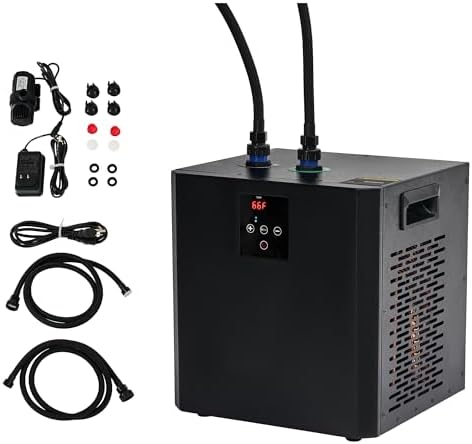
You must confirm your aquarium’s total water volume is 30L or less before ordering, and then calculate your specific heat load to ensure the 100W power output can maintain your target temperature.
How the 100W aquarium chiller manages heat for small fish tanks
The 100W Aquarium Chiller uses a 1/10 HP compressor to move heat away from the water through an internal heat exchange coil, which is a tube system where a refrigerant (a chemical that absorbs and releases heat) transfers thermal energy. While the 100W rating defines the power draw, the 30L limit is the specific volume the device can regulate. Because aquarium water chillers must combat both internal heat from fish and external heat from the room, efficiency drops if your ambient temperature is high. We selected this unit for our comparison because it represents the entry-level power bracket for small hobbyist setups. If you are keeping a high-bioload setup, such as a dense colony of tropical fish in a 25L tank, the 30L limit provides a necessary safety margin to prevent the compressor from short-cycling, which occurs when a unit is too small for the volume and shuts off repeatedly to prevent burnout.
What to Check Before Buying the 100W Aquarium Chiller
Measure your aquarium’s total water volume to ensure it does not exceed 30L.
Confirm your room’s average ambient temperature, as higher room heat reduces the effective cooling capacity.
Verify your power outlet can support a 100W continuous load without tripping a breaker.
Ensure your pump provides a flow rate sufficient to move water past the heat exchange coil quickly enough to prevent hot spots.
Comparing the 100W Aquarium Chiller to Other Options
This device serves as a compact cooling solution for small hobbyist tanks. Buyers requiring larger volumes or higher-capacity cooling should look at industrial-grade chillers that offer higher compressor horsepower and larger cooling capacities.
Reviewed by the Early Pricing editorial team. Early Pricing writes these guides from the 17 most-reviewed aquarium water chiller listings in our retail dataset, not from manufacturer copy.
The best aquarium water chiller for hydroponics is the GOSHET YSZY-02 60L Aquarium Water Chiller, which provides 200W of power to cool small nutrient reservoirs for hobbyists and indoor growers.
The picks are right below, in order. Everything after them is the reasoning, if you want it.
How Early Pricing picked: we started from the 17 most-reviewed aquarium water chiller listings in our retail dataset, removed duplicates, accessories and off-category products, and 13 qualified. The picks on this page were selected from those 13 candidates against this topic’s requirements. The order of the picks reflects fit to this topic; each shows its rating and the number of ratings behind it, so you can weigh how much to trust it. Specifications come from manufacturer listings and ratings from verified Amazon buyer reviews (data checked November 2026).
What We Recommend and Why
Last Updated: November 13, 2026
A successful hydroponic cooling system maintains a consistent temperature to ensure stable nutrient uptake and prevent root rot. The right chiller must match your reservoir’s requirements so the cooling rate actually keeps pace with the heat generated by your lights or environment.
The GOSHET YSZY-02 60L Aquarium Water Chiller delivers 200W of power to keep small nutrient tanks stable. For larger hydroponic systems requiring a 1/3 HP compressor, the Albott ACE001 79 Gal 1/3 HP Chiller offers more capacity, while the Poafamx 1/3 HP Aquarium Chiller provides a 40 to 80 gallon compatibility range.
We selected these models from 13 aquarium water chillers screened and 10 compared here at Early Pricing. The shortlist covers a price range from $149 to $329.99, with a median price of $149 among the 10 products in our comparison.
Consult the buying guide to understand the essential criteria for selecting the right cooling system.
Prices are approximate and move frequently – check the current price before deciding.
Among our top picks, the Poafamx 1/3 HP Aquarium Chiller is the value leader because it provides 1/3 HP of cooling power for $900.06 per unit.
Price vs. buyer rating for the 10 Aquarium Water Chiller products we compared. Highlighted points are our top picks.
The Full Review of Each Pick for Hydroponic Cooling
The 3 picks below are reviewed in the same order as the cards above.
GOSHET YSZY-02 60L Aquarium Water Chiller
The GOSHET YSZY-02 provides a compact cooling solution for small-scale hydroponic setups where space is limited and the reservoir volume is modest.
What we like: This unit features a 200W power output, which provides a high power-to-size ratio for a thermoelectric (Peltier) system. It includes a temperature probe with a 6.56-foot wire and a digital tube code display to monitor reservoir conditions.
Keep in mind: Because it uses a semiconductor refrigeration element rather than a compressor, it is suited only for smaller water volumes rather than large-scale hydroponic systems.
Poafamx 1/3 HP Aquarium Chiller
The Poafamx 1/3 HP Aquarium Chiller provides a balance of cooling capacity and durability for medium-sized hydroponic reservoirs.
What we like: This model utilizes a compressor with a 1/3 HP motor and a titanium evaporator, a material that resists corrosion in chemically active nutrient solutions. It supports a tank volume of 40 to 80 gallons and operates at a noise level under 45dB.
Keep in mind: At the $299.99 price point, this unit is intended for users who need more cooling capacity than a thermoelectric model can provide for a 40-gallon reservoir.
Albott ACE001 79 Gal 1/3 HP Chiller
The Albott ACE001 79 Gal 1/3 HP Chiller is a high-capacity choice for large-scale hydroponic cooling and nutrient tank temperature regulation.
What we like: This chiller offers a 1/3 HP compressor and a titanium evaporator, which provides a long lifespan in hydroponic environments. It supports a tank volume of up to 79 gallons and includes stainless steel braided pipes for circulation.
Keep in mind: With a price of $329.99, this unit is a larger investment suited for high-volume reservoirs rather than small desktop setups.
Titanium vs. Copper Heat Exchangers
Titanium heat exchangers offer superior resistance to corrosion in chemically active hydroponic nutrient solutions compared to copper, which can degrade over time. While the data for these specific models shows titanium evaporators for the compressor units, the material choice dictates the long-term durability of the cooling surface.
Cooling power per dollar for GOSHET YSZY-02 and Poafamx models
The GOSHET YSZY-02 offers the highest cooling power per dollar for small grow rooms, providing 200W of power for $149. For medium-sized reservoirs requiring a compressor, the Poafamx 1/3 HP Aquarium Chiller provides a 1/3 HP motor and 40 to 80 gallon compatibility for $299.99.
Check the technical requirements to ensure your system meets the minimum cooling capacity for your needs.
See our top picks for a quick overview of the best-performing chillers available.
Visit the FAQ to find quick answers to common questions about hydroponic cooling.
What to Look For in an Aquarium Chiller for Hydroponic Cooling
Flow Rate for Nutrient Circulation
Prioritize a chiller with an included water pump to ensure a steady flow of nutrient solution throughout your hydroponic reservoir. A consistent flow prevents stagnant zones where heat can build up and nutrients can settle. The GOSHET YSZY-02 60L Aquarium Water Chiller, Poafamx 1/3 HP Aquarium Chiller, and Albott ACE001 79 Gal 1/3 HP Chiller all state they include a water pump to move liquid through the cooling system.
Matching aquarium chiller capacity to hydroponic reservoir water volume
Match your chiller to your reservoir size to avoid short-cycling, which occurs when a unit is too small for the water volume and cycles on and off rapidly, potentially leading to compressor burnout. The Albott ACE001 79 Gal 1/3 HP Chiller supports a volume of up to 79 gallons, while the Poafamx 1/3 HP Aquarium Chiller handles between 40 and 80 gallons. Smaller setups can use the GOSHET YSZY-02 60L Aquarium Water Chiller, which is designed for 60 liters. For high-capacity industrial needs, units like the Hailea or EcoTech serve as the benchmark for precision, though the options here are sized for home-scale indoor farming.
Using 1/3 HP compressors for high-nutrient hydroponic reservoir cooling
Select a 1/3 HP compressor for high-nutrient reservoir cooling to maintain stable temperatures against the heat loads of active hydroponic systems. The Poafamx 1/3 HP Aquarium Chiller and Albott ACE001 79 Gal 1/3 HP Chiller both feature 1/3 HP motors, providing significant cooling power compared to thermoelectric alternatives. For smaller, low-heat reservoirs, the GOSHET YSZY-02 60L Aquarium Water Chiller provides 200W of power using a thermoelectric (Peltier) method, which uses a semiconductor to transfer heat. For a high-nutrient reservoir, you need enough cooling capacity to offset both the ambient room temperature and the heat generated by the water’s high turnover.
Continuous duty cycle ratings for 24/7 hydroponic cooling systems
Ensure your chiller is rated for continuous operation to maintain a steady temperature in a 24/7 hydroponic environment. Compressor-based units like the Poafamx 1/3 HP Aquarium Chiller and Albott ACE001 79 Gal 1/3 HP Chiller are designed for consistent output, whereas the GOSHET YSZY-02 60L Aquarium Water Chiller uses a compressor-less cooling fan. If your system requires constant cooling, check that the specific model is rated for 24-hour operation.
Noise Levels for Grow Room Environments
Look for a noise level under 45dB if your hydroponic system is located in a living space or a quiet indoor grow room. The Poafamx 1/3 HP Aquarium Chiller and Albott ACE001 79 Gal 1/3 HP Chiller both state a noise level of approximately 45dB. Because these units use compressors and dual cooling fans, they produce a consistent hum rather than the high-pitched whine of some smaller fans. If you are running a large-scale indoor farm, the Albott ACE001 79 Gal 1/3 HP Chiller provides a balance of high cooling capacity and manageable noise output.
What Each Job Calls For vs What These Picks State
Match the job you actually need done to the figure it calls for, then check which picks state that figure or more. Where none do, the row says so.
What Each Job Calls For vs What These Picks State – Aquarium Water Chiller
What you want to do
The figure it calls for
Picks at or above it
Maintain a nutrient solution chiller
1/3 HP Compressor Horsepower
Poafamx 1/3 HP Aquarium Chiller, Albott ACE001 79 Gal 1/3 HP Chiller
Manage a hydroponic reservoir temperature controller
79 gallon Tank Volume Compatibility
Albott ACE001 79 Gal 1/3 HP Chiller
Operate a large-scale hydroponic water cooling system
Industrial Grade Chillers
None of the picks clear this; industrial grade chillers are required
These figures are the levels this category is generally held to, not manufacturer claims. A pick at or above a figure states that number; how it reaches it and the rest of your setup still decide the job, so check them against your own workload before buying.
Who Buys Aquarium Water Chillers, and What It Really Costs
Who buys an aquarium water chiller, and what each one needs
Indoor vertical garden owners — a compressor system to provide consistent cooling for high-heat water reservoirs
Hydroponic greenhouse hobbyists — a closed loop system (external hoses and pumps) to move water through long tubing
Small-scale mushroom farmers — a chiller that avoids short-cycling (rapidly turning on and off) to maintain steady temperatures
Home greenhouse builders — a unit with high tank volume compatibility to manage large water reservoirs without overheating
Aquaponic system operators — a chiller with high cooling capacity to offset heat from high-intensity grow lights
What a fish tank cooler really costs, and where to buy one
What to budget for on top of the fish tank cooler
Insulation material — to prevent condensation buildup (water pooling on electronics) on the reservoir
External water pump — to move water through the chiller if using an open loop setup
Waterproof electrical outlets — to protect the power source from moisture in humid growing areas
Replacement tubing — to connect the chiller to the hydroponic reservoir
What you can leave out of the budget
Submersible cooling units — these are often too small for large hydroponic reservoirs and lead to short-cycling
Thermoelectric cooling pads — these have lower cooling capacity than compressor models for large water volumes
Where this kind of product is normally sold
Specialized hydroponic supply stores — provides access to technical advice and compatible plumbing fittings
General electronics retailers — offers standard return windows and easy shipping for the unit itself
Aquarium supply shops — provides access to heavy-duty pumps and specialized tubing for water movement
Online marketplaces — offers a wide variety of models but requires careful checking of shipping dimensions
Explore the detailed reviews for an in-depth analysis of every product featured in this list.
Review the article scope to see exactly which products and cooling methods are included here.
What It Takes to Run One, and What to Verify
What you need before your chiller starts cooling
You need a 110 Volts corded electric power source to operate any of these aquarium water chillers. Each unit requires a flat, stable surface for placement to ensure proper ventilation and heat dissipation.
The GOSHET YSZY-02 60L Aquarium Water Chiller includes a water pump, meaning you do not need to purchase an External Water Pump (which circulates water from the tank to the chiller) to move fluid through the system.
You must source Inlet and Outlet Hoses to connect the aquarium to the cooling unit; ensure the hose diameter matches the threaded connectors on the chiller.
The Albott ACE001 79 Gal 1/3 HP Chiller includes 2 stainless steel braided pipes, while the Poafamx 1/3 HP Aquarium Chiller includes a water hose and hose connectors.
Verifying your chiller on arrival
Warranty cover and return windows differ by seller and country. Confirm these details with your specific retailer before the return window closes.
Verify the cooling capacity and pump functionality by running the unit; if the pump does not move water or the unit fails to draw power, the internal circulation may be obstructed.
Check that the titanium evaporator material and stainless steel connectors are free of shipping damage, as these components are primary heat exchange points and difficult to replace.
Confirm the compressor power or power output matches the stated figures (such as the 200W on the GOSHET or 1/3 HP on the Albott), as this dictates the maximum cooling rate for your hydroponic reservoir.
Plug the unit into a dedicated outlet and run a test cycle to confirm the temperature probe and pump are circulating water correctly before you fill the reservoir with nutrients.
Aquarium Water Chillers for Hydroponic Cooling: The Questions This Choice Raises
How much electricity will I use to keep a large hydroponic reservoir cool all day?
The electricity you use to keep a large hydroponic reservoir cool depends on the power output of the chiller and the ambient temperature of your growing space. A unit with a 200W power output, like the GOSHET YSZY-02 60L Aquarium Water Chiller, draws a specific amount of energy to maintain the set point, while larger systems with 1/3 HP compressors will have different consumption rates based on their motor strength.
Which aquarium water chiller is best for a small hydroponic reservoir?
The aquarium water chiller that suits a small hydroponic reservoir depends on your specific volume needs, with the GOSHET YSZY-02 60L Aquarium Water Chiller offering 200W of power for smaller setups. For larger needs, the Albott ACE001 79 Gal 1/3 HP Chiller handles up to 79 gallons of water.
What is the cooling capacity of a 1/3 HP compressor chiller?
A 1/3 HP compressor chiller provides a specific cooling capacity, such as the Poafamx 1/3 HP Aquarium Chiller which can lower temperatures by up to 10C below room temperature. This mechanical power output determines how much heat the unit can remove from your nutrient solution in a set timeframe.
Does the Albott ACE001 79 Gal 1/3 HP Chiller include a pump?
Yes, the Albott ACE001 79 Gal 1/3 HP Chiller includes a water pump to move liquid through the cooling system. This allows for circulation throughout your hydroponic system to ensure even temperature distribution.
Use the audience checklist to determine which specific model best fits your unique growing setup.
Who Should Skip These Fish Tank Coolers
If you operate a large-scale hydroponic water cooling system, these three picks may not meet your requirements. None of the options we compared reach the capacity of industrial grade chillers, which are the standard for high-capacity industrial farming. These units are designed for high-volume output that exceeds the 79-gallon limit of the Albott ACE001 or the 200W power output of the GOSHET YSZY-02.
For large-scale operations, you should look for industrial grade chillers designed for high-volume heat exchange. If you are running a smaller setup for specific aquatic needs, you may find more tailored results in our other guides, such as best small aquarium water chiller for 20 gallon tanks or .
Not stated in the listing – confirm with the seller before ordering
Power Output
Not stated in the listing – confirm with the seller before ordering
Suits axolotl owners
Axolotl owners
Home reef keepers
Jellyfish hobbyists
Small-scale tropical fish breeders
$110 over the category median
This Aquarium Water Chiller
$279.99
Median of the 13 Aquarium Water Chillers we screened
$169.99
Range
$119.99 to $435
Cheaper than this one
9 of those 13
What the Poafamx POA-100 Chiller Is, and Who For
Poafamx POA-100 Chiller cools water for tanks up to 30 gallons for owners of axolotls, corals, or tropical fish.
Last Updated: November 6, 2026
A titanium evaporator prevents the corrosion that often degrades the cooling surfaces of lower-grade aquarium cooling systems over time. Using the Poafamx POA-100 Chiller ensures that the heat exchange components remain intact even in high-salinity environments.
The Poafamx POA-100 Chiller uses an R134a compressor to reach its cooling capacity, making it suitable for a 20-30 gallon setup. It provides a reliable method for heat removal in smaller hobbyist tanks.
We evaluated 13 aquarium water chillers and selected this model for a full review because it has 38 buyer ratings, the 3rd most of the 13 screened. This review is for those seeking a compressor-based cooling system for freshwater or saltwater environments.
How Early Pricing picked: we started from the 17 most-reviewed aquarium water chiller listings in our retail dataset, removed duplicates, accessories and off-category products, and 13 qualified. This product is one of 9 from that pool chosen for a full review. Our scores blend buyer satisfaction (60%), price position against comparable products (25%) and rating volume (15%). Specifications come from manufacturer listings and ratings from verified Amazon buyer reviews (data checked November 2026).
The Numbers on the Spec Sheet – Poafamx POA-100 Chiller
Power Output
AC
Tank Volume Compatibility
20-30 Gallon
Compressor Horsepower
1/13 HP
Cooling Method
Compressor
Water Pump Included
Yes
Circulation Function
Yes
Water Pump Flow Rate
210 GPH
Temperature Range
65-80F (18-27C)
Product Dimensions
13.4″L x 7.9″W x 11.8″H
Tank Volume Compatibility measures the maximum total water volume the device is designed to maintain, and the Poafamx POA-100 Chiller is rated for 20-30 gallons.
Where the Poafamx POA-100 Chiller sits on each spec this category is judged by, against the Aquarium Water Chiller listings we screened.
Where this sits in the buyer data: Among the 9 products screened for this category, this one’s 4.0 rating places it #3, on 38 ratings – above the 4-rating median of that group, so the average rests on more feedback than most of its comparables. On price it undercuts 3 of them.
Before You Buy: Aquarium Cooling System Checklist
The first thing to check is your aquarium’s total water volume to ensure it falls within the 20-30 gallon range.
✓ Confirm your tank volume is under 30 gallons — a unit too small for the tank volume will cycle on and off rapidly, leading to compressor burnout and unstable temperatures.
✓ Measure 6 inches of clearance on all sides — insufficient space around the unit can lead to condensation buildup where water pools on electronics and causes short circuits.
✓ Verify your water type is freshwater or saltwater — the corrosion-resistant titanium evaporator allows for use in both environments.
✓ Budget for a 22.05 pound unit — the weight of the chiller may require specific placement considerations for your aquarium stand.
✓ Check that you have an AC power source — the unit requires a standard AC connection to operate the cooling system.
You should not buy this product if your aquarium exceeds 30 gallons, as the cooling capacity will not be sufficient to maintain stable temperatures.
Practical Performance of this Aquarium Water Chiller
How titanium evaporator material resists corrosion in saltwater
The Poafamx POA-100 Chiller uses a corrosion-resistant titanium evaporator to handle the chemical demands of both freshwater and saltwater environments. Titanium is a metal that resists oxidation and pitting, which allows you to maintain the cooling unit in aggressive salt conditions without the metal degrading over time. This material choice supports the use of the unit for diverse species, including corals and jellyfish, which require specific water chemistry.
The titanium construction enables the unit to function in high-salinity setups where standard copper or aluminum components might fail. Because the evaporator is designed to resist corrosion, you can operate the chiller in a reef tank environment without worrying about mineral buildup compromising the heat exchange surface. This durability ensures the cooling component remains functional even when exposed to the constant chemical cycling of a saltwater aquarium.
Dual fans and vents manage heat for this aquatic cooling unit
The Poafamx POA-100 Chiller utilizes dual rear fans and front and side cooling vents to manage the heat generated during the cooling process. These vents allow for a higher volume of air to pass over the unit, which helps maintain the 65-80F temperature range by preventing the internal components from overheating. You can position the unit as long as you maintain the required 6 inches of space around it to ensure these vents remain unobstructed.
Effective heat dissipation via these multiple vents allows the chiller to maintain consistent performance during periods of high thermal load. By distributing airflow through three different sides of the chassis, the system prevents heat soak, which can cause a unit to lose efficiency or shut down. This configuration supports a stable operating environment for tropical fish that require steady temperatures even in warm ambient conditions.
210 GPH water flow rate circulates a 30-gallon tank
The 210 GPH water pump flow rate is sufficient to circulate water in a 30-gallon setup, ensuring that the entire volume of the tank stays cool. A flow rate of 210 gallons per hour (GPH) means the water moves through the cooling system frequently enough to prevent hot spots in large tanks. You should confirm your tank’s total volume is within the 20-30 gallon capacity to ensure this flow rate provides even temperature distribution.
This circulation capacity allows you to maintain a uniform temperature across the aquarium, which is necessary for the health of sensitive species like axolotls. If your tank volume exceeds 30 gallons, the 210 GPH flow may not move water fast enough to keep the furthest corners of the tank at the target temperature. For a 30-gallon setup, this flow rate ensures the water moves through the heat exchanger at a pace that supports consistent cooling.
Where the Poafamx POA-100 Chiller Sits Among the Alternatives
The Poafamx POA-100 Chiller provides a 1/13 HP compressor capable of maintaining temperatures between 65F and 80F for tanks up to 30 gallons.
Comparison with Similar Products
The Poafamx POA-100 Chiller ranks as the highest-rated option among the 4 products compared, offering a 4.0 average from 38 buyer ratings.
The Poafamx 1/3 HP Aquarium Chiller features a 1/3 HP compressor, which is larger than the 1/13 HP motor in the Poafamx POA-100 Chiller.
Plug the unit into an AC outlet and monitor the temperature until it reaches your desired range of 65-80F.
Verifying warranty terms and refrigerant levels for this cooling unit
Warranty terms and support availability vary by seller and country. Before the return window closes, you should confirm several details to ensure the unit meets your needs.
Verify the R134a refrigerant level is intact, as a leak would prevent the unit from cooling the water.
Check that the 210 GPH flow rate is sufficient for your specific tank volume, as low flow can lead to uneven cooling.
Confirm the titanium evaporator is free of debris, which is necessary to maintain the heat exchange surface.
Test the unit’s ability to lower the water temperature by 5 degrees within the first hour of operation to confirm it is cooling correctly before keeping the product.
Questions Buyers Ask About This Aquarium Water Chiller
What should I consider before buying an aquarium water chiller?
Maintaining a stable temperature in a large tank often requires a dedicated cooling system to prevent heat spikes during summer months. The Poafamx POA-100 Chiller provides a cooling capacity for 20-30 gallons, which is the maximum volume of water the unit can maintain at a steady temperature. Because it is rated for 20-30 gallons, you should verify your tank’s total volume before ordering to ensure the unit can handle your specific water load.
Does the Poafamx POA-100 Chiller include a water pump?
Yes, the Poafamx POA-100 Chiller includes a water pump with a flow rate of 210 GPH (gallons per hour), which moves water through the cooling system. Since the unit includes the pump and water pipe, you can begin circulating water through the chiller without purchasing additional external pumping hardware. This flow rate helps ensure the water reaches the titanium evaporator for efficient heat exchange.
Is the Poafamx POA-100 Chiller compatible with my saltwater setup?
Yes, the Poafamx POA-100 Chiller is compatible with both freshwater and saltwater environments. It uses a corrosion-resistant titanium evaporator, a material choice that helps the unit withstand the mineral content of saltwater. This makes it suitable for various species including corals and tropical fish.
What space do I need to install this chiller?
You need to provide 6 inches of clearance around the unit to allow for proper airflow and heat dissipation. Because the device features front and side cooling vents and dual rear fans, maintaining this specific gap ensures the compressor does not overheat. Measure your available space to confirm it meets this 6-inch requirement before you place the unit.
Is the Poafamx POA-100 Chiller Right for You?
Who the Poafamx POA-100 Chiller suits and the jobs it is the wrong choice for, listed below with the reason for each.
Who the Poafamx POA-100 Chiller is for, and what it does well
Who this aquarium water chiller suits
Axolotl owners — the 20-30 gallon capacity and 65-80F range are ideal for maintaining the cool water these amphibians require
Home reef keepers — the corrosion-resistant titanium evaporator and saltwater compatibility make it suitable for small coral setups
Jellyfish hobbyists — the specific temperature range and saltwater compatibility support the needs of delicate jellyfish species
Small-scale tropical fish breeders — the 210 GPH flow rate and 1/13 HP compressor provide consistent cooling for small breeding tanks
Apartment dwellers with limited space — the compact 13.4″L x 7.9″W x 11.8″H dimensions allow for placement in smaller living areas
What this fish tank cooler handles well
Maintaining tropical fish temperatures — the 65-80F temperature range
Cooling saltwater reef tanks — the corrosion-resistant titanium evaporator
High-turnover water circulation — the 210 GPH water pump flow rate
Compact aquarium setups — the 20-30 gallon capacity compatibility
Heat dissipation in tight spaces — the front and side cooling vents and dual rear fans
What the Poafamx POA-100 Chiller is the wrong choice for
Large koi ponds — the 20-30 gallon capacity limit is too small for outdoor ponds
High-heat tropical environments — the 1/13 HP compressor may struggle to cool very large volumes or extreme heat spikes
Large marine displays — the 20-30 gallon capacity limit rules out large-scale saltwater setups
Deep-water cooling — the 210 GPH flow rate may be insufficient for very deep, high-volume tanks
What to budget alongside the Poafamx POA-100 Chiller, and what to skip
Accessories worth buying with this aquarium water chiller
Power strip — the AC power source requires a dedicated outlet near the 6-inch clearance zone
Aquarium stand — the 22.05 lb weight and 6-inch clearance requirement need a stable, level surface
Water conditioner — necessary for the saltwater environments the unit supports
Replacement tubing — the included water pipe may need extending to reach specific tank locations
Thermometer — needed to monitor the 65-80F range to ensure the chiller is hitting targets
Accessories you can skip buying for this aquarium cooling system
External water pump — the unit already includes a water pump
Extra water pipes — the unit includes a water pipe in the box
Titanium evaporator replacement — the unit already features a corrosion-resistant titanium evaporator
In November 2026 the Poafamx POA-100 Chiller was listed at $279.99. Prices move, so read that as a snapshot, not a quote.
Aquarium water chillers are sold by the retailers below – we do not track which of them has the Poafamx POA-100 Chiller in stock, so check availability and the current price with the retailer before making a trip.
Amazon (online only) — broad selection of brands and consumer models
Petco (online and physical stores) — in-store availability and physical returns
PetSmart (online and physical stores) — local availability and brand variety
Chewy (online only) — large inventory of pet maintenance equipment
Marine Depot (online only) — specialist selection for saltwater and reef systems
eBay (online only) — open-box and refurbished equipment options
Final Verdict on the Poafamx POA-100 Chiller
If you need to maintain a stable temperature for a small to medium-sized tank, the Poafamx POA-100 Chiller is a viable option. You can find this unit for around $279.99.
The 20-30 gallon tank volume compatibility means this system is designed to manage the heat load of a specific water volume, much like a small refrigerator is sized for a specific interior capacity. Because it supports a maximum of 30 gallons, it provides the necessary cooling for species like axolotls or tropical fish in smaller setups.
The 1/13 HP compressor provides the mechanical power necessary to move heat out of the water. This power level, combined with a 210 GPH water pump flow rate, allows the unit to circulate and cool the water within the specified 65-80F temperature range.
The titanium evaporator material is used to resist corrosion from constant water contact. Because the unit includes a water pump and circulation function, you do not need to provide an external means to move water through the cooling system.
You must ensure you have 6 inches of space around the unit for proper airflow. This clearance allows the front and side cooling vents and dual rear fans to dissipate heat effectively.
If you are maintaining a small freshwater or saltwater environment and require a dedicated cooling system for a 30-gallon capacity, the Poafamx POA-100 Chiller is a practical choice at the $279.99 price point.
The unit’s ability to support a 30-gallon volume while maintaining a 65-80F range provides a specific cooling envelope for smaller aquatic habitats. It currently holds a 4.0 rating from 38 buyers.
Skip it if: Your aquarium exceeds 30 gallons or if you require a cooling capacity beyond the 20-30 gallon compatibility range.
You must ensure your room has enough space for the three-side ventilation and one front fan to move heat away from the unit. Verify that your power outlet can support the upgraded internal power supply to prevent electrical humming.
How the Poafamx 16gal Chiller thermoelectric system affects bedroom noise levels
The Poafamx 16gal Chiller uses a thermoelectric (Peltier) system, which is a cooling method that uses electricity to transfer heat from one side of a ceramic plate to the other without a moving compressor. Because this device lacks a compressor—the heavy motor usually found in large refrigerators—it operates with a more consistent hum rather than a loud mechanical kick. We included this model in our comparison of the aquarium chiller options we evaluated because of its specific noise profile and small footprint. In a bedroom, the primary sound source is the front fan, which manages heat dissipation. To keep this noise at the rated level, you must provide clear airflow; restricted space forces the fan to work harder and louder. You should also check for vibration dampening, which is a material like a thick rubber mat that absorbs shaking, as resonance can amplify the internal fan’s sound. While the unit features real-time temperature monitoring and an automatic constant temperature between 65-75F, the data does not state if the water pump creates a gurgling sound in the return line.
Measure the clearance around the three-side ventilation to ensure the fan doesn’t have to run at maximum capacity to exhaust heat.
Confirm your power outlet can handle the load without an extension cord, which can cause buzzing.
Identify a spot for the unit to sit where you can place a dampening mat to minimize surface vibration.
Verify that the heat exhaust direction aligns with your room’s airflow so it doesn’t blow hot air directly toward your bed.
Comparing the Poafamx 16gal Chiller to Other Options
The Poafamx 16gal Chiller is designed for smaller setups, specifically household fish tanks less than 16gal. If you require a high-capacity cooling rate for a large volume of water, you may need to look at industrial-grade chillers that utilize a compressor for heavy-duty heat removal. Buyers with very limited space or those who prioritize a silent bedroom environment will prefer this thermoelectric model. However, if your tank requires rapid cooling of a large volume of water quickly, you should consider alternatives with higher cooling capacity ratings.
Reviewed by the Early Pricing editorial team. Early Pricing writes these guides from the 17 most-reviewed aquarium water chiller listings in our retail dataset, not from manufacturer copy.
Where to go next in our aquarium cooling system coverage
Too small a sample to conclude anything either way
Where it comes from
The product listing, read 6 November 2026
2 deciding specs not stated
Tank Volume Compatibility
Not stated in the listing – confirm with the seller before ordering
Compressor Horsepower
Not stated in the listing – confirm with the seller before ordering
Suits home aquarium hobbyists
Home aquarium hobbyists
Axolotl owners
Shrimp breeders
Aquaponic system starters
Where the DYRABREST Water Chiller Fits
DYRABREST 35L 100W Aquarium Water Chiller cools water volumes up to 30L/7.93GAL for owners of freshwater or seawater systems with specific temperature requirements.
Last Updated: November 6, 2026
Maintaining a consistent water temperature allows for the successful cultivation of axolotls and shrimp in a controlled environment. The DYRABREST 35L 100W Aquarium Water Chiller achieves this stability through an electronically temperature-controlled chilling process.
The unit supports a cooling capacity of 30L/7.93GAL and includes a built-in fan for heat dissipation. It is compatible with various systems, including aquaponic and seawater setups.
We evaluated 13 aquarium water chillers and selected this model for a full review because it was one of the most-rated products to pass screening, with 3 buyer ratings. This review is for buyers who need precise temperature management for specific aquatic life.
How Early Pricing picked: we started from the 17 most-reviewed aquarium water chiller listings in our retail dataset, removed duplicates, accessories and off-category products, and 13 qualified. This product is one of 9 from that pool chosen for a full review. Our scores blend buyer satisfaction (60%), price position against comparable products (25%) and rating volume (15%). Specifications come from manufacturer listings and ratings from verified Amazon buyer reviews (data checked November 2026).
The Short Answer on the DYRABREST Water Chiller
Best for: you need to maintain a water temperature between 10°C and 40°C in a small aquatic system.
The DYRABREST Water Chiller is a practical choice for these requirements at the $138.92 mark.
Pro: Includes a circulation pump that moves up to 3 L/min to ensure even cooling throughout the tank.
Pro: Features an LED digital temperature display for real-time monitoring of the water.
Pro: Supports a variety of aquatic life, including axolotls and coral reef organisms.
Con: The 30L/7.93GAL cooling capacity limits its use to smaller setups, as larger volumes will result in slower temperature drops.
Con: The 4.3 rating is based on only 3 buyer ratings, which provides little data on long-term reliability.
Don’t buy this if: you need to cool a total water volume that exceeds 30L/7.93GAL, as the unit will struggle to maintain stable temperatures in larger tanks.
Price assessment: The $138.92 price is fair for a unit that includes both a cooling system and a dedicated circulation pump.
7.4/10
Early Pricing score: 7.4/10 (data-driven – see “How we picked” above)
The Specifications That Matter
The Specifications That Matter – DYRABREST Water Chiller
Cooling Capacity
30L/7.93GAL
Power Output
100W
Tank Volume Compatibility
30L/7.93GAL
Water Pump Included
Yes
Circulation Function
Yes
LED Indicator
Yes
Temperature Control Range
10-40C
Circulation Pump Flow
Up to 3 L/min
The Cooling Capacity of 30L/7.93GAL measures the volume of water the unit can lower by a specific temperature in a set timeframe.
Where the DYRABREST Water Chiller sits on each spec this category is judged by, against the Aquarium Water Chiller listings we screened.
Where this sits in the buyer data: Among the 9 products screened for this category, this one’s 4.3 rating places it #2, on 3 ratings – below the 4-rating median of that group, so treat the average as less settled than its comparables. On price it undercuts 9 of them.
Before You Buy: Aquarium Water Chiller Checklist
The first thing to check is the cooling capacity relative to your tank volume to avoid short-cycling, which occurs when a unit is too small for the water volume and cycles on and off rapidly, leading to compressor burnout and unstable temperatures.
☐ Confirm your tank volume is under 30L/7.93GAL — exceeding this limit may cause the unit to cycle too frequently and fail.
☐ Verify your power supply can handle a 100W draw — insufficient power may cause the unit to shut down or trip breakers.
☐ Measure your ventilation space to prevent condensation buildup — poor airflow allows water to pool on electronics and cause short circuits.
☐ Budget for a 3 L/min circulation flow — ensure this rate is sufficient to move water throughout your specific tank layout.
You should not buy the DYRABREST Water Chiller if your aquarium exceeds the 30L/7.93GAL cooling capacity limit.
Performance: What the Specs Deliver
Compatibility with freshwater seawater and aquaponic systems
The DYRABREST 35L 100W Aquarium Water Chiller supports freshwater, seawater, and aquaponic systems, making it compatible with various organisms including fish, axolotl, shrimp, and coral reef inhabitants. This broad compatibility allows you to maintain specific environments for different species without needing separate cooling hardware for each tank type.
The DYRABREST Water Chiller is designed to maintain a temperature range of 10-40C. Because this range covers most standard aquatic environments, you can use it for both tropical and temperate species, provided your specific setup does not require temperatures outside these 30-degree boundaries.
Real-time monitoring via the LED digital temperature display
The LED digital temperature display provides a constant readout of the current water temperature, allowing you to monitor your aquatic environment at a glance. Having a dedicated display means you can verify that the unit is maintaining your desired range without needing to manually check a separate thermometer.
The DYRABREST Water Chiller features an electronically temperature-controlled system to maintain these levels. Since the data does not specify a precise response time for the controller, you should monitor the display during the initial cooling phase to ensure the environment stabilizes as expected for your specific livestock.
Efficient Heat Dissipation
The DYRABREST Water Chiller provides a cooling capacity of up to 30L/7.93GAL, which is the volume of water the unit can lower by a specific temperature in a set timeframe. To ensure your tank stays cool during a heatwave, you must confirm your total water volume is 30L or less, as the unit is not designed to handle larger volumes effectively.
A circulation pump with a flow of up to 3 L/min and a built-in fan for heat dissipation help manage the thermal load. Because the cooling capacity is tied to the 30L limit, you should avoid overfilling the tank or adding significant heat sources, as these factors can exceed the 100W power output’s ability to maintain a steady temperature.
How the DYRABREST Water Chiller Compares to Other Aquarium Chillers
The DYRABREST Water Chiller provides a cooling capacity of 30L/7.93GAL, which determines the volume of water the unit can lower by a specific temperature in a set timeframe. This capacity limits the system to smaller setups, as it does not decide the total tank size or the intensity of the heat source. If you need to maintain a larger volume, you must verify your total water volume against this 30L limit before ordering.
Comparison to Similar Products
The DYRABREST Water Chiller is the 4th cheapest option among the similar models we evaluated, offering a balance of features for mid-range setups.
The aikeec Aquarium Water Chiller is $1.75 cheaper than the DYRABREST Water Chiller.
What the DYRABREST Water Chiller costs next to the Aquarium Water Chiller alternatives we compared.
What the deciding spec costs here: Measured as price per unit of Power Output, the reviewed product works out to $1.39 against a $1.20 median across the 7 other screened products that state the spec, and 5 of them deliver more of it per dollar. The cheapest screened product that beats its 100W is the aikeec Aquarium Water Chiller at $137.17 with 72W / 180W, which is $1.75 less than this one for more of the spec that decides this category.
From Delivery to First Use with This Aquarium Chiller
Setting up the DYRABREST 35L 100W Aquarium Water Chiller
You must have a stable power source and a dedicated space for the unit before you begin the setup. This aquarium chiller includes a built-in fan for heat dissipation, which requires clear clearance around the unit to prevent overheating.
Connect the inlet and outlet hoses to the chiller and your aquarium tank.
Plug the unit into a power source to activate the LED digital temperature display.
Adjust the temperature control range to your desired setting between 10°C and 40°C.
Verifying warranty coverage and power requirements before use
Warranty coverage and return policies vary significantly depending on the specific retailer and your geographic location. Before the return window closes, you should confirm the following details to ensure the unit performs as expected:
Verify the 100W power draw matches your circuit’s capacity to avoid tripping breakers.
Confirm the circulation pump flow of up to 3 L/min is sufficient for your specific tank volume.
Check that the 30L/7.93GAL cooling capacity aligns with your desired temperature drop speed.
Test the unit in your setup and verify the temperature reaches your target setting within the first 24 hours of operation.
The DYRABREST Water Chiller: Remaining Questions
How much will the DYRABREST 35L 100W Aquarium Water Chiller cost to run each month?
The monthly cost depends on your local electricity rates and how many hours the unit runs to maintain your desired temperature. The DYRABREST Water Chiller has a power output of 100W, which is a relatively low draw for this category of aquatic cooling units. Because the chiller only runs when the water exceeds your set point, the actual energy consumption will be lower than a constant 100W load.
Is the DYRABREST 35L 100W Aquarium Water Chiller compatible with my saltwater reef tank?
Yes, the DYRABREST Water Chiller is compatible with seawater systems, making it suitable for coral reef tanks. It supports a cooling capacity of up to 30L/7.93GAL to maintain stable temperatures in smaller aquatic environments. You should confirm your tank’s total volume is within this 30L limit before ordering to avoid short-cycling, which occurs when a unit is too small for the water volume and cycles on and off rapidly.
Does the DYRABREST 35L 100W Aquarium Water Chiller include a pump for water circulation?
The DYRABREST Water Chiller states it includes a water pump with a flow rate of up to 3 L/min. This circulation function moves water through the cooling system to ensure even temperature distribution across your tank. Since only 6 of the 13 screened listings state they include a circulation function, this is a notable inclusion for your setup.
What is the temperature range for the DYRABREST 35L 100W Aquarium Water Chiller?
The DYRABREST Water Chiller offers a temperature control range of 10-40C. This range allows you to maintain specific conditions for various aquatic organisms, including axolotls and shrimp. The unit uses an electronically temperature controlled system to keep the water within these bounds.
Who the DYRABREST Water Chiller suits and the jobs it is the wrong choice for, listed below with the reason for each.
Who this aquarium water chiller is for, and what it does well
Who the DYRABREST Water Chiller suits
Home aquarium hobbyists — the 30L cooling capacity is ideal for small to medium-sized desktop tanks
Axolotl owners — the specific compatibility with axolotl ensures the temperature stays within their required range
Shrimp breeders — the low noise operation and precise electronic temperature control are perfect for sensitive shrimp colonies
Aquaponic system starters — the compatibility with aquaponic systems allows for integrated fish and plant cooling
Coral reef hobbyists — the seawater system compatibility allows for maintaining the specific temperatures needed for reef life
What this aquarium chiller handles well
Maintaining stable temperatures for jellyfish — the electronically controlled temperature range of 10-40C
Cooling small freshwater setups — the 30L/7.93GAL cooling capacity
Running quiet indoor fish tanks — the low noise operation
Managing high-efficiency cooling — the high efficiency chilling process
Monitoring water temperature in real-time — the LED digital temperature display
What this aquatic cooling unit is the wrong choice for
Cooling large outdoor ponds — the 30L cooling capacity is too small for large bodies of water
High-volume water circulation — the 3 L/min pump flow limit restricts heavy-duty turnover
Industrial-scale aquaculture — the 100W power output is insufficient for large-scale commercial use
What to budget alongside this aquarium water chiller, and what to skip
Accessories worth buying with the DYRABREST Water Chiller
Water tubing — to connect the circulation pump to the main tank
Power adapter — to provide the 100W of power required for operation
Water conditioner — to ensure the chemistry is safe for the compatible fish and shrimp
Submersible pump — to move water into the chiller if the 3 L/min flow is insufficient for the tank size
Thermometer — to verify the accuracy of the LED digital temperature display
Accessories you can skip buying for this aquarium water chiller
Analog thermometer — the built-in LED digital temperature display provides this functionality
External cooling fans — the built-in fan for heat dissipation handles the unit’s cooling needs
Where to Buy This Aquarium Water Chiller
When we looked in November 2026, the DYRABREST Water Chiller was listed at $138.92 – a snapshot that may have changed since.
Aquarium water chillers are sold by the retailers below – we do not track which of them has the DYRABREST Water Chiller in stock, so check availability and the current price with the retailer before making a trip.
PetSmart (online and physical stores) — local availability and brand variety
Chewy (online only) — large inventory of pet maintenance equipment
Marine Depot (online only) — specialist selection for saltwater and reef systems
eBay (online only) — open-box and refurbished equipment options
Amazon (online only) — broad selection of brands and consumer models
Petco (online and physical stores) — in-store availability and physical returns
Final Verdict on the DYRABREST Water Chiller
If you need to maintain a steady temperature for a small aquatic cooling unit, the DYRABREST Water Chiller provides a compact solution for specific hobbyist needs. This model is available for around $138.92 and carries a 4.3 average across 3 buyer ratings, though a sample this small settles nothing regarding long-term reliability.
The DYRABREST Water Chiller features a cooling capacity of 30L/7.93GAL, which determines the volume of water the unit can lower by a specific temperature in a set timeframe. Because this capacity is limited to 30 liters, it is suited for small setups rather than large industrial systems. The 100W power output measures the electrical energy consumed by the device, which stays within a standard range for small-scale aquarium chillers.
The circulation pump flow reaches up to 3 L/min, moving water through the system to ensure even cooling. To prevent the common mistake of installing a chiller that is too small for the tank volume, which leads to short-cycling and compressor burnout, you must confirm your total water volume is well below the 30L limit before ordering. The unit includes an LED digital temperature display and a built-in fan for heat dissipation to manage the heat generated during the chilling process.
You should choose the DYRABREST Water Chiller if you are maintaining a small aquarium, such as one for shrimp or axolotls, where the total water volume does not exceed 30 liters. It is available for around $138.92.
The 30L/7.93GAL cooling capacity is the primary factor for this selection, as it defines the specific limits of the water volume this unit can effectively regulate.
Skip it if: your aquarium holds more than 30 liters of water or if you require the higher cooling capacities found in industrial-grade chillers.
Reviewed by the Early Pricing editorial team.
The other aquatic cooling unit guides we have published
You must confirm your aquarium’s total volume is within this 30L limit before ordering, then check that your space allows for a unit with a built-in fan for heat dissipation.
DYRABREST Water Chiller power rating and 3 L/min circulation pump flow
The 100W rating for this unit refers to its power output, which measures the electrical energy the device consumes rather than the heat removal capacity. In our comparison of the aquarium water chiller options we evaluated, the DYRABREST Water Chiller features a circulation pump that moves water at a flow rate of up to 3 L/min. This flow rate helps the heat exchanger—a component that transfers heat from the water to the cooling system—distribute chilled water evenly. Because aquarium water chillers must maintain stable temperatures for sensitive organisms like jellyfish or coral reef tanks, ensuring the pump can move enough water to prevent hotspots is vital. The device uses a compressor, which is the mechanical motor that provides the cooling power, to reach a temperature control range of 10-40C.
Measure your available space to ensure the unit can vent heat through its built-in fan.
Verify that your aquarium setup can accommodate a flow rate of 3 L/min through the cooling coils.
Check that your installation site has adequate space for the unit, as the listing does not state specific drainage or condensate requirements.
Comparing the DYRABREST Water Chiller to Other Options
The DYRABREST Water Chiller functions as a compact cooling system that lowers water temperature for small aquatic environments. Buyers who require high-capacity cooling for large industrial tanks or massive home aquariums should look at alternatives with higher cooling capacities. For those with very small setups, the 100W power draw and 30L capacity provide a specific entry point into temperature-controlled maintenance.
If you need to maintain a small freshwater or seawater system within a 30L limit, the DYRABREST Water Chiller is a suitable choice for your setup.
Reviewed by the Early Pricing editorial team. Early Pricing writes these guides from the 17 most-reviewed aquarium water chiller listings in our retail dataset, not from manufacturer copy.
The other aquarium chiller guides we have published
An aquarium water chiller is a mechanical cooling system that removes heat from a fish tank to maintain a constant water temperature. You need a chiller when your aquarium’s water temperature fluctuates by more than 2 degrees Celsius during peak summer heat or when your livestock requires a stable environment that ambient air cannot provide.
How aquarium water chillers maintain stable temperatures in closed environments
Aquariums are closed environments where biological processes, lighting, and external weather create significant thermal loads. In many climates, a standard aquarium setup can quickly overheat, leading to oxygen depletion and stress for aquatic life. A chiller provides a consistent heat sink, ensuring that the water temperature stays within the narrow range required for specific species, regardless of the room’s ambient temperature.
How an Aquarium Water Chiller Works
The operation of an aquarium water chiller follows a thermodynamic cycle designed to move heat from the water to the outside air. The process occurs in the following sequence:
Several internal components and engineering standards determine the efficiency and capacity of an aquarium cooling system. Each part plays a specific role in how the unit manages the heat load of your tank.
The cooling method defines the hardware’s capability and energy efficiency. Compressor systems use a mechanical pump to circulate refrigerant, which provides high-capacity cooling for larger volumes and maintains stability even in extreme heat. Thermoelectric or Peltier systems use electricity to create a temperature difference across a ceramic plate; these are generally suited for very small volumes and offer less cooling power than a compressor unit.
Open Loop vs. Closed Loop Systems
The configuration dictates whether the chiller unit is submerged or connected via external hoses and pumps. In an open loop system, water is pumped out of the tank, through the chiller, and back into the aquarium. A closed loop system involves a separate heat exchanger submerged in the tank, where only the cooling fluid inside the machine is circulated, keeping the aquarium’s main water body isolated from the chiller‘s internal mechanics.
Heat Exchanger and Coil Mechanics
The heat exchanger transfers heat from the water to the cooling medium, acting as the bridge between the two environments. This process relies on two specific coils: the evaporator coil, which absorbs heat from the circulating water, and the condenser coil, which dissipates heat into the surrounding air. The efficiency of these coils determines how quickly the system can lower the temperature of a large body of water.
What an Aquarium Water Chiller Changes in Practice
Having a chiller changes the aquarium from a reactive environment to a controlled one. In practical terms, this means you no longer have to rely on ice blocks or frequent water changes to drop the temperature during a heatwave. The chiller works constantly to counteract the heat produced by high-intensity lights and heaters, providing a steady state that prevents the “sawtooth” temperature spikes that stress fish.
Why aquarium chillers do not replace filtration or aeration systems
However, a chiller does not change the water chemistry or the oxygen levels of the tank. It is a thermal management tool, not a filtration or aeration system. If your tank is overcrowded, a chiller will keep the water cool, but it will not solve the biological issues caused by high waste levels. Furthermore, a chiller does not replace the need for proper ventilation; it simply ensures that the heat remains out of the water.
How does the cooling speed compare to larger, more expensive industrial chillers?
Cooling speed is determined by the cooling capacity, which measures the volume of water the unit can lower by a specific temperature in a set timeframe. Smaller units have lower cooling capacities and will take longer to lower the temperature of a large tank compared to industrial chillers. If you have a very large volume, a smaller unit might struggle to bring the temperature down quickly, though it can still maintain that temperature once reached.
Is this better than just using a regular aquarium fan?
A fan provides evaporative cooling, which relies on the water turning into vapor to carry heat away. This is effective in dry environments but fails in high-humidity rooms where evaporation slows down. An aquarium water chiller provides active cooling regardless of humidity levels, making it a more reliable solution for consistent temperature control in tropical climates or enclosed spaces.
How does this compare to a larger chiller if I decide to upgrade my tank later?
If you upgrade to a larger tank, the cooling capacity of your current unit may no longer meet the requirements of the new volume. A chiller’s capacity is a fixed limit on the amount of heat it can remove per hour.
How much is it going to cost to run this every day?
The daily cost depends on the power output, which measures the amount of electrical energy consumed by the device. Because chillers must work harder as the ambient room temperature rises, electricity consumption fluctuates based on the environment. To estimate costs, you must check the wattage of the unit and compare it to your local electricity rates.
Will it struggle to keep the water cool if the room gets really hot?
A chiller will struggle if the ambient room temperature is higher than the target water temperature, as it must move heat against a steep gradient. The efficiency of the condenser coil depends on the surrounding air temperature; if the room is very hot, the unit must work much harder to dissipate heat. For extreme heat, you may need a unit with a higher cooling capacity to compensate for the increased load.
You need an aquarium water chiller if you keep tropical fish in a climate where summer temperatures regularly exceed 28 degrees Celsius. It is also necessary for reef tanks where even a 2-degree fluctuation can cause coral bleaching or stress. If you live in a region with high humidity, a chiller is a more reliable choice than fans because it does not rely on evaporation.
When a large scale aquatic system requires a dedicated cooling unit
You do not need an aquarium water chiller if you keep temperate fish in a climate with mild summers, or if your aquarium is small enough that a simple fan provides sufficient cooling. If your primary goal is to maintain a stable temperature in a small desktop tank, the cost of a chiller may outweigh the benefits. However, if you are running a large-scale aquatic system or live in a tropical zone, a chiller is a fundamental requirement for stability.
Reviewed by the Early Pricing editorial team. Early Pricing writes these guides from the 17 most-reviewed aquarium water chiller listings in our retail dataset, not from manufacturer copy.
The other aquatic cooling unit guides we have published
You must confirm your aquarium holds 80 gallons or less before ordering and measure your available floor space to ensure the unit fits with adequate clearance.
Poafamx 1/3 HP Chiller cooling capacity and titanium evaporator features
The Poafamx 1/3 HP Chiller uses a compressor to move heat away from the water, which is a machine that chills aquarium water by circulating it through a cooling system. This chiller maintains a temperature range of 65-80F (18-27C) while operating at a noise level under 45dB. Because aquarium chillers run continuously to prevent fish from overheating during summer peaks, ensuring the unit has enough space to exhaust heat is vital for maintaining the rated cooling capacity. We included this model in our comparison of compressor-based chillers because it provides a titanium evaporator, which resists corrosion from water minerals. The unit draws 110 Volts of power, but the specific amperage is not stated in the provided data.
Measure the clearance around the unit to ensure the dual cooling fans can exhaust heat effectively.
Verify your power outlet can handle the continuous 110 Volt draw of the compressor.
Confirm your aquarium’s flow rate is sufficient to move water through the heat exchanger, which is the component where the water transfers its heat to the cooling system.
Ensure the unit is placed in a ventilated area to prevent condensation from pooling on the electronics.
Comparing the Poafamx 1/3 HP Chiller to Other Options
Buyers who manage massive reef tanks exceeding 80 gallons should look at high-capacity industrial-grade chillers instead of this model. While this unit offers a 1/3 HP motor, larger setups require higher cooling capacities to prevent short-cycling, which occurs when a unit is too small for the water volume and turns on and off too rapidly. For a standard home aquarium, this model provides a balanced power output for moderate-sized setups.
Reviewed by the Early Pricing editorial team. Early Pricing writes these guides from the 17 most-reviewed aquarium water chiller listings in our retail dataset, not from manufacturer copy.
How Early Pricing picked: we started from the 17 most-reviewed aquarium water chiller listings in our retail dataset, removed duplicates, accessories and off-category products, and 13 qualified. The picks on this page were selected from those 13 candidates against this topic’s requirements. The order of the picks reflects fit to this topic; each shows its rating and the number of ratings behind it, so you can weigh how much to trust it. Specifications come from manufacturer listings and ratings from verified Amazon buyer reviews (data checked November 2026).
Our Verdict and How We Chose
Last Updated: November 6, 2026
A successful aquatic cooling system maintains a consistent thermal environment that prevents the rapid temperature spikes which can stress amphibians. Proper cooling ensures the water stays within the specific range required for axolotl health without the system struggling to keep up with the room’s ambient heat.
The Usoraszkt 100W Aquarium Chiller for Axolotl Water achieves this stability for smaller tanks through its 100W power output and dedicated circulation pump. For users with larger requirements, the Poafamx POA-100 26gal Aquarium Chiller provides a 1/13 HP compressor, or you can choose the Poafamx 1/3 HP Aquarium Chiller for high-capacity needs.
We evaluated 13 aquarium water chillers and selected 4 for comparison here at Early Pricing. Our shortlist covers a price range from $124.22 to $299.99, with a median price of $289.99.
Best buyer rating in the comparison: Poafamx POA-100 26gal Aquarium Chiller at 4.0/5 from 38 ratings.
Aquarium Water Chillers for Axolotls Compared Side by Side
Aquarium Water Chillers for Axolotls Compared Side by Side
Product
Price
Rating
Compressor Horsepower
Tank Volume Compatibility
Usoraszkt 100W Aquarium Chiller for Axolotl Water
$124.22
3.0 (1 ratings)
Not stated
30L/7.93GAL
Poafamx POA-100 26gal Aquarium Chiller
$279.99
4.0 (38 ratings)
1/13 HP
20-30 Gallon
Poafamx 1/3 HP Aquarium Chiller
$299.99
3.8 (125 ratings)
1/3 HP
40 to 80 gallon
Albott ACE001 79 Gal 1/3 HP Chiller
$329.99
3.8 (17 ratings)
1/3 HP
up to 79 gallons
Prices are approximate and move frequently – check the current price before deciding. “Not stated” means the manufacturer listing does not give that figure – we do not estimate it.
Among our top picks, the Poafamx 1/3 HP Aquarium Chiller is the value leader because it provides the highest compressor power for the lowest cost per unit of horsepower.
Price vs. buyer rating for the 4 Aquarium Water Chiller products we compared. Highlighted points are our top picks.
Each Pick for Axolotls, Reviewed in Detail
The 3 picks below are reviewed in the same order as the cards above.
Usoraszkt 100W Aquarium Chiller for Axolotl Water
The Usoraszkt 100W Aquarium Chiller for Axolotl Water is included because it is specifically marketed for axolotl habitats, providing a targeted entry-level cooling solution for smaller setups.
What we like: This unit features a 100W power output and a cooling capacity of 30L/7.93GAL, which is suitable for smaller aquatic environments. It includes a circulation pump with a flow rate of up to 3 L/min and an intelligent controller with microcomputer monitoring to maintain a temperature range of 10-40C.
Keep in mind: The 30L/7.93GAL cooling capacity limits this model to smaller volumes; it is not suitable for large-scale tanks.
Poafamx POA-100 26gal Aquarium Chiller
The Poafamx POA-100 26gal Aquarium Chiller provides a mid-range compressor-based cooling system designed to handle moderate tank volumes with high reliability.
What we like: This model uses a 1/13 HP compressor and a titanium evaporator to maintain temperatures between 65-80F (18-27C). It includes a water pump with a 210 GPH flow rate and requires 6 inches of clearance around the unit for proper heat dissipation.
Keep in mind: With a tank volume compatibility of 20-30 gallons, this unit is restricted to small to medium setups and cannot support larger habitats.
Poafamx 1/3 HP Aquarium Chiller
The Poafamx 1/3 HP Aquarium Chiller is a high-capacity cooling system designed for large-scale aquatic environments requiring significant heat removal.
What we like: This unit features a 1/3 HP compressor and a cooling capacity that can lower water temperatures by up to 10C below room temperature. It is compatible with tank volumes from 40 to 80 gallons and operates at a noise level under 45dB.
Keep in mind: The 40 to 80 gallon compatibility means this unit is not intended for small desktop tanks or limited-volume setups.
For a small 20-gallon tank, the Poafamx POA-100 26gal Aquarium Chiller is suitable as it supports a 20-30 gallon volume, while the Poafamx 1/3 HP Aquarium Chiller is designed for larger 40 to 80 gallon volumes. A compressor is a cooling method that uses a mechanical motor to move refrigerant, which generally provides more consistent cooling for larger volumes than a thermoelectric (Peltier) system, which uses electricity to create a temperature difference across a ceramic plate. To determine which chiller fits your needs, measure your total tank volume in gallons and compare it against the tank volume compatibility listed for each model. If your volume is under 20 gallons, the Usoraszkt 100W Aquarium Chiller for Axolotl Water is a viable option; if your volume exceeds 30 gallons, you will need to select a model with a higher compressor horsepower, such as the 1/3 HP model.
The Specs That Decide an Aquatic Cooling Unit for Axolotls
Low-Temperature Threshold Capability for Axolotl Water Cooling
Select a unit that can maintain the specific range your axolotl requires, as these models generally provide a 10-40C (18-40F) range or 65-80F (18-27C) range. The Usoraszkt 100W Aquarium Chiller for Axolotl Water provides a 10-40C range, while the Poafamx POA-100 26gal Aquarium Chiller and Poafamx 1/3 HP Aquarium Chiller are rated for 65-80F (18-27C). While industrial grade chillers like Hailea or EcoTech are known for extreme precision in these lower ranges, the units we evaluated provide the necessary cooling for common household setups. You should confirm your target temperature falls within the specific range of the model before ordering, as some units are cooling-only and do not include a heater for warming the water.
Wattage to Tank Volume Ratio
Balance the power output against your total water volume to prevent short-cycling, which occurs when a unit is too small for the tank and cycles on and off rapidly, potentially leading to compressor burnout. The Usoraszkt 100W Aquarium Chiller for Axolotl Water offers a 30L/7.93GAL cooling capacity at 100W. For larger environments, the Poafamx 1/3 HP Aquarium Chiller provides a 1/3 HP compressor to manage a 40 to 80 gallon volume, whereas the Poafamx POA-100 26gal Aquarium Chiller uses a 1/13 HP compressor for 20-30 gallon tanks. A higher wattage or horsepower allows the system to drop the temperature more quickly, but you must match the capacity to your specific tank size to ensure stable conditions.
Noise Level for Bedroom Placement
Check the noise level for bedroom placement to ensure the unit operates quietly enough for overnight use. The Poafamx 1/3 HP Aquarium Chiller states a noise level under 45dB, which is a standard target for units intended for proximity to living spaces. The Usoraszkt 100W Aquarium Chiller for Axolotl Water and Poafamx POA-100 26gal Aquarium Chiller do not state a specific decibel rating in the data. Because noise is often a byproduct of fan speed and compressor size, choosing a model with a stated low decibel rating provides more certainty for bedroom placement.
Digital Temperature Precision for Stable Axolotl Environments
Look for a system with an intelligent controller to maintain the steady environment axolotls need. The Usoraszkt 100W Aquarium Chiller for Axolotl Water features an intelligent controller with microcomputer monitoring for precise adjustments. The Poafamx POA-100 26gal Aquarium Chiller and Poafamx 1/3 HP Aquarium Chiller use internal controls to maintain their respective 65-80F ranges. Precise monitoring helps prevent the temperature swings that can stress amphibians, though the specific degree of precision is not stated for all models.
Easy-to-Clean Titanium Heat Exchangers for Aquarium Chillers
Identify the evaporator material to determine how easily the heat exchanger can be maintained. The Poafamx POA-100 26gal Aquarium Chiller and Poafamx 1/3 HP Aquarium Chiller both use corrosion-resistant titanium, a material that resists mineral buildup and oxidation. The Usoraszkt 100W Aquarium Chiller for Axolotl Water uses selected plastic material for its construction. Titanium is a common standard in high-end cooling to ensure the heat exchange surface remains clear of debris over time.
Match the job you actually need done to the figure it calls for, then check which picks state that figure or more. Where none do, the row says so.
What Each Job Calls For vs What These Picks State – Aquarium Water Chiller
What you want to do
The figure it calls for
Picks at or above it
Maintain stable temperatures for a medium axolotl habitat
20-30 Gallon Tank Volume Compatibility
Poafamx POA-100
Manage a large-scale aquatic cooling system
40 to 80 gallon Tank Volume Compatibility
Poafamx 1/3 HP
Provide high-capacity industrial cooling for large volumes
1/3 HP Compressor Horsepower
Poafamx 1/3 HP
These figures are the levels this category is generally held to, not manufacturer claims. A pick at or above a figure states that number; how it reaches it and the rest of your setup still decide the job, so check them against your own workload before buying.
Who Buys Aquarium Water Chillers, and What It Really Costs
Who buys an aquarium water chiller, and what each one needs
Axolotl hobbyists — a compressor system to provide consistent cooling and high heat dissipation
Home aquarium owners — a closed loop system where hoses connect the unit to the tank
Small-scale breeders — a unit with a cooling capacity that prevents short-cycling (rapidly turning on and off)
Indoor pond keepers — a chiller with a tank volume compatibility that matches their specific water volume
What an aquarium cooling system really costs, and where to buy one
What to budget for on top of the aquarium cooling system
Insulation material — prevents condensation buildup (water pooling on electronics)
External plumbing — connects the chiller to the tank in open loop setups
Water testing kit — monitors temperature and chemistry changes during cooling
Power surge protector — protects the compressor motor from electrical spikes
What you can leave out of the budget
Submersible heaters — unnecessary if the chiller maintains the target temperature
Extra cooling fans — redundant if the chiller has adequate heat dissipation
Where this kind of product is normally sold
Specialty aquarium shops — provides expert advice and local warranty handling
Online marketplaces — offers competitive pricing and wide selection of models
General electronics retailers — provides easy returns and standard shipping options
What These Aquatic Cooling Units Need, and What to Check on Arrival
Preparing your axolotl tank cooling system
You need a reliable power source and a stable surface to operate your aquatic cooling units. All three models require a standard AC power connection to function.
The Poafamx 1/3 HP Aquarium Chiller is compatible with tanks up to 80 gallons, while the Poafamx POA-100 26gal Aquarium Chiller is rated for 20-30 gallon volumes.
Verifying your aquarium cooling system on arrival
Warranty cover and return windows vary by seller and country. Verify these details before the return period ends to ensure your investment is protected.
Confirm the compressor and evaporator materials match the specs, as titanium and R134a or R290 refrigerants are specific to the high-capacity Poafamx models.
Inspect the chassis for any shipping damage to the internal fans or electronics, as these components are not user-serviceable and are difficult to replace.
Plug in the unit and run it in a dry state for a few minutes to ensure the fans and internal components engage before you connect it to your water source.
Buying Questions About Aquarium Water Chillers for Axolotls, Answered
How much extra electricity will running this chiller cost me per month?
The monthly electricity cost depends on the power output of the aquarium cooling system you select. For example, the Usoraszkt 100W Aquarium Chiller for Axolotl Water draws 100W of power, while the Poafamx 1/3 HP Aquarium Chiller uses a much more powerful 1/3 HP motor. Because the data does not state the specific electricity rates for your local utility, you would need to multiply the wattage by your local cost per kilowatt-hour to find your exact monthly total.
Which aquarium water chiller is best for a small axolotl tank?
If you need a cooling system for a small axolotl habitat, the Usoraszkt 100W Aquarium Chiller for Axolotl Water is the most targeted option. It provides a cooling capacity of 30L/7.93GAL and uses a thermoelectric (Peltier) cooling method, which is a system that uses electricity to create a temperature difference between two surfaces. This model is priced around $124.22.
Does the Poafamx 1/3 HP Aquarium Chiller support large volumes?
Yes, the Poafamx 1/3 HP Aquarium Chiller supports large volumes with a compatible capacity of 40 to 80 gallons. This unit provides 1/3 HP of compressor power to maintain temperatures, and it is designed for larger freshwater or saltwater setups.
What is the difference between a compressor and a thermoelectric chiller?
The difference between a compressor and a thermoelectric chiller is the mechanical method used to remove heat from the water. The Poafamx POA-100 26gal Aquarium Chiller uses a compressor, which is a mechanical pump that circulates refrigerant, while the Usoraszkt 100W Aquarium Chiller for Axolotl Water uses a thermoelectric (Peltier) system. Compressor units generally offer higher cooling capacities for larger volumes, while thermoelectric units are often used for smaller, specialized setups.
If you notice your aquarium water temperature fluctuating rapidly or the unit clicking on and off repeatedly, you may be experiencing short-cycling. This occurs when a chiller’s cooling capacity is insufficient for the water volume, leading to potential compressor burnout. Check that the tank volume you intend to cool does not exceed the maximum capacity listed for your chosen model.
The Poafamx POA-100 26gal Aquarium Chiller provides a middle ground for those with 20-30 gallon tanks. It features a 1/13 HP compressor and a water pump flow rate of 210 GPH, which is the speed at which the unit moves water through the system. This model is designed for specific tank sizes and provides a dedicated cooling solution for those who do not need the 1/3 HP capacity of the larger unit.
If you require a system for a large-scale industrial setup or a high-capacity commercial display, these three picks may not suit your needs. These units are designed for residential aquarium sizes and do not reach the capacities required for industrial-grade chillers.
Reviewed by the Early Pricing editorial team.
The other aquatic cooling unit guides we have published
Cooling capacity for aquarium water chillers should range from 10 to 100 Gallons depending on the specific volume and temperature requirements of the aquatic environment. You need to select a unit that provides a cooling rate capable of offsetting the heat generated by your lights, heaters, and surrounding room temperature to maintain your target degree.
Recommended Cooling Capacity by Use Case
Recommended Cooling Capacity by Use Case – Aquarium Water Chiller
Use Case
Recommended Cooling Capacity
Why this number
Keep a saltwater reef tank cool
10 to 30 Gallons
This range covers the heat load for standard reef volumes where rapid temperature shifts are risky.
Cool a freshwater fish tank
20 to 50 Gallons
A 20 to 50 Gallon capacity handles the thermal mass of common community tanks.
Maintain a stable temperature for an axolotl
10 to 30 Gallons
Axolotls require precise, lower temperatures that a 10 to 30 Gallon capacity can stabilize quickly.
Cool a shrimp breeding setup
5 to 15 Gallons
Small breeding containers require low-capacity cooling to prevent over-cooling of small volumes.
Prevent algae growth by lowering temp
10 to 40 Gallons
Lowering the ambient water temperature effectively limits algae reproduction in moderate-sized systems.
Cool a large hydroponic reservoir
50 to 100 Gallons
High-volume reservoirs require 50 to 100 Gallons of capacity to move large amounts of water.
Products in this category with a full review here
Prices across these 3 run from $124.22 to $299.99; each one has a full review here.
What happens if you under-buy or over-buy Cooling Capacity?
Under-buying cooling capacity means the aquarium water chiller cannot remove heat as fast as the environment adds it. If the heat load from your lights or the room exceeds the unit’s rated capacity, the water temperature will continue to rise despite the chiller running constantly. This leads to a failure to reach the target temperature, which can stress aquatic life or cause a system crash in hydroponic setups. A unit that is too small will often run at 100% duty cycle, leading to premature mechanical wear and potential motor failure because it never reaches its goal.
Risks of over-buying aquarium chiller cooling capacity for fish health
Over-buying cooling capacity involves selecting a unit with a much higher Gallon rating than your system requires. While a larger unit will reach the target temperature faster, it can cause the water to drop too quickly if the thermostat is not calibrated correctly. Rapid temperature fluctuations are stressful for fish and can shock the biological balance of a reef tank. Furthermore, over-buying results in a higher initial cost for a machine that provides more performance than your specific setup can ever utilize.
What is the mistake most buyers make with Cooling Capacity?
The most common mistake buyers make is equating the total volume of the tank with the required cooling capacity of the aquarium water chiller. If you have a 50 Gallon tank, buying a chiller with a 50 Gallon cooling capacity does not guarantee the water will stay cool. Cooling capacity measures the rate of heat removal, not the total amount of water the unit can hold. You must account for the “heat load,” which is the amount of energy entering the water from external sources like high-intensity LED lights or heaters.
Calculating aquarium chiller needs based on environmental heat loads
Instead of only looking at the tank size, you should optimize for the heat load of your specific environment. A small 20 Gallon tank placed in a hot garage with powerful grow lights may require a higher cooling capacity than a 50 Gallon tank kept in a climate-controlled room with minimal lighting. Calculate your needs by identifying the maximum temperature the water reaches when the lights are on and determining how many degrees you need to drop it by. If the water rises 5 degrees in an hour under full lights, you need a chiller that can remove that specific amount of heat within that same hour.
How does Cooling Capacity interact with other deciding specs?
Cooling capacity interacts with the power output of the aquarium water chiller to determine how much electricity the unit draws to perform its task. A high cooling capacity usually requires a higher power output, which translates to higher energy consumption. If you choose a high-capacity unit for a small tank, you may pay for a high power draw that you do not need. Conversely, a low-power unit might have a cooling capacity that is too low to handle a large volume of water, resulting in the unit running indefinitely without cooling the tank.
Matching aquarium chiller cooling capacity to specific tank volume limits
Cooling capacity is also limited by the tank volume compatibility of the system. Even if a chiller has a massive cooling capacity, it cannot effectively cool a tank that exceeds its supported volume. If the water volume is too large for the unit’s design, the heat exchange surface area will be insufficient to move the energy out of the water quickly enough. You must ensure the cooling capacity is sufficient for the heat load while the tank volume compatibility matches the physical size of your reservoir.
A buyer first identifies the total volume of their water and the specific temperature goal they need to maintain. They then estimate the heat added by external factors like lights or room temperature to determine the required heat removal rate. Finally, they select an aquarium water chiller with a cooling capacity that exceeds that heat load while staying within a reasonable power output for their home’s electrical limits.
A practical example of heat load calculation
A reef tank owner with a 30 Gallon system uses high-intensity lights that raise the water temperature by 4 degrees every hour. To maintain a steady temperature, they need a chiller with a cooling capacity that can remove that 4-degree rise in under 60 minutes. They select a unit with a 30 Gallon cooling capacity to ensure they have enough overhead to handle the heat load without the motor running at maximum capacity all day.
In a large hydroponic reservoir, a chiller with a 50 Gallon cooling capacity might be insufficient if the water is exposed to direct sunlight. The solar energy hitting the surface of the water can add heat faster than a mid-range unit can remove it. In this case, the buyer must choose a unit with a higher cooling capacity, even if the water volume itself is relatively small, to compensate for the extreme external heat source.
Reviewed by the Early Pricing editorial team. Early Pricing writes these guides from the 17 most-reviewed aquarium water chiller listings in our retail dataset, not from manufacturer copy.
Power output for an aquarium water chiller should typically range between 72 and 200 Watts depending on the specific volume and temperature requirements of the aquatic environment. You need to select a unit that provides enough wattage to maintain your target temperature against the ambient heat of your room and the biological heat generated by your fish and equipment.
Recommended Power Output for Aquarium Water Chillers
Recommended Power Output for Aquarium Water Chillers
Use Case
Recommended Power Output
Why this number
Small nano tanks (under 40 litres)
72 – 100 Watts
Small volumes require less energy to move heat, but need consistent power to counter room temperature fluctuations.
Standard hobbyist tanks (40 – 100 litres)
100 – 150 Watts
This range provides sufficient cooling capacity for mid-sized systems without excessive electrical draw.
Large reef systems (100 – 250 litres)
150 – 200 Watts
Higher volumes require more wattage to maintain stable temperatures in high-bioload environments.
High-heat environments (e.g. tropical locations)
150 – 200 Watts
Increased ambient temperatures require the chiller to work harder to reach the set point.
Heavy livestock/High-light setups
150 – 200 Watts
High-intensity lighting and large fish populations generate significant internal heat that must be removed.
Aquarium Water Chillers we have reviewed in detail
From $169.99 to $299.99: 3 of the 9 in this category we have reviewed in full.
Under-buying power output means the aquarium water chiller will struggle to reach the set temperature during the hottest parts of the day. If the wattage is too low for the water volume, the unit may run constantly without ever reaching the target, which can lead to a cycle of heat buildup. This puts stress on the cooling mechanism and can cause the system to fail to keep the fish safe in extreme conditions.
Why excessive chiller wattage leads to temperature overshooting and higher costs
Over-buying power output involves selecting a unit with a much higher wattage than your specific setup requires. While a more powerful unit might reach the target temperature faster, it does not necessarily mean it will hold it more accurately. A chiller with excessive power can lead to “overshooting,” where the water temperature drops too quickly and then fluctuates as the unit cycles on and off. Additionally, higher wattage units often result in higher electricity costs over the life of the product.
The common mistake with power output and what to optimize instead
A common mistake is assuming that a higher Watt rating directly translates to a faster cooling speed for your specific tank. While power output is a component of the system, it is not the only factor determining how quickly heat is removed from the water. Buyers often focus on the Watt figure while ignoring the actual cooling capacity of the unit.
Calculating cooling capacity and heat loads for optimal chiller selection
You should instead optimize for the cooling capacity, which measures the volume of water the unit can lower by a specific temperature in a set timeframe. For example, a system designed to cool 100 litres of water by 2 degrees in 10 minutes is more useful than a high-wattage unit that lacks the specific heat exchange surface area to do the same. Ensure you calculate the total heat load of your room, your lights, and your heaters before choosing the Wattage.
How power output interacts with other aquarium water chiller specs
Power output is often limited by the tank volume compatibility of the aquarium water chiller. If you have a 200 Watt unit but the device is only rated to maintain a 50 litre volume, the high power output is wasted because the heat exchange surface is too small to process the water effectively. The cooling capacity is the true bottleneck in these scenarios.
Balancing compressor horsepower and electrical wattage for efficient heat movement
Another critical interaction is between power output and the compressor horsepower. The horsepower determines the mechanical power of the cooling motor, while the Watts represent the electrical energy consumed. A high-wattage unit with a low-horsepower motor may consume significant electricity but lack the mechanical strength to move heat efficiently in high-demand situations. You should look for a balance where the wattage supports the required cooling capacity without exceeding the electrical limits of your home’s circuit.
How limited heat transfer surface area affects large reef tank cooling
Consider a setup where you have a large reef tank with high-intensity LED lighting. How much power will it take to keep the water at 25 degrees? If your tank exceeds the supported volume of a 200 Watt unit, no amount of extra power will compensate for the lack of surface area for heat transfer.
Comparing compressor and thermoelectric cooling methods for different water volumes
Lastly, power output is influenced by the cooling method, such as a compressor versus a thermoelectric system. Compressor-based units typically offer more efficient power-to-cooling ratios for larger volumes. If you are using a smaller system, a lower Wattage unit might be more than sufficient if it is designed specifically for the smaller volume of water you need to maintain.
More Aquarium Water Chiller research from our team
Reviewed by the Early Pricing editorial team. Early Pricing writes these guides from the 17 most-reviewed aquarium water chiller listings in our retail dataset, not from manufacturer copy.
Aquarium water chillers maintain specific water temperatures by removing heat from the water through a heat exchange system. You need a chiller when your environment exceeds 28°C or when your livestock requires a stable range below 25°C to prevent thermal stress. Measure your room’s peak temperature and your tank’s total volume before deciding if a dedicated cooling unit is necessary for your setup.
Can fans provide enough aquarium cooling?
Fans provide aquarium cooling by moving air across the water surface to facilitate evaporative cooling. This method relies on the latent heat of vaporization, where water turns into vapor and carries heat away from the system. If you are maintaining a small tank in a room with high airflow and low humidity, fans can maintain temperatures within 2-3°C of the ambient air. This method costs significantly less than a compressor-based system because it requires only a standard household fan rather than a specialized heat exchanger.
How room temperature and humidity affect fan cooling efficiency
Fans beat buying a chiller when the ambient room temperature stays consistently below 26°C. In these conditions, the energy required to move air is minimal, and the cost of electricity is negligible compared to running a motorized compressor. However, this method stops making sense when the room temperature exceeds 30°C or when humidity levels are high. In high humidity, the rate of evaporation drops significantly, meaning the fan will move air but fail to pull sufficient heat out of the water.
Why cooling the room is necessary before using fans
A common mistake is assuming a fan can compensate for a room that is already too hot. If the air entering the room is 32°C, a fan will simply circulate 32°C air over the water, failing to lower the temperature. You must ensure the room itself is cooled to a manageable level before relying on surface evaporation.
How does evaporative cooling work for aquatic systems?
Evaporative cooling for aquatic systems works by passing water through a wet media, such as foam or pads, where a fan blows air through the moisture. This creates a “swamp cooler” effect that can drop air temperatures by 5-10°C depending on the local humidity. This sits between a simple fan and a full chiller in terms of cost and complexity, often requiring a dedicated housing and a water pump.
How arid climates make evaporative cooling a viable alternative
Evaporative cooling beats buying a chiller in arid climates where the dry air can facilitate rapid evaporation. It is a cost-effective way to drop the temperature of the air surrounding the tank, which in turn cools the water. This method stops making sense in humid environments, such as coastal regions, where the air cannot absorb more moisture. In such cases, the cooling effect drops toward zero, and the unit becomes a source of unnecessary humidity and potential condensation buildup.
You should calculate the humidity of your room before choosing this route. If your local humidity stays above 60% for most of the day, an evaporative system will provide very little temperature drop for your aquarium.
Is buying secondhand a viable way to get a chiller?
Buying secondhand allows you to acquire an aquarium cooling system at a fraction of the retail price by purchasing used equipment from private sellers or liquidators. This route requires a thorough inspection of the compressor’s operation and the condition of the heat exchanger coils. Because these units are durable, a well-maintained used model can provide the same cooling capacity as a new unit for 40-60% less initial cost.
Benefits and risks of purchasing a secondhand aquarium chiller
Buying secondhand beats buying new when you have a specific budget constraint and are willing to perform basic maintenance, such as cleaning the condenser coils or replacing seals. It is a viable path for hobbyists who understand how to troubleshoot mechanical components. This route stops making sense if the unit shows signs of “short-cycling,” where the compressor turns on and off rapidly. Short-cycling indicates a unit that is undersized for the tank volume or has a failing internal component, both of which lead to premature motor failure.
When looking at used units, verify the rated cooling capacity matches your tank volume. If a previous owner used a 1/10 HP unit for a 300-litre tank, the compressor may have been overstressed, shortening its remaining lifespan.
Can you manage without an aquarium water chiller?
Managing without an aquarium water chiller involves using passive cooling methods like shading, water changes, and increasing water volume to buffer temperature swings. Shading the tank with opaque covers blocks solar radiation, which is the primary cause of rapid temperature spikes in indoor setups. Increasing the water volume provides a higher thermal mass, meaning the water takes longer to heat up during the warmest parts of the day.
When maintaining stable water temperatures without a chiller is possible
Doing without a chiller beats buying one when your room temperature naturally stays between 22°C and 26°C. In these conditions, the thermal mass of the water is usually sufficient to maintain stability without active mechanical intervention. This is the most cost-effective route as it requires zero electricity and zero maintenance. However, this method stops making sense the moment your ambient room temperature consistently exceeds 28°C or if you live in a climate with extreme daily heat fluctuations.
If you find your tank temperature rising by more than 3°C in a single afternoon, passive methods are likely insufficient. At that point, the heat gain from the environment is faster than the water’s ability to dissipate it naturally.
Comparison of cooling alternatives for aquarium water
Comparison of cooling alternatives for aquarium water – Aquarium Water Chiller
Route
Who it suits
Main advantage
Where it breaks down
Fans
Small tanks in cool rooms
Lowest cost
High humidity or hot rooms
Evaporative
Users in arid climates
Moderate cooling/cost
High humidity environments
Secondhand
Budget-conscious owners
Lower entry price
Risk of mechanical wear
Doing without
Stable indoor environments
Zero cost
Hot climates or large volumes
When is buying an aquarium water chiller the right answer?
Buying an aquarium water chiller is the right answer when you require precise temperature control regardless of the outside environment or humidity levels. If your livestock requires a specific range, such as 24-26°C, and your room frequently hits 30°C, a compressor-based chiller is the only way to guarantee those parameters. These units provide a consistent heat exchange that does not rely on evaporation, making them reliable in all climates.
Why a dedicated chiller is necessary for high-value livestock
A chiller is necessary when the cost of losing livestock due to a heat spike outweighs the initial investment of the hardware. If you are keeping high-value species that are sensitive to even 1°C fluctuations, the reliability of a dedicated cooling system provides a level of security that fans or evaporative pads cannot offer. It is the correct choice for large volumes where the thermal mass is too great for passive methods to counteract rapid environmental heating.
Reviewed by the Early Pricing editorial team. Early Pricing writes these guides from the 17 most-reviewed aquarium water chiller listings in our retail dataset, not from manufacturer copy.
How Early Pricing picked: we started from the 17 most-reviewed aquarium water chiller listings in our retail dataset, removed duplicates, accessories and off-category products, and 13 qualified. The picks on this page were selected from those 13 candidates against this topic’s requirements. The order of the picks reflects fit to this topic; each shows its rating and the number of ratings behind it, so you can weigh how much to trust it. Specifications come from manufacturer listings and ratings from verified Amazon buyer reviews (data checked November 2026).
Our Verdict and How We Chose
Last Updated: November 6, 2026
A stable aquatic environment depends on a cooling system that maintains a consistent temperature without creating excessive noise in a living space. Achieving this requires a balance between the mechanical cooling method and the power output of the unit.
The GOSHET YSZY-02 60L Aquarium Water Chiller delivers a reliable 200W output for quiet home use. For those needing a compressor-based system for 20-30 gallons, the Poafamx POA-100 26gal Aquarium Chiller is a strong pick, while the Poafamx 1/3 HP Aquarium Chiller is designed for larger 40 to 80 gallon tanks.
We selected these models after screening 13 aquarium water chillers and comparing 10 options here at Early Pricing. The shortlist covers a price range from $149 to $299.99, with a median price of $149 among the 10 products in our comparison.
Quiet Aquarium Water Chillers for Home Use: The Short Version
Top pick: GOSHET YSZY-02 60L Aquarium Water Chiller at $149 (Power Output: 200W).
Also picked: Poafamx POA-100 26gal Aquarium Chiller at $279.99; Poafamx 1/3 HP Aquarium Chiller at $299.99.
Prices are approximate and move frequently – check the current price before deciding.
Among our top picks, the Poafamx 1/3 HP Aquarium Chiller is the value leader because it provides the highest compressor power for the lowest cost per unit of horsepower.
Price vs. buyer rating for the 10 Aquarium Water Chiller products we compared. Highlighted points are our top picks.
Each Pick for Home Use, Reviewed in Detail
The 3 picks below are reviewed in the same order as the cards above.
GOSHET YSZY-02 60L Aquarium Water Chiller
The GOSHET YSZY-02 60L Aquarium Water Chiller is a high-rated compact model that balances a 200W power output with a specialized thermoelectric cooling method.
What we like: This unit features a 200W power output and a three-side ventilation design to manage heat. It includes a digital tube code display and a 6.56 feet temperature probe wire for monitoring. The 5.0 rating from 2 buyers reflects its popularity in the compact home use tier.
Keep in mind: The thermoelectric (Peltier) cooling method, which uses electricity to create a temperature difference like a high-tech heat sink, is best for smaller volumes. This model is suited for smaller setups rather than large-scale industrial requirements.
Poafamx POA-100 26gal Aquarium Chiller
The Poafamx POA-100 26gal Aquarium Chiller serves as a mid-range versatile option for hobbyists needing a compressor-based cooling system for specific species.
What we like: It utilizes a 1/13 HP compressor and a corrosion-resistant titanium evaporator. The unit supports a 20-30 gallon tank volume and features a water pump with a flow rate of 210 GPH. It is compatible with both freshwater and saltwater environments.
Keep in mind: You must provide 6 inches of space around the unit for proper airflow. This model is intended for those with a 20-30 gallon capacity who do not require the higher cooling power of larger compressors.
Poafamx 1/3 HP Aquarium Chiller
The Poafamx 1/3 HP Aquarium Chiller is a high-capacity unit designed for larger residential environments that require significant heat removal.
What we like: This model features a 1/3 HP compressor and a cooling capacity of up to 10C below room temperature. It supports a tank volume of 40 to 80 gallons and operates at a noise level under 45dB. The R290 refrigerant is a low GWP (Global Warming Potential) option for home use.
Keep in mind: The 37-pound weight and 1/3 HP power make this a heavy-duty choice. It is intended for owners of large 40-80 gallon systems rather than small desktop tanks.
How quiet home models differ from industrial cooling systems
A quiet model differs from a standard industrial chiller by using smaller motors and specialized housing to reduce decibel output rather than just scaling up industrial hardware. While industrial units like those from Hailea or EcoTech prioritize high-capacity heat removal for massive volumes, home-focused models prioritize noise reduction for indoor proximity. The Poafamx 1/3 HP Aquarium Chiller operates under 45dB, which is a specific noise level for residential use. Think of the difference like a household dishwasher versus a commercial kitchen oven: both clean or cook, but one is engineered to run near you without constant noise.
Consult the buying guide to learn the key criteria for making your final choice.
Compare the comparison table for a side-by-side look at all technical specifications.
The Specs That Decide an Aquatic Cooling Unit for Home Use
Decibel Level Rating
Look for a rating under 45dB to ensure the unit does not disrupt a quiet home environment. The Poafamx 1/3 HP Aquarium Chiller states a noise level under 45dB, while the GOSHET YSZY-02 60L Aquarium Water Chiller and Poafamx POA-100 26gal Aquarium Chiller do not state a specific decibel value. Lower decibel ratings allow for placement in living areas without constant humming.
How dual cooling fans and ventilated cases dampen compressor vibration
Prioritize units with dual cooling fans and ventilated cases to help stabilize the vibration of the cooling motor. The Poafamx 1/3 HP Aquarium Chiller includes a dual cooling fan system to manage heat and movement. In contrast, industrial grade chillers like those from Hailea or EcoTech provide high-capacity stability through heavy-duty builds that our selected models, which focus on residential use, lack in scale.
How compressor vs thermoelectric systems affect indoor noise footprints
A quiet indoor noise footprint depends on the cooling method, as compressor units generally produce more mechanical sound than thermoelectric systems. The GOSHET YSZY-02 60L Aquarium Water Chiller uses a compressor-less cooling fan and a semiconductor refrigeration element to minimize noise. Because these units are for home use, the lack of a heavy compressor allows for a smaller footprint in bedrooms or offices.
How front and side vents improve heat dissipation design
Check the ventilation layout to ensure the unit can shed heat quickly enough to prevent short-cycling, which occurs when a unit is too small for the tank and cycles on and off rapidly. The Poafamx POA-100 26gal Aquarium Chiller features front and side cooling vents alongside dual rear fans. The GOSHET YSZY-02 60L Aquarium Water Chiller utilizes a three-side ventilation design to move heat away from the internal components.
How 200W power draw affects 24/7 chiller operation frequency
Running a chiller 24/7 can add significant electricity costs depending on the power draw. The GOSHET YSZY-02 60L Aquarium Water Chiller draws 200W of power. To manage your monthly bill, choose a unit with a power output that matches your cooling needs rather than over-specifying capacity. A 50-gallon tank in a hot room requires a cooling capacity that accounts for both the water volume and the ambient room temperature; for example, the Poafamx 1/3 HP Aquarium Chiller provides a cooling capacity of up to 10C below room temperature for tanks up to 80 gallons.
Match the job you actually need done to the figure it calls for, then check which picks state that figure or more. Where none do, the row says so.
What Each Job Calls For vs What These Picks State – Aquarium Water Chiller
What you want to do
The figure it calls for
Picks at or above it
Run a hushed indoor aquarium cooling system
20-30 Gallon Tank Volume Compatibility
POA-100 26gal
Maintain a silent fish tank temperature
1/3 HP Compressor Horsepower
1/3 HP Aquarium Chiller
Manage a large home aquatic cooling system
40 to 80 gallon Tank Volume Compatibility
1/3 HP Aquarium Chiller
These figures are the levels this category is generally held to, not manufacturer claims. A pick at or above a figure states that number; how it reaches it and the rest of your setup still decide the job, so check them against your own workload before buying.
Who Buys Quiet Aquarium Water Chillers, and What It Really Costs
Who buys an aquarium water chiller, and what each one needs
Marine aquarium hobbyists — compressor cooling for high heat dissipation
Home reef keepers — closed loop system to keep unit out of water
Tropical fish breeders — cooling capacity to prevent short-cycling in large tanks
Aquatic plant collectors — power output that balances heat removal with low noise
Home office aquarium owners — quiet operation to avoid distracting noise during work
What an aquarium cooling system really costs, and where to buy one
What to budget for on top of the quiet aquarium cooling system
Insulation foam — prevents condensation buildup on electronics
External hoses — required for closed loop setups
Water pump — moves water through the chiller for heat exchange
Power surge protector — protects the compressor from electrical spikes
What you can leave out of the budget
Submersible cooling units — unnecessary if using a closed loop system
Peltier cooling pads — ineffective for large volumes compared to compressors
Where this kind of product is normally sold
Specialty aquarium shops — provide expert advice and local warranty handling
Online marketplaces — offer competitive pricing and wide variety of models
General electronics retailers — provide standard return windows and shipping options
What These Aquatic Cooling Units Need, and What to Check on Arrival
Preparing your aquarium cooling system
You need an AC power source and a flat surface to operate these units before they can begin cooling your tank.
The Poafamx 1/3 HP Aquarium Chiller states it is compatible with 40 to 80 gallon freshwater or saltwater volumes, whereas the Poafamx POA-100 26gal Aquarium Chiller is for 20-30 gallon tanks.
The GOSHET YSZY-02 60L Aquarium Water Chiller uses a 200W power output with a thermoelectric (Peltier) cooling method, which is a semiconductor refrigeration element that cools without a compressor.
The Poafamx 1/3 HP Aquarium Chiller includes a water pump, while the GOSHET YSZY-02 60L Aquarium Water Chiller also states a water pump is included.
The Poafamx POA-100 26gal Aquarium Chiller requires 6 inches of space around the unit for proper airflow.
To move water from your tank to the cooling unit, you must ensure you have inlet and outlet hoses that fit the specific connection points of your chosen model.
Verifying your purchase upon arrival
Warranty coverage and return windows vary by seller and country, so check your specific purchase terms immediately.
Confirm the water pump flow rate or circulation function works as expected, as these parts move the water that the chiller cools.
Verify the titanium evaporator material is present and undamaged, as this is the surface where the actual heat exchange occurs.
Check that the temperature probe wire, such as the 6.56 feet wire on the GOSHET YSZY-02 60L Aquarium Water Chiller, is intact to ensure accurate readings.
Inspect the housing for any cracks or damage to the exterior, which could lead to condensation buildup and short circuits.
Plug the unit in and run it for one hour to confirm it reaches the desired temperature range before adding your fish.
View our top picks for a quick glance at the highest-rated units.
Review the article scope to see exactly which brands and models are included.
Visit the FAQ to find quick answers to common chiller questions.
Buying Questions About Quiet Aquarium Water Chillers for Home Use, Answered
What happens if the power goes out or the chiller loses water flow?
A power outage or loss of water flow can lead to rapid temperature spikes or equipment damage because most aquarium water chillers lack a built-in auto-shutoff for these specific events. The GOSHET YSZY-02 60L Aquarium Water Chiller and the Poafamx models do not state a specific safety cutoff value for these scenarios in the provided data. You should ensure your setup includes a secondary failsafe, such as a battery-backed thermometer alarm, to protect your fish if the power fails.
Which aquarium water chiller is best for a small axolotl tank?
The aquarium water chiller that suits a small axolotl tank is the GOSHET YSZY-02 60L Aquarium Water Chiller. This unit provides 200W of power for a compact setup, and its 50-104 temperature range covers the requirements for these aquatic pets. It is available for around $149.
Which aquarium water chiller is best for a budget?
If you are looking for a budget-friendly option, the GOSHET YSZY-02 60L Aquarium Water Chiller is a primary choice. It offers a 200W power output for approximately $149, providing a high power-to-price ratio for home use. The Poafamx POA-100 26gal Aquarium Chiller is another option at the $279.99 mark for smaller volumes.
Which quiet aquarium water chiller is best for a larger shrimp farm?
The aquarium water chiller for a larger shrimp farm is the Poafamx 1/3 HP Aquarium Chiller. It features a 1/3 HP compressor and is designed for volumes between 40 to 80 gallons, providing enough cooling capacity to maintain large numbers of shrimp. This model is priced at $299.99.
Selecting a chiller that is too small for your aquarium volume can lead to short-cycling. This occurs when a unit cycles on and off rapidly to maintain temperature, which can cause compressor burnout and result in unstable water temperatures. To avoid this, confirm your aquarium’s total gallon capacity matches the 40 to 80 gallon range supported by the Poafamx 1/3 HP Aquarium Chiller.
If you require a chiller for a system exceeding 80 gallons, these selections will not provide sufficient cooling. These units are designed for residential home use and lack the high-capacity output of industrial-grade chillers used in large-scale commercial displays.
For large-scale requirements or industrial applications, you should look for high-capacity industrial grade chillers. If you are looking for a specific setup for a smaller saltwater environment, see best budget aquarium water chiller for saltwater reef tanks.
Median of the 13 Aquarium Water Chillers we screened
$169.99
Range
$119.99 to $435
Cheaper than this one
1 of those 13
3.0/5 from 1 buyers
Average buyer rating
3.0 out of 5
Ratings behind it
1
What that supports
Too small a sample to conclude anything either way
Where it comes from
The product listing, read 6 November 2026
2 deciding specs not stated
Tank Volume Compatibility
Not stated in the listing – confirm with the seller before ordering
Compressor Horsepower
Not stated in the listing – confirm with the seller before ordering
Usoraszkt Aquarium Chiller Overview
Usoraszkt 100W Aquarium Chiller cools water volumes up to 30L/7.93GAL for owners of small aquatic systems like axolotl tanks.
Last Updated: November 6, 2026
Maintaining a consistent 10-40C temperature range allows for a stable environment where aquatic life can thrive without the stress of heat fluctuations. Achieving this stability depends on the unit’s ability to move heat efficiently through its internal components.
The Usoraszkt Aquarium Chiller achieves this stability through an intelligent controller with microcomputer monitoring to manage the cooling process. The 100W power output provides the necessary energy to maintain these temperatures in a small aquatic cooling system.
We evaluated 13 aquarium water chillers and selected this one for a full review because it was among the most-rated products that passed screening, with 1 buyer rating (the 8th most of the 13 screened). This review is for users seeking a compact cooling solution for small hobbyist tanks. Our full review is based on a data-driven spec breakdown of the products we compared.
How Early Pricing picked: we started from the 17 most-reviewed aquarium water chiller listings in our retail dataset, removed duplicates, accessories and off-category products, and 13 qualified. This product is one of 9 from that pool chosen for a full review. Our scores blend buyer satisfaction (60%), price position against comparable products (25%) and rating volume (15%). Specifications come from manufacturer listings and ratings from verified Amazon buyer reviews (data checked November 2026).
The Short Answer on the Usoraszkt Aquarium Chiller
Best for:you need to maintain water temperatures between 10°C and 40°C for a small aquatic setup like an axolotl tank.
The Usoraszkt Aquarium Chiller is a capable choice for these requirements at the $124.22 mark.
Pro: The circulation pump moves water at a flow rate of up to 3 L/min to ensure even cooling.
Pro: It features an intelligent controller with microcomputer monitoring for precise temperature management.
Con: The 30L cooling capacity limits this unit to smaller volumes, as it cannot maintain large tanks without short-cycling.
Con: The 3.0 rating from 1 buyer provides no reliable data on long-term durability or performance consistency.
Don’t buy this if: your total water volume exceeds 30L (7.93GAL), as the cooling capacity will be insufficient to regulate the temperature.
Price assessment: The $124.22 price is fair for a thermoelectric unit that includes a circulation pump and microcomputer monitoring.
6/10
Early Pricing score: 6/10 (data-driven – see “How we picked” above)
Full technical specifications for this aquatic cooling unit
Full technical specifications for this aquatic cooling unit – Usoraszkt Aquarium Chiller
Cooling Capacity
30L/7.93GAL
Power Output
100W
Tank Volume Compatibility
30L/7.93GAL
Cooling Method
Thermoelectric (Peltier)
Circulation Function
Yes
LED Indicator
Yes
Temperature Control Range
10-40C
Circulation Pump Flow
Up to 3 L/min
Cooling Capacity of 30L/7.93GAL measures the volume of water the unit can lower by a specific temperature in a set timeframe.
Where the Usoraszkt Aquarium Chiller sits on each spec this category is judged by, against the Aquarium Water Chiller listings we screened.
Where this sits in the buyer data: Among the 9 products screened for this category, this one’s 3.0 rating places it #7, on 1 ratings – below the 4-rating median of that group, so treat the average as less settled than its comparables. On price it undercuts 11 of them.
Before You Buy: Aquarium Water Chiller Checklist
The first thing to check is whether the cooling capacity matches your specific water volume to prevent short-cycling, which occurs when a unit cycles on and off rapidly due to being undersized, leading to compressor burnout and unstable temperatures.
☐ Confirm the cooling capacity is 30L/7.93GAL — a smaller capacity will cause the unit to cycle too frequently and fail.
☐ Verify the 100W power output fits your electrical circuit — insufficient power may lead to an unstable cooling cycle.
☐ Check the 3 L/min circulation pump flow — a lower flow rate creates hot spots and dead zones in larger tanks.
☐ Ensure the plastic material is rated for your environment — non-corrosion-resistant housing can melt or degrade in high-humidity areas.
☐ Measure your available space for the unit — the physical footprint must allow for adequate ventilation to prevent condensation buildup.
You should not buy the Usoraszkt Aquarium Chiller if your aquarium volume exceeds 30L, as the cooling capacity will be insufficient to maintain stable temperatures.
What These Specifications Let You Do
Microcomputer monitoring maintains a 10-40C temperature range
The Usoraszkt Aquarium Chiller uses an intelligent controller with microcomputer monitoring to maintain a temperature control range of 10-40C. This specific range allows you to keep Axolotl water at the lower end of the spectrum, which is necessary for maintaining the narrow, cool environment these aquatic pets require. Because the system is electronically temperature controlled, it manages the cooling output to stay within those bounds without manual oversight.
This monitoring system supports a cooling capacity of 30L/7.93GAL, which represents the maximum volume of water the unit can effectively lower by a set temperature in a specific timeframe. While this capacity is sufficient for smaller setups, you should confirm your total tank volume is within this 30L limit before ordering. If your tank exceeds this volume, the unit may struggle to lower the temperature quickly enough during a heatwave, as the cooling rate is tied directly to this 30L capacity figure.
Impact and Wear Resistant Build
The Usoraszkt Aquarium Chiller features a body made of selected plastic material designed to be impact, wear, and corrosion resistant. These material properties mean the housing can withstand the physical rigors of a high-humidity aquatic environment where mineral buildup or accidental bumps might occur. Using materials that resist corrosion helps prevent the degradation of the exterior surfaces over time.
Because the build is designed for durability, the unit is suited for long-term placement near water sources where moisture is constant. The focus on wear resistance suggests the exterior maintains its integrity even with frequent handling or cleaning. While the plastic material provides these protections, the specific weight and thickness of the housing are not stated in the data.
A 3 L/min circulation pump prevents aquarium hot spots
The Usoraszkt Aquarium Chiller includes a circulation pump capable of a flow rate up to 3 L/min. This flow rate ensures that water moves consistently through the cooling system, preventing hot spots in your aquarium by distributing the cooled water evenly. A steady flow is necessary to move the volume of water that the 100W power output is designed to process.
The 3 L/min flow rate allows you to maintain consistent temperatures in a small setup, such as a 20-liter tank, where water movement is easily achieved. However, because this is a 3 L/min limit, the circulation speed may be lower in larger volumes where the pump must move more water across a greater distance. This flow rate is the specific metric that determines how quickly the water cycles through the cooling mechanism.
The Usoraszkt Aquarium Chiller Against Similar Aquarium Water Chillers
The Usoraszkt Aquarium Chiller provides a 30L/7.93GAL cooling capacity, which determines the volume of water the unit can lower by a specific temperature in a set timeframe. Choosing a unit with a lower capacity than your tank volume can lead to short-cycling, where the compressor turns on and off rapidly, potentially causing the motor to burn out.
If you require a cooling capacity larger than 30L or a higher power output for a larger system, the GOSHET YSZY-02 60L Aquarium Water Chiller is the better pick.
What the Usoraszkt Aquarium Chiller costs next to the Aquarium Water Chiller alternatives we compared.
What the deciding spec costs here: Measured as price per unit of Power Output, the reviewed product works out to $1.24 against a $1.20 median across the 7 other screened products that state the spec, and 4 of them deliver more of it per dollar. The cheapest screened product that beats its 100W is the aikeec Aquarium Water Chiller at $137.17 with 72W / 180W, so more of the spec that decides this category starts $12.95 above this one.
Setting Up This Aquarium Cooling System, and What Support Covers
Setting Up the Usoraszkt Aquarium Chiller
You must have a stable power source and a dedicated space for the unit before starting. Because this model uses a thermoelectric (Peltier) cooling method—a process that uses electricity to transfer heat from one surface to another—it requires a flat area to dissipate heat effectively.
Unpack the Usoraszkt Aquarium Chiller and place it in a well-ventilated area.
Connect the circulation pump to the inlet and outlet hoses to move water from your tank to the chiller.
Plug the unit into a power source to provide the 100W of power required for operation.
Set the target temperature using the button-operated adjustment to a value between 10°C and 40°C.
>
Warranty and Support: What to Check
Warranty coverage and return policies vary by seller and your specific country. Before your return window closes, confirm these details to ensure the unit meets your needs:
Verify the 30L/7.93GAL cooling capacity is sufficient for your specific water volume, as a unit too small for your tank can lead to rapid cycling.
Confirm the circulation pump flow of up to 3 L/min matches your tank’s requirements to ensure even cooling.
Check that the included temperature controller correctly identifies your desired range to prevent the unit from over-cooling or under-cooling.
Test the unit’s cooling performance on your specific tank volume immediately upon arrival to ensure it reaches your target temperature.
How much does it cost to run the Usoraszkt 100W Aquarium Chiller all day?
The Usoraszkt Aquarium Chiller draws 100W of power, which determines the electricity cost for constant operation. Because the cost depends on your local utility rates, you should multiply 100 watts by the number of hours used and your local price per kilowatt-hour to find the daily total. Since this is a thermoelectric (Peltier) unit—a cooling method that uses electricity to transfer heat—continuous use will impact your monthly bill based on that 100W consumption.
Which aquarium water chiller should I get for my first setup?
If you are setting up a first tank, you need to match the cooling capacity to your specific water volume. The Usoraszkt Aquarium Chiller provides a cooling capacity of 30L/7.93GAL, which is the amount of water it can lower by a set temperature in a specific timeframe. You should measure your total tank volume and ensure it does not exceed the 30L limit to avoid short-cycling, which occurs when a unit is too small for the water volume and cycles on and off rapidly.
Does the Usoraszkt Aquarium Chiller include a circulation pump?
Yes, the Usoraszkt Aquarium Chiller includes a circulation pump with a flow of up to 3 L/min. This pump moves water through the cooling system to ensure even temperature distribution throughout your aquatic cooling system. You should confirm your plumbing layout can accommodate a 3 L/min flow rate before installation.
Is the Usoraszkt Aquarium Chiller suitable for large tanks?
The Usoraszkt Aquarium Chiller is designed for smaller volumes, as it states a maximum cooling capacity of 30L/7.93GAL. For larger setups, you would need a unit with a higher cooling capacity figure, as this specific model is limited to the 30L threshold. This 30L capacity is what puts small-scale cooling in reach while keeping larger volumes out of its range.
Is the Usoraszkt Aquarium Chiller Right for You?
Who the Usoraszkt Aquarium Chiller suits and the jobs it is the wrong choice for, listed below with the reason for each.
Who the Usoraszkt Aquarium Chiller is for, and what it does well
Who this aquatic cooling unit suits
Axolotl keepers — the specific mention of axolotl water and the 10-40C range fits their need for cool, stable temperatures
Small freshwater aquarium hobbyists — the 30L cooling capacity is ideal for small-scale home tanks
Home laboratory researchers — the microcomputer monitoring and electronic temperature control provide precise stability for small water samples
Desktop fish tank owners — the compact 100W power output and plastic construction suit small indoor setups
What this aquarium water chiller handles well
Maintaining axolotl habitat temperatures — 10-40C temperature control range
Small tank water circulation — circulation pump flow up to 3 L/min
Precise thermal regulation — intelligent controller with microcomputer monitoring
Durability in humid environments — corrosion resistant and wear resistant materials
Compact space cooling — built-in fan for heat dissipation
What the Usoraszkt Aquarium Chiller is the wrong choice for
Large tropical fish ponds — cooling capacity limited to 30L/7.93GAL
Large scale outdoor water features — 100W power output is insufficient for large volumes
What to budget alongside the Usoraszkt Aquarium Chiller, and what to skip
Accessories worth buying with this aquarium cooling system
Power adapter — required to provide the 100W power output
Water tubing — needed to connect the circulation pump to the tank
Water conditioner — necessary to maintain water quality for the 30L capacity
Aquarium stand — needed to support the weight of the 30L water volume
Replacement filters — needed to maintain water clarity alongside the circulation pump
Accessories you can skip buying for this aquarium water chiller
External temperature probe — already features an intelligent controller with microcomputer monitoring
Manual thermostat — skip because it is already electronically temperature controlled
Metal housing — skip because the product is already made of impact and corrosion resistant plastic
Where to Buy This Aquarium Water Chiller
The Usoraszkt Aquarium Chiller sat at $124.22 in the listing data from November 2026; the price you see at checkout can differ.
Aquarium water chillers are sold by the retailers below – we do not track which of them has the Usoraszkt Aquarium Chiller in stock, so check availability and the current price with the retailer before making a trip.
Petco (online and physical stores) — in-store availability and physical returns
PetSmart (online and physical stores) — local availability and brand variety
Chewy (online only) — large inventory of pet maintenance equipment
Marine Depot (online only) — specialist selection for saltwater and reef systems
eBay (online only) — open-box and refurbished equipment options
Amazon (online only) — broad selection of brands and consumer models
Final Verdict on the Usoraszkt Aquarium Chiller
If you need to maintain stable water temperatures for an axolotl habitat, the Usoraszkt Aquarium Chiller is a functional option for around $124.22. It provides a cooling capacity of 30L/7.93GAL, which determines the volume of water the unit can lower by a specific temperature in a set timeframe.
The Usoraszkt Aquarium Chiller uses a thermoelectric (Peltier) cooling method, which is a solid-state system that uses electricity to create a temperature difference. This method is suitable for smaller setups but differs from compressor systems that use mechanical pumps to move refrigerant. The unit features a circulation pump with a flow of up to 3 L/min to move water through the cooling system and an intelligent controller with microcomputer monitoring to regulate the 10-40C temperature range.
You should confirm your total water volume before ordering, as this unit is designed to maintain a maximum of 30L/7.93GAL. Because it is a thermoelectric system, it may struggle with larger volumes where a compressor-based aquatic cooling unit would be required to move more heat. The device is constructed from impact, wear, and corrosion-resistant plastic to withstand the humid environment of an aquarium.
You should choose the Usoraszkt Aquarium Chiller if you are maintaining a small axolotl tank that requires consistent temperature regulation under 30L/7.93GAL. At the $124.22 price point, it provides a dedicated cooling solution with a built-in fan for heat dissipation and a 100W power output.
The 30L/7.93GAL cooling capacity is the primary factor for this unit, as it defines the specific limit of water volume the device can effectively manage. While it holds a 3.0 rating from 1 buyer, a sample of this size does not provide a basis for conclusions on long-term reliability.
Skip it if: Your aquarium exceeds 30L/7.93GAL or if you require the higher cooling capacity provided by a compressor-based system.
Reviewed by the Early Pricing editorial team.
Where to go next in our aquatic cooling unit coverage
The best affordable saltwater reef tank chiller is the GOSHET YSZY-02 60L Aquarium Water Chiller, which provides 200W of power to maintain stable temperatures for small to medium reef systems.
Most Aquarium Water Chiller options look identical on a listing page. These 3 are the ones that differ where it actually matters.
How Early Pricing picked: we started from the 17 most-reviewed aquarium water chiller listings in our retail dataset, removed duplicates, accessories and off-category products, and 13 qualified. The picks on this page were selected from those 13 candidates against this topic’s requirements. The order of the picks reflects fit to this topic; each shows its rating and the number of ratings behind it, so you can weigh how much to trust it. Specifications come from manufacturer listings and ratings from verified Amazon buyer reviews (data checked November 2026).
The Verdict, and the Basis for It
Last Updated: November 6, 2026
A successful reef tank relies on a consistent temperature that prevents rapid fluctuations from stressing sensitive corals and marine life. A reliable chiller maintains this equilibrium by providing steady heat removal, ensuring your reef environment remains stable even during the hottest parts of the day.
The GOSHET YSZY-02 60L Aquarium Water Chiller achieves this stability through its 200W power output, making it a strong choice for consistent cooling. If you require a larger cooling capacity for a high-volume tank, the Poafamx 1/3 HP Aquarium Chiller is a better fit, while the DYRABREST 35L 100W Aquarium Water Chiller suits those with more modest cooling requirements.
We selected these models after screening 13 aquarium water chillers and comparing 10 in our final evaluation here at Early Pricing. The selection covers a price range from $138.92 to $299.99, and the median price of the 10 products in our comparison is $149.
Use our audience checklist to find the best chiller based on your specific hobbyist needs.
See our top picks for a quick glance at the highest-rated budget options.
Consult the buying guide to understand the key factors that determine a chiller’s value.
Budget Aquarium Cooling Systems for Saltwater Reef Tanks: The Findings in Brief
Top pick: GOSHET YSZY-02 60L Aquarium Water Chiller at $149 (Power Output: 200W).
Also picked: DYRABREST 35L 100W Aquarium Water Chiller at $138.92; Poafamx 1/3 HP Aquarium Chiller at $299.99.
Prices are approximate and move frequently – check the current price before deciding. “Not stated” means the manufacturer listing does not give that figure – we do not estimate it.
Among our top picks, the value leader is GOSHET YSZY-02 60L Aquarium Water Chiller because it provides the highest power output for the price.
Price vs. buyer rating for the 10 Aquarium Water Chiller products we compared. Highlighted points are our top picks.
Each Pick for Saltwater Reef Tanks, Reviewed
The 3 picks below are reviewed in the same order as the cards above.
GOSHET YSZY-02 60L Aquarium Water Chiller
The GOSHET YSZY-02 60L Aquarium Water Chiller made this list because it provides a high 200W power output for a budget-friendly price of $149. It balances a high-capacity cooling potential with a lower cost of entry for reef tank owners.
What we like: This model features a 200W power output, which ranks highest among the options we compared. It includes a 6.56 feet temperature probe wire and a digital tube code display to monitor conditions. The unit also includes a water pump and circulation function to move water through the cooling system.
Keep in mind: This chiller uses a thermoelectric (Peltier) cooling method, which is a semiconductor refrigeration element that relies on heat exchange rather than a compressor. It is best suited for smaller setups where a 200W output is sufficient for the volume of water.
DYRABREST 35L 100W Aquarium Water Chiller
The DYRABREST 35L 100W Aquarium Water Chiller is a strong budget choice for smaller saltwater reef tanks due to its specific cooling capacity and low price point of $138.92.
What we like: This chiller provides a cooling capacity of 30L/7.93GAL, which is the volume of water the unit can lower by a specific temperature in a set timeframe. It also features a circulation pump with a flow of up to 3 L/min and an LED digital temperature display.
Keep in mind: With a 100W power output, this model is designed for smaller volumes. It is a practical choice for those who do not require the higher wattage of a 200W unit.
Poafamx 1/3 HP Aquarium Chiller
The Poafamx 1/3 HP Aquarium Chiller made the list for its high-capacity compressor cooling and its ability to handle larger tank volumes up to 80 gallons.
What we like: This unit uses a 1/3 HP compressor, which provides the mechanical power output of the cooling motor to handle larger volumes. It features a titanium evaporator and a 10C cooling capacity, which is the amount the unit can lower the water temperature below the room temperature.
Keep in mind: The price is $299.99, making it the most expensive option here. It is intended for larger setups and may be more than what a beginner needs for a small reef tank.
Best Cooling Power Per Dollar
The GOSHET YSZY-02 60L Aquarium Water Chiller offers the best cooling power per dollar spent at $149 for 200W of power output. For a budget reef tank, choosing a unit with higher wattage generally allows for more effective heat removal in a smaller timeframe.
What Matters Most in an Aquarium Water Chiller for Saltwater Reef Tanks
Matching BTU cooling output to your saltwater tank volume
Choose a cooling capacity that matches your tank volume to prevent short-cycling, which occurs when a unit cycles on and off rapidly because it is too small to maintain the target temperature. You can determine your needs by matching your tank size to the rated capacity; for example, the Poafamx 1/3 HP Aquarium Chiller supports 40 to 80 gallon volumes. Under-sizing is the primary reason budget chillers fail to maintain stable temperatures. This is like trying to cool a large living room with a small desk fan; the fan runs constantly but never lowers the room’s temperature. While industrial grade chillers like Hailea or EcoTech serve as the benchmark for high-capacity precision, the products we evaluated offer entry-level cooling for smaller reef setups.
Noise Decibel Rating
Prioritize a noise level under 45dB if the chiller will sit near your living area, as the Poafamx 1/3 HP Aquarium Chiller states this specific rating. Most budget models rely on fans or small compressors that generate steady hums. Because the GOSHET YSZY-02 60L Aquarium Water Chiller uses a compressor-less cooling fan, it operates differently than the compressor-based units. We found that the specific decibel figures for the DYRABREST 35L 100W Aquarium Water Chiller are not stated in the data.
Ensuring aquarium chiller flow rates prevent hot spots in reef tanks
Ensure your chiller’s circulation pump can move enough water to prevent hot spots, such as the DYRABREST 35L 100W Aquarium Water Chiller which states a flow rate up to 3 L/min. The GOSHET YSZY-02 60L Aquarium Water Chiller and Poafamx 1/3 HP Aquarium Chiller both include a water pump to move water through the cooling system. If a pump’s flow rate is not stated, verify that the included pump matches your tank’s internal plumbing requirements before ordering.
Energy Consumption Per Hour
Calculate your monthly power bill by looking at the power output, such as the 200W draw of the GOSHET YSZY-02 60L Aquarium Water Chiller or the 100W draw of the DYRABREST 35L 100W Aquarium Water Chiller. Higher wattage means the unit consumes more electrical energy every hour it runs to maintain the temperature. Since these are budget-friendly options, the 100W to 200W range represents a lower energy cost than high-output industrial units. The Poafamx 1/3 HP Aquarium Chiller does not state a specific wattage, only its 1/3 HP motor power.
Selecting budget aquarium chillers with specific saltwater corrosion resistance
Select a chiller that specifies compatibility with seawater to ensure the internal components can withstand salt buildup. The DYRABREST 35L 100W Aquarium Water Chiller states it is compatible with seawater systems, as does the Poafamx 1/3 HP Aquarium Chiller. For reef tanks, the use of a titanium evaporator in the Poafamx 1/3 HP Aquarium Chiller helps protect the cooling surfaces from the corrosive nature of salt. The GOSHET YSZY-02 60L Aquarium Water Chiller does not state a specific material for its refrigeration element or its saltwater compatibility.
Browse the FAQ for quick answers to common questions about saltwater cooling.
Refer to the comparison table to see the technical specifications of each model side by side.
Review the setup and warranty for information on installation, power needs, and manufacturer support.
Match the job you actually need done to the figure it calls for, then check which picks state that figure or more. Where none do, the row says so.
What Each Job Calls For vs What These Picks State – Aquarium Water Chiller
What you want to do
The figure it calls for
Picks at or above it
Maintain a medium-sized saltwater tank
60L Tank Volume Compatibility
GOSHET YSZY-02 60L Aquarium Water Chiller
Cool a large saltwater reef system
80 gallon Tank Volume Compatibility
Poafamx 1/3 HP Aquarium Chiller
Manage high-volume reef cooling
Industrial Grade Chillers
None of our picks clear this; a high-capacity industrial chiller is required
These figures are the levels this category is generally held to, not manufacturer claims. A pick at or above a figure states that number; how it reaches it and the rest of your setup still decide the job, so check them against your own workload before buying.
Who Buys Aquarium Cooling Systems, and What It Really Costs
Who buys a fish tank cooler, and what each one needs
Home reef hobbyists — a compressor system for efficient heat removal
Small reef keepers — a closed loop system for easy hose connections
Saltwater aquarium owners — a unit that avoids short-cycling by matching tank volume
Marine biology students — a chiller that manages condensation buildup to protect electronics
What an aquarium water chiller really costs, and where to buy one
What to budget for on top of the aquarium water chiller
Waterproof power strips — to prevent electrical shorts from moisture
Insulated tubing — to maintain water temperature during transport
Dedicated electrical circuit — to handle the power draw of the compressor
Waterproof sealant — to prevent leaks at connection points
What you can leave out of the budget
External water pumps — unnecessary if the unit has an integrated flow system
High-end industrial chillers — these are for large-scale use and exceed budget needs
Where this kind of product is normally sold
Online marketplaces — offer competitive pricing and wide selection variety
Specialty aquarium shops — provide expert advice and local warranty handling
General electronics retailers — offer standard return windows and shipping options
View the article scope to see exactly which chiller models and tank sizes we cover.
Check the minimum requirements to ensure your reef system meets the necessary cooling specifications.
Explore the detailed reviews for an in-depth look at each featured product’s performance.
Before the First Use, and After Delivery
Pre-purchase requirements for your budget aquarium cooling system
Each aquarium water chiller requires a standard 110 Volts corded electric power source to operate the cooling mechanism.
The Poafamx 1/3 HP Aquarium Chiller is a compressor model that weighs 37 pounds, requiring a sturdy, level surface to support the weight.
The GOSHET YSZY-02 60L Aquarium Water Chiller uses a semiconductor electronic refrigeration element (a Peltier plate that transfers heat via electricity) and measures 11.8 x 5.5 x 8.46 inches.
The DYRABREST 35L 100W Aquarium Water Chiller includes a circulation pump with a flow up to 3 L/min, which handles the movement of water through the system.
Verifying your chiller upon arrival
Warranty coverage and return policies vary by seller and country, so confirm these details through your specific retailer before the return window closes.
Check that the temperature probe wire for the GOSHET YSZY-02 60L Aquarium Water Chiller is intact, as the 6.56 feet wire is the only way the unit receives data.
Verify the titanium evaporator material on the Poafamx 1/3 HP Aquarium Chiller is free of surface pitting, as this component is the primary heat exchange surface.
Confirm the DYRABREST 35L 100W Aquarium Water Chiller includes its internal circulation pump and the LED digital temperature display functions.
Plug the unit into a grounded outlet and run it for one hour to ensure the cooling fan and pump engage without unusual noise.
Integrated controls and external requirements
The GOSHET YSZY-02 60L Aquarium Water Chiller and the DYRABREST 35L 100W Aquarium Water Chiller both state they have a digital temperature display and internal temperature control, meaning you do not need to buy a separate temperature controller to automate the power cycle.
The Poafamx 1/3 HP Aquarium Chiller also features a temperature range of 65-80F (18-27C) and does not require an external thermostat. To connect these units to your reef tank, you must have inlet and outlet hoses that match the diameter of the chiller’s connection ports. If your specific setup requires moving water from a distant tank, you may need an external water pump to circulate water from the tank to the chiller.
Questions Buyers Ask Before Choosing Fish Tank Coolers for Saltwater Reef Tanks
How do I plumb this into my existing plumbing without leaks?
Plumbing an aquarium cooling system requires connecting the water pump and hoses to your tank while ensuring all joints are sealed against pressure. The Poafamx 1/3 HP Aquarium Chiller includes a water pump, water hose, and hose connectors to facilitate this connection. If your setup requires specific threaded connections not listed in the specs, you must confirm the fitting sizes before ordering.
Can this chiller handle the high salinity of a reef tank without corroding?
The high salinity of a reef tank can corrode standard metals, so saltwater systems often require specific materials like titanium. The Poafamx 1/3 HP Aquarium Chiller states it uses a titanium evaporator, a material known for resisting corrosion in marine environments. For the DYRABREST 35L 100W Aquarium Water Chiller, the listing explicitly states it is compatible with seawater systems.
Which aquarium water chiller is best for a small saltwater reef?
The best aquarium water chiller for a small saltwater reef depends on your specific tank volume and power needs. The DYRABREST 35L 100W Aquarium Water Chiller offers a 30L/7.93GAL cooling capacity, which suits smaller setups while remaining compatible with coral reef tanks. The GOSHET YSZY-02 60L Aquarium Water Chiller provides a 200W power output for those needing higher energy for their cooling needs.
Is the Poafamx 1/3 HP Aquarium Chiller worth it for a 60-gallon tank?
If you have a 60-gallon tank, the Poafamx 1/3 HP Aquarium Chiller is a viable choice because it states a tank volume compatibility of 40 to 80 gallons. This model costs $299.99 and utilizes a 1/3 HP compressor to maintain temperatures between 65-80F.
Choosing the wrong aquarium cooling system can lead to short-cycling, which occurs when a unit is too small for the tank volume and cycles on and off rapidly. This cycle causes compressor burnout and results in unstable temperatures for your reef. To avoid this, verify that the cooling capacity matches your specific water volume before ordering.
If you select a system that cannot handle your specific water volume, you risk a costly compressor replacement or a destroyed unit. Check the tank volume compatibility and cooling capacity figures for each model to ensure the hardware can maintain your desired temperature.
If you require cooling for high-volume reef systems, these options are not the right tool for your setup. These units do not reach the capacity levels of Industrial Grade Chillers, which are required for large-scale marine environments.
Yes, the Poafamx 1/3 HP Chiller can be used in saltwater setups because it supports a compatible aquarium size of 40 to 80 gallons for both freshwater and saltwater.
Poafamx 1/3 HP Aquarium Chiller3.8/5 from 125 ratings
You must confirm your system’s heat load before ordering, as saltwater setups often use high-intensity lights that generate significant heat. Measure your tank’s total volume and your lighting’s BTU capacity to ensure the unit can maintain your target temperature.
Poafamx 1/3 HP Chiller uses titanium evaporator to resist saltwater corrosion
The Poafamx 1/3 HP Chiller uses a compressor cooling system to lower water temperatures by up to 10C below room temperature. Because saltwater environments are prone to saltwater corrosion—the gradual degradation of metal and plastic caused by salt—this unit utilizes a titanium evaporator (a heat exchanger that transfers heat between the coolant and the water) to resist damage. We selected this model for our comparison because it includes a dedicated water pump and a 1/3 HP motor, which provides the mechanical power needed to move water through the cooling cycle. While the device handles a 300L/79gal volume, you should verify if your specific saltwater flow dynamics require a higher flow rate than the included pump provides to prevent hot spots in large tanks.
Verify that your aquarium’s total water volume falls within the 40 to 80 gallon range.
Confirm your high-intensity lighting’s BTU capacity does not exceed the chiller’s cooling capacity.
Ensure your space can accommodate the 12.6 x 12.6 x 7.28 inch dimensions and a 37-pound weight.
Check if your existing plumbing allows for the included hose connectors and clamp system.
Confirm your local electrical supply provides 110 Volts for the corded power source.
Alternative Options for the Poafamx 1/3 HP Chiller
This aquarium chiller, which is essentially a refrigerator for your fish tank, fits a specific niche of hobbyists. If you manage a very large tank exceeding 80 gallons or a high-density reef with extreme heat loads, you may need to look at industrial-grade chillers. Those units offer higher cooling capacities and more robust heat exchange surfaces for professional-grade setups. Buyers with smaller tanks or those who only need to drop the temperature by a few degrees might find smaller, more compact units sufficient for their needs.
If you have a standard-sized saltwater tank and need a reliable way to maintain stable temperatures, choose the Poafamx 1/3 HP Chiller. It provides the necessary titanium durability and compressor power for a mid-sized saltwater environment.
Reviewed by the Early Pricing editorial team. Early Pricing writes these guides from the 17 most-reviewed aquarium water chiller listings in our retail dataset, not from manufacturer copy.
Every aquarium cooling system guide in this category
Aquarium water chillers are systems that remove heat from aquatic environments to maintain stable temperatures. You need a chiller when your aquarium’s ambient temperature exceeds 28°C (82°F) or when your specific livestock requires a consistent range that your current cooling method cannot provide. Before purchasing, you must measure your total water volume in liters or gallons to ensure the unit’s cooling capacity matches your needs.
Choosing Between Compressor and Thermoelectric Systems
The cooling method determines how the aquarium cooling system manages heat and how much electricity it consumes. Most hobbyists assume all chillers work the same way, but the internal mechanics create a significant divide in performance and cost.
Compressor – This method uses a sealed refrigeration cycle to move heat from the water to the outside air; a larger horsepower (HP) rating indicates a more powerful motor capable of cooling larger volumes of water quickly.
Thermoelectric (Peltier) – This method uses electricity to create a temperature difference between two ceramic plates; these are often smaller and quieter but are generally less efficient than compressor units for large tanks.
Heat Exchanger – This component transfers heat from the water to the cooling medium, such as a refrigerant or a water circuit; a larger surface area allows for faster heat transfer.
Condenser Coil – This part of the system dissipates heat into the surrounding air; its placement determines how much ventilation the room needs to prevent the unit from overheating.
Evaporator Coil – This component absorbs heat from the circulating water; its efficiency is tied to the flow rate of the water passing through it.
Where these choices show up in our reviews
Each of the 3 shown here has its own full review on this site; they run from $119.99 to $329.99.
The configuration of an aquarium cooling system dictates whether the unit sits inside your tank or stays on a nearby shelf. Each setup changes the physical footprint and how you manage the water flow.
Open Loop – This setup connects the chiller to the aquarium via external hoses and pumps; it allows you to place the unit away from the tank, which is useful for managing heat dissipation in small rooms.
Closed Loop – This system is often submerged or integrated directly into the water path; it simplifies the plumbing but requires the unit to be physically near or inside the water source.
External Water Pump – This device circulates water from the tank to the chiller; you must ensure the pump’s flow rate (liters per hour) meets the requirements of the chiller’s evaporator coil.
Inlet and Outlet Hoses – These connect the aquarium to the cooling unit; you must verify the diameter of these hoses matches the ports on the chiller to ensure a leak-proof fit.
Temperature Controller – This device automates the power cycle based on real-time readings; a high-precision controller prevents the temperature from swinging wildly between “on” and “off” states.
Understanding Cooling and Power Specifications
Technical specifications tell you how much work the aquarium water chiller can do and how much it will cost to run. You should prioritize the capacity figures over the brand names to ensure the device can handle your specific environment.
Cooling Capacity – This measures the volume of water the unit can lower by a specific temperature in a set timeframe; a higher number means the unit can handle a larger tank or a hotter environment.
Power Output – This measures the electrical energy consumed by the device, often stated in Watts; a lower wattage for the same cooling capacity indicates a more energy-efficient unit.
Tank Volume Compatibility – This is the maximum total water volume the device is designed to maintain; you must ensure your total tank volume, including substrate and decorations, stays below this limit.
Compressor Horsepower – This measures the mechanical power output of the cooling motor; a higher HP rating generally allows the unit to reach target temperatures faster in high-heat conditions.
Hose Length – This is the length of the included tubing; if the stated length is shorter than the distance between your tank and your intended chiller location, you will need to purchase additional tubing.
Circulation Function – This indicates if the unit moves water internally; if a unit lacks this, you must provide a separate pump to move water through the heat exchanger.
LED Indicator – This provides a visual status of the unit’s operation; it does not affect cooling performance but helps you monitor if the unit is currently active.
Terms That Often Cause Confusion
Several terms in the aquarium cooling industry sound similar but describe very different physical properties or capabilities. Understanding these differences prevents you from buying a unit that cannot handle your tank’s specific requirements.
Cooling capacity describes the actual work done on the water, while power output describes the electricity the machine pulls from your wall. A unit can have a high power output but a low cooling capacity if the heat exchanger is poorly designed. You should prioritize cooling capacity for your tank size and use power output to estimate your monthly electricity costs.
How Horsepower and Watts differ in aquarium chiller specifications
Horsepower refers specifically to the mechanical strength of the compressor motor, whereas Watts measure the total electrical consumption of the entire device. A 0.2HP compressor does not mean the unit uses 200 Watts; it only describes the size of the cooling motor. You need the Horsepower figure to determine if the motor is strong enough for your volume, and the Wattage to understand your power bill.
Open loop refers to the plumbing layout where hoses carry water to a separate unit, while closed loop refers to a system where the cooling happens within a self-contained circuit. If you have limited space near your tank, an open loop system is usually the better choice because it allows you to place the chiller elsewhere. If you have a very large setup where plumbing is difficult, a closed loop system might be more practical.
Reviewed by the Early Pricing editorial team. Early Pricing writes these guides from the 17 most-reviewed aquarium water chiller listings in our retail dataset, not from manufacturer copy.
Median of the 13 Aquarium Water Chillers we screened
$169.99
Range
$119.99 to $435
Cheaper than this one
0 of those 13
2.2/5 from 4 buyers
Average buyer rating
2.2 out of 5
Ratings behind it
4
What that supports
Too small a sample to conclude anything either way
Where it comes from
The product listing, read 6 November 2026
1 deciding spec not stated
Tank Volume Compatibility
Not stated in the listing – confirm with the seller before ordering
100W Aquarium Chiller Overview
100W 30L 1/10 HP Aquarium Water Chiller cools water volumes up to 30L/7.93GAL for owners of small aquatic systems requiring a 100W power output.
Last Updated: November 6, 2026
A stable aquatic environment allows fish to thrive in consistent conditions without the risk of temperature fluctuations caused by ambient air. The 100W Aquarium Chiller achieves this stability through an intelligent microcomputer controller that monitors and regulates the water.
By utilizing a 100W power output, the 100W Aquarium Chiller provides enough cooling capacity to maintain a 10-40C range. This makes it a suitable choice for hobbyists who need precise temperature monitoring in a limited space.
We selected this model from the 13 aquarium water chillers we evaluated because it was among the most-rated products that pass screening, with 4 buyer ratings. This review is for an upgrader looking for a reliable cooling system for a small aquatic environment. Our full review is based on a data-driven spec breakdown of the options we compared.
How Early Pricing picked: we started from the 17 most-reviewed aquarium water chiller listings in our retail dataset, removed duplicates, accessories and off-category products, and 13 qualified. This product is one of 9 from that pool chosen for a full review. Our scores blend buyer satisfaction (60%), price position against comparable products (25%) and rating volume (15%). Specifications come from manufacturer listings and ratings from verified Amazon buyer reviews (data checked November 2026).
The Short Answer on the 100W Aquarium Chiller
Best for: you need to maintain a small aquatic environment with a total water volume of up to 30L.
The 100W Aquarium Chiller is a viable option for these requirements at around $119.99.
Pro: The intelligent microcomputer controller provides precise temperature monitoring.
Pro: It includes a circulation pump with a flow of up to 3 L/min.
Pro: The unit features a built-in fan for heat dissipation.
Con: The 2.2 rating from 4 buyers provides a small sample size that settles nothing regarding long-term reliability.
Don’t buy this if: your aquarium exceeds 30L, as the cooling capacity will be insufficient to maintain stable temperatures.
Price assessment: The $119.99 price point is fair for a unit that includes both a circulation pump and a microcomputer controller.
5.5/10
Early Pricing score: 5.5/10 (data-driven – see “How we picked” above)
Technical Specifications for the 100W Aquarium Water Chiller
Technical Specifications for the 100W Aquarium Water Chiller – 100W Aquarium Chiller
Cooling Capacity
30L/7.93GAL
Power Output
100W
Tank Volume Compatibility
30L/7.93GAL
Compressor Horsepower
1/10 HP
Hose Length
2m
Water Pump Included
Yes
Circulation Function
Yes
The 1/10 HP compressor horsepower measures the mechanical power output of the cooling motor for the 100W Aquarium Chiller.
Where the 100W Aquarium Chiller sits on each spec this category is judged by, against the Aquarium Water Chiller listings we screened.
Where this sits in the buyer data: Among the 9 products screened for this category, this one’s 2.2 rating places it #9, on 4 ratings – above the 4-rating median of that group, so the average rests on more feedback than most of its comparables. On price it undercuts 12 of them.
Before You Buy: Aquarium Water Chiller Checklist
The first thing to check is your aquarium’s total volume to ensure it does not exceed the cooling capacity of the unit.
✅ Confirm your tank volume is under 30L/7.93GAL — exceeding this limit causes short-cycling, where the compressor cycles on and off rapidly and risks burnout.
✅ Verify your power source can provide 100W — insufficient power will prevent the unit from maintaining the target temperature.
✅ Measure your plumbing requirements against the 3 L/min circulation pump flow — a lower flow rate may fail to move water through thick hoses or large filters.
✅ Check your ventilation area for airflow — inadequate ventilation leads to condensation buildup, where water pools on electronics and causes short circuits.
✅ Confirm the 10-40C temperature control range fits your needs — the unit cannot maintain temperatures outside of these specific bounds.
You should not buy this aquarium water chiller if your tank exceeds 30L or requires a cooling capacity beyond the 100W power output.
What These Specifications Let You Do
Microcomputer Temperature Regulation
The 100W Aquarium Chiller uses an intelligent microcomputer controller to maintain a temperature range of 10-40C. This precise monitoring allows you to maintain stable conditions for tropical fish that require consistent water temperatures even during peak daylight hours. Because the controller is designed for this specific range, you can rely on it to prevent fluctuations that occur when ambient temperatures rise.
The 30L/7.93GAL cooling capacity defines the maximum volume of water the unit can maintain at a set temperature. If your aquarium exceeds 30L, the 100W power output may not provide enough heat removal to keep the water cool during high-heat periods. You should confirm your tank’s total volume before ordering to ensure the cooling rate supports your specific setup.
High impact resistance plastic protects the aquatic cooling unit
The 100W Aquarium Chiller features a high impact resistance body made of selected plastic. This material choice allows the unit to withstand accidental bumps or pressure in a high-traffic aquatic environment. You can place the unit where it is needed without worrying about the structural integrity of the housing under regular handling.
The construction includes a circulation pump that moves water at up to 3 L/min. This flow rate supports the movement of water through the cooling system to ensure even temperature distribution throughout your tank. While the plastic housing provides durability, the 3 L/min flow rate is the specific metric that dictates how quickly the water circulates through the cooling path.
Built-in fan ensures consistent heat dissipation for the chiller
A built-in fan handles the heat dissipation for the 100W Aquarium Chiller. By moving heat away from the internal components, the fan allows the system to maintain its cooling capacity without overheating the electronics. This setup enables the unit to provide consistent cooling for a 30L system without the need for external cooling hardware.
The unit operates at a noise level of 35-45 decibels, which is the sound produced by the fan and cooling components. This allows you to run the system in a home office or bedroom without significant auditory disruption. Because the noise level is tied to the heat dissipation fan, it remains a consistent factor during the cooling cycle.
The 100W Aquarium Chiller Against Similar Aquarium Water Chillers
The 100W Aquarium Chiller provides a lower entry price than the other models we evaluated, costing $119.99. Choosing a unit with lower cooling capacity than your tank requires can lead to short-cycling, where the compressor turns on and off rapidly, potentially causing the motor to burn out.
If you need to maintain a larger volume of water than 30L, you should choose the GOSHET YSZY-02 60L Aquarium Water Chiller or the Ritabiity YSZY-02 60L Aquarium Chiller, as both provide a 200W power output for larger capacities.
What the 100W Aquarium Chiller costs next to the Aquarium Water Chiller alternatives we compared.
What the deciding spec costs here: Measured as price per unit of Power Output, the reviewed product works out to $1.20 against a $1.24 median across the 7 other screened products that state the spec, and 3 of them deliver more of it per dollar. The cheapest screened product that beats its 100W is the aikeec Aquarium Water Chiller at $137.17 with 72W / 180W, so more of the spec that decides this category starts $17.18 above this one.
Setting Up This Aquarium Cooling System, and What Support Covers
Setting Up the 100W Aquarium Chiller
You must have a stable power source nearby before the 100W Aquarium Chiller can begin cooling your water.
Unpack the unit and place it on a level surface near your aquarium.
Connect the 2m hose to the chiller’s outlet and the other end to your tank’s intake.
Plug the unit into a power source and set the intelligent microcomputer controller to your desired temperature between 10-40C.
Verify the circulation pump flow reaches up to 3 L/min to ensure consistent water movement.
Warranty and Support: What to Check
Warranty coverage and return policies vary significantly by seller and country.
Confirm the specific 10-40C temperature control range works for your needs before the return window closes, as this defines the unit’s operating limits.
Verify the circulation pump flow rate of 3 L/min is sufficient for your tank size to prevent heat pockets.
Check that the built-in fan for heat dissipation is clear of obstructions to prevent the motor from overworking.
Turn the unit on and run it for one hour to confirm the water temperature drops as expected before you finalize your setup.
100W Aquarium Chiller Buying Questions Answered
How much will it cost to run the 100W 30L 1/10 HP Aquarium Water Chiller daily?
Running the 100W 30L 1/10 HP Aquarium Water Chiller depends on your local electricity rates and how often the unit cycles to maintain temperature. Because the 100W power output measures the electrical energy consumed, you can calculate daily costs by multiplying 100 watts by the hours of operation and your local kilowatt-hour price. Since the 100W power output does not decide cooling speed, the actual cost may vary based on how quickly your specific water volume reaches its target temperature.
What is the cooling capacity of the 100W 30L 1/10 HP Aquarium Water Chiller?
The 100W 30L 1/10 HP Aquarium Water Chiller provides a cooling capacity of up to 30L/7.93GAL. This figure measures the volume of water the unit can lower by a specific temperature in a set timeframe, which determines the size of the aquatic cooling system you can maintain. If your aquarium exceeds 30L, the unit may struggle to keep up, potentially leading to short-cycling where the motor turns on and off rapidly.
Does the 100W 30L 1/10 HP Aquarium Water Chiller include a pump?
Yes, the 100W 30L 1/10 HP Aquarium Water Chiller states it includes a water pump. The circulation pump flow is rated up to 3 L/min, which moves water through the cooling system to ensure even temperature distribution. You should confirm your total water volume is compatible with this flow rate before ordering to ensure consistent cooling throughout the tank.
What is the temperature range for the 100W 30L 1/10 HP Aquarium Water Chiller?
The 100W 30L 1/10 HP Aquarium Water Chiller operates within a temperature control range of 10-40C. This range is managed by an intelligent microcomputer controller that provides precise temperature monitoring. Because the control range is limited to these specific degrees, you should verify your desired aquarium temperature falls within these bounds before purchase.
Who the 100W Aquarium Chiller suits and the jobs it is the wrong choice for, listed below with the reason for each.
Who the 100W Aquarium Chiller is for, and what it does well
Who this aquatic cooling unit suits
Nano aquarium hobbyists — the 30L cooling capacity is perfectly scaled for small desktop tanks
Betta fish owners — the precise temperature monitoring ensures the stable environment required for tropical fish
Home office aquarium keepers — the 35-45 decibel noise level allows the unit to run near a workspace without distraction
Small shrimp breeders — the 10-40C temperature control range provides the specific cooling needed for tropical aquatic species
What this aquarium water chiller handles well
Maintaining stable tropical water temperatures — the intelligent microcomputer controller
Small tank cooling — the 30L/7.93GAL cooling capacity
Quiet background operation — the 35-45 decibel noise level
Consistent water circulation — the 3 L/min pump flow
High-precision thermal management — the precise temperature monitoring
What the 100W Aquarium Chiller is the wrong choice for
Large reef tank cooling — the 30L/7.93GAL cooling capacity limit
High-flow circulation systems — the 3 L/min pump flow limit
Industrial aquaculture cooling — the 1/10 HP compressor horsepower limit
What to budget alongside the 100W Aquarium Chiller, and what to skip
Accessories worth buying with this aquarium cooling system
Aquarium tubing — to connect the 3 L/min pump to the main tank
Water conditioner — to ensure the 30L of water is safe for livestock
Power strip — to provide electricity for the 100W power output
Replacement filters — to maintain water clarity while the chiller manages temperature
Submersible heater — to balance the 10-40C range during colder ambient temperatures
Accessories you can skip buying for this aquarium water chiller
External temperature probe — the unit features precise temperature monitoring built-in
High-output cooling fan — the unit includes a built-in fan for heat dissipation
Heavy-duty impact housing — the high impact resistance of the selected plastic is already included
Where to Buy This Aquarium Water Chiller
The 100W Aquarium Chiller sat at $119.99 in the listing data from November 2026; the price you see at checkout can differ.
Aquarium water chillers are sold by the retailers below – we do not track which of them has the 100W Aquarium Chiller in stock, so check availability and the current price with the retailer before making a trip.
eBay (online only) — open-box and refurbished equipment options
Amazon (online only) — broad selection of brands and consumer models
Petco (online and physical stores) — in-store availability and physical returns
PetSmart (online and physical stores) — local availability and brand variety
Chewy (online only) — large inventory of pet maintenance equipment
Marine Depot (online only) — specialist selection for saltwater and reef systems
Final Verdict on the 100W Aquarium Chiller
If you need to maintain a small aquatic cooling system for a setup with a total volume of up to 30L/7.93GAL, the 100W Aquarium Chiller is a functional option for around $119.99. You should confirm your tank’s specific volume before ordering, as this cooling capacity limits the total water volume the device can maintain.
The 100W Aquarium Chiller features a 1/10 HP compressor and an intelligent microcomputer controller for precise temperature monitoring between 10-40C. It includes a circulation pump with a flow of up to 3 L/min and a built-in fan for heat dissipation. While the 2.2 rating from 4 buyers is a small sample size that settles nothing about long-term reliability, the unit provides a dedicated cooling method for small-scale reef tank chillers.
Skip it if: Your aquarium exceeds 30L/7.93GAL or if you require a higher cooling capacity than 30L/7.93GAL for rapid temperature drops.
You must ensure your room has sufficient space for heat dissipation, which is the process where the unit moves heat from the water into the surrounding air. Measure a clear area around the unit to prevent the fans from straining against restricted airflow.
Albott 79 Gal chiller operates at 45dB for indoor use
This 1/3 HP compressor—the motor that drives the cooling cycle—runs at a 45dB level to maintain water temperatures between 59-80F. Because aquarium water chillers are often placed near living areas, noise and heat management are critical for consistent operation. We selected the Albott ACE001 Chiller for this review because it offers a high-capacity 79-gallon limit for home systems. How much space do you actually have? You need to confirm your floor space can accommodate the unit and its exhaust path to prevent the compressor from short-cycling. While the decibel rating is a key metric, the frequency of the compressor cycling on and off depends on your specific water volume and ambient room temperature.
What to Check Before Buying the Albott ACE001 Chiller
Measure the available clearance around the unit to ensure the dual cooling fans can exhaust heat effectively.
Confirm your power outlet can support the 1/3 HP power draw without tripping a circuit breaker.
Verify the distance between the chiller and your aquarium to ensure the included water pump maintains sufficient pressure without cavitation noise.
Check that your room’s ventilation allows for the heat rejected by the 79-gallon capacity cooling cycle.
Comparing the Albott ACE001 Chiller to Other Options
The Albott ACE001 Chiller serves as a mid-range solution for hobbyists who need to manage large volumes of water, such as those in axolotl or hydroponic setups. Buyers seeking industrial-grade precision or extreme cooling speeds might look at high-capacity chillers that offer higher horsepower ratings. If you require a system for a much larger commercial setup, you may need to prioritize higher cooling capacity over the 79-gallon limit found here. For most home fish tanks and shrimp systems, this unit provides the necessary balance of power and noise management.
Reviewed by the Early Pricing editorial team. Early Pricing writes these guides from the 17 most-reviewed aquarium water chiller listings in our retail dataset, not from manufacturer copy.
Where to go next in our aquarium cooling system coverage
A large enough sample to read as a real buyer signal
Where it comes from
The product listing, read 6 November 2026
3 deciding specs not stated
Cooling Capacity
Not stated in the listing – confirm with the seller before ordering
Power Output
Not stated in the listing – confirm with the seller before ordering
Compressor Horsepower
Not stated in the listing – confirm with the seller before ordering
Suits nano tank hobbyists
Nano tank hobbyists
Bedroom fish keepers
Beginner aquarium owners
Home office decorators
The Poafamx 16gal Chiller in Short
Poafamx 16gal 60L Aquarium Chiller maintains water temperatures for fish tanks less than 16gal.
Last Updated: November 6, 2026
Maintaining a steady environment allows fish to thrive without the stress of fluctuating temperatures. The Poafamx 16gal Chiller achieves this through an upgraded internal power supply and real-time temperature monitoring.
The Poafamx 16gal Chiller is designed for household fish tanks less than 16gal. Its thermoelectric (Peltier) cooling method provides constant temperature regulation without the need for a bulky compressor.
We evaluated 13 aquarium water chillers and selected this as one of 9 for a full review. This product was chosen because it is one of the most-rated products that pass screening, with 109 buyer ratings, the 2nd most of the 13 screened. Our review is based on a spec breakdown of the products we compared.
How Early Pricing picked: we started from the 17 most-reviewed aquarium water chiller listings in our retail dataset, removed duplicates, accessories and off-category products, and 13 qualified. This product is one of 9 from that pool chosen for a full review. Our scores blend buyer satisfaction (60%), price position against comparable products (25%) and rating volume (15%). Specifications come from manufacturer listings and ratings from verified Amazon buyer reviews (data checked November 2026).
Key Specifications for the 16gal 60L Aquarium Chiller
Key Specifications for the 16gal 60L Aquarium Chiller – Poafamx 16gal Chiller
Power Output
Not stated
Tank Volume Compatibility
less than 16gal
Cooling Method
Thermoelectric (Peltier)
Noise Level
less than 45db
Temperature Range
65-75F
Ventilation
Three side ventilation, one front fan
Monitoring
Real-time temperature monitoring
Tank Volume Compatibility measures the maximum total water volume the device is designed to maintain, and this model is rated for systems less than 16gal.
Where the Poafamx 16gal Chiller sits on each spec this category is judged by, against the Aquarium Water Chiller listings we screened.
Where this sits in the buyer data: Among the 9 products screened for this category, this one’s 3.5 rating places it #6, on 109 ratings – above the 4-rating median of that group, so the average rests on more feedback than most of its comparables. On price it undercuts 6 of them.
Before You Buy: Fish Tank Cooler Checklist
The first thing to check is the volume of your aquarium to ensure it does not exceed the 16gal (60L) limit stated for the Poafamx 16gal Chiller.
☐ Confirm your tank volume is under 16gal — exceeding this limit can cause the unit to short-cycle, where the cooler cycles on and off rapidly, leading to compressor burnout and unstable temperatures.
☐ Verify your aquarium is a household fish tank — the Poafamx 16gal Chiller is designed specifically for household use rather than industrial setups.
☐ Check your ventilation space — ensure the unit has space for three-side ventilation to prevent condensation buildup, which occurs when poorly ventilated units allow water to pool on electronics and cause short circuits.
☐ Measure your power source — this unit uses an upgraded internal power supply that plugs into a standard household outlet without requiring a special circuit.
☐ Confirm your required temperature range is between 65-75F — the chiller maintains a constant temperature within this specific range.
You should not buy this product if your aquarium exceeds 16gal or if you require a cooling range outside of 65-75F.
What the Numbers Mean in Use
Real-time temperature monitoring maintains a stable 65-75F environment
The Poafamx 16gal Chiller features a temperature probe on the back of the unit and real-time temperature monitoring to help you maintain a stable environment. Because the device provides a constant temperature between 65-75F, you can maintain a consistent climate for your fish without manual adjustments.
This constant temperature range allows you to keep your fish comfortable during fluctuating ambient temperatures. Since the device is designed for household fish tanks less than 16gal, this monitoring ensures that the water volume stays within a safe thermal window for your specific setup.
Quiet operation under 45db allows for discreet home placement
You can keep the Poafamx 16gal Chiller running near your living space because it operates at a noise level less than 45db. This lower decibel rating means the unit won’t create a constant hum that disrupts your home environment.
The noise level of 45db is particularly useful for smaller home setups where the chiller is located in a bedroom or living area. Because the device uses an electronic cooling system rather than a compressor, it avoids the heavy mechanical vibrations often associated with larger cooling units.
Refined temperature control keeps aquarium water within 65-75F
The Poafamx 16gal Chiller uses a refined temperature controller to manage the cooling output for your aquarium. This control system ensures the water stays within the 65-75F range, providing a steady environment for your aquatic life.
You can rely on this controller to prevent the rapid temperature swings that occur when manual systems are used. While the device is suited for tanks under 16gal, the refined control provides the stability needed to prevent the risk of short-cycling, which occurs when a unit is too small for its intended water volume.
How the Poafamx 16gal Chiller Compares to Alternatives
The Poafamx 16gal Chiller uses a thermoelectric (Peltier) cooling system rather than a compressor. This means it relies on electronic cooling to move heat away from the water, which is a common method for smaller setups where a compressor might be too large or loud. Because it lacks a compressor, the Poafamx 16gal Chiller is designed for household fish tanks with a capacity of less than 16gal.
When choosing a cooling method, do you need the high-capacity power of a compressor or the compact design of a thermoelectric unit? The Poafamx 16gal Chiller provides a thermoelectric solution that maintains a constant temperature between 65-75F. This specific range is suitable for maintaining stable conditions in smaller hobbyist environments. The unit operates at a noise level of less than 45db, which is a result of the fan-based cooling rather than a mechanical motor.
It provides a specific set of features for smaller volumes, including a temperature probe on the back and real-time monitoring.
Getting the Poafamx 16gal Chiller Working, and What to Check After
Setting up the Poafamx 16gal Chiller
You must have a standard electrical outlet available to power the unit before beginning the setup.
Unpack the Poafamx 16gal Chiller and place it on a flat surface near your aquarium.
Connect the inlet and outlet hoses to the unit and your tank, ensuring the hose diameters match the chiller’s port sizes.
Attach an external water pump to the inlet hose to move water from the tank into the cooling system.
Plug the unit into a power source and verify the temperature probe is positioned to read the water temperature.
Connecting the pump and hoses to the chiller is like hooking up a garden hose to a sprinkler; the water must flow through the correct path to reach the target.
Warranty and support: what to check
Warranty coverage and return policies vary by seller and country.
Confirm the temperature probe functions within the 65-75F range to ensure the automatic constant temperature feature works.
Verify the noise level remains under 45db during operation to ensure the unit meets your environment’s requirements.
Check that the three-side ventilation remains unobstructed to prevent the electronic cooling system from overheating.
Test the real-time temperature monitoring display to ensure it reflects accurate readings from the probe.
Run the Poafamx 16gal Chiller for one hour and check the temperature stability immediately to confirm it functions before the return window closes.
What Buyers Still Want to Know About This Aquarium Water Chiller
Frequently asked questions about this aquarium water chiller
Is the Poafamx 16gal 60L Aquarium Chiller compatible with my tank?
Yes, the Poafamx 16gal Chiller is suitable for household fish tanks with a volume of less than 16gal. You should measure your tank’s total water capacity to ensure it falls under this 16gal limit before ordering.
How does the Poafamx 16gal 60L Aquarium Chiller regulate temperature?
The Poafamx 16gal Chiller uses an electronic cooling system to maintain a constant temperature between 65-75F. This automatic range provides a consistent environment for your fish without requiring manual adjustments.
What is the noise level of the Poafamx 16gal 60L Aquarium Chiller?
The Poafamx 16gal Chiller operates at a noise level of less than 45db. This low decibel rating makes it suitable for indoor use where a quiet environment is preferred.
Does the Poafamx 16gal 60L Aquarium Chiller include a compressor?
No, the Poafamx 16gal Chiller does not have a compressor, as it utilizes a thermoelectric (Peltier) cooling method. This means the unit relies on electronic cooling rather than a mechanical compressor to lower water temperatures.
Is the Poafamx 16gal Chiller Right for You?
Who the Poafamx 16gal Chiller suits and the jobs it is the wrong choice for, listed below with the reason for each.
Who this fish tank cooler is for, and what it does well
Who the Poafamx 16gal Chiller suits
Nano tank hobbyists — the 16gal capacity limit is perfect for small desktop setups
Bedroom fish keepers — the noise level under 45db allows for use in sleeping areas
Beginner aquarium owners — the automatic constant temperature setting simplifies climate control
Home office decorators — the compact size and real-time monitoring fit into small workspaces
Betta fish keepers — the 65-75F range is ideal for maintaining stable tropical water temperatures
What this aquarium water chiller handles well
Maintaining stable tropical water — automatic constant temperature between 65-75F
Desktop aquarium cooling — noise level less than 45db
Small freshwater setups — suitable for household fish tanks less than 16gal
Constant temperature monitoring — real-time temperature monitoring
Compact space cooling — three side ventilation and one front fan
What this aquarium water chiller is the wrong choice for
Large reef tank cooling — tank volume compatibility limited to less than 16gal
High-volume industrial cooling — no compressor system for heavy-duty heat exchange
Large livestock transport — tank volume compatibility limited to less than 16gal
What to budget alongside this aquarium chiller, and what to skip
Accessories worth buying with the Poafamx 16gal Chiller
Power outlet — upgraded internal power supply requires a standard wall connection
Water tubing — needed to connect the chiller to the aquarium for heat exchange
Aquarium pump — required to circulate water through the chiller for even cooling
Water conditioner — necessary to maintain the chemistry of the 16gal volume
Submersible heater — needed to provide the baseline heat for the 65-75F range
Accessories you can skip buying for this fish tank cooler
External power brick — upgraded internal power supply means it is not needed
Separate thermometer — real-time temperature monitoring is built-in
External temperature controller — refined temperature controller is already included
Where to Buy This Aquarium Chiller
The Poafamx 16gal Chiller sat at $169.99 in the listing data from November 2026; the price you see at checkout can differ.
Aquarium water chillers are sold by the retailers below – we do not track which of them has the Poafamx 16gal Chiller in stock, so check availability and the current price with the retailer before making a trip.
Marine Depot (online only) — specialist selection for saltwater and reef systems
eBay (online only) — open-box and refurbished equipment options
Amazon (online only) — broad selection of brands and consumer models
Petco (online and physical stores) — in-store availability and physical returns
PetSmart (online and physical stores) — local availability and brand variety
Chewy (online only) — large inventory of pet maintenance equipment
Final Verdict on the Poafamx 16gal Chiller
If you need to maintain a stable temperature for a small household fish tank, the Poafamx 16gal Chiller provides a dedicated cooling solution for around $169.99. This aquarium chiller uses a thermoelectric (Peltier) cooling method, which is a solid-state system that transfers heat without moving parts like a compressor. Because it relies on this method, it is designed for smaller volumes rather than high-capacity industrial setups.
The Poafamx 16gal Chiller maintains a constant temperature between 65-75F. This range is suitable for many tropical fish species, and the real-time temperature monitoring allows you to track fluctuations immediately. Because it lacks a compressor, the unit operates at a noise level of less than 45db, which is useful for keeping the aquarium area quiet.
The device supports a tank volume compatibility of less than 16gal. This limit means the unit is sized for smaller setups; it does not have the cooling capacity to manage larger volumes without risking short-cycling, which occurs when a unit cycles on and off rapidly due to being undersized. The three-side ventilation and front fan help manage the heat generated by the internal power supply and cooling elements.
You should measure your aquarium’s total water volume and confirm it is under 16gal before ordering. Since the cooling method is thermoelectric, it is best suited for smaller environments where high-precision, low-noise cooling is the priority over high-volume heat removal. A qualified installer should handle the placement and connection to ensure the unit is properly ventilated according to local rules.
You should choose the Poafamx 16gal Chiller if you are managing a small household fish tank under 16 gallons and require a quiet, solid-state cooling solution for around $169.99. It provides a reliable way to keep water between 65-75F without the mechanical noise of a compressor.
The Poafamx 16gal Chiller holds a 3.5 rating from 109 buyers, providing a clear signal of how the unit performs in real-world household environments. This rating, combined with the specific 65-75F range, makes it a practical choice for small-scale temperature control.
Skip it if: Your aquarium holds more than 16 gallons of water or if you require a high-capacity compressor system for large-scale cooling.
The best aquarium water chiller for freshwater fish is the Poafamx POA-100 26gal Aquarium Chiller which handles 20-30 Gallon tanks for those needing a reliable compressor system for small to medium setups.
Most Aquarium Water Chiller options look identical on a listing page. These 3 are the ones that differ where it actually matters.
How Early Pricing picked: we started from the 17 most-reviewed aquarium water chiller listings in our retail dataset, removed duplicates, accessories and off-category products, and 13 qualified. The picks on this page were selected from those 13 candidates against this topic’s requirements. The order of the picks reflects fit to this topic; each shows its rating and the number of ratings behind it, so you can weigh how much to trust it. Specifications come from manufacturer listings and ratings from verified Amazon buyer reviews (data checked November 2026).
Our Pick and How the List Was Built
Last Updated: November 6, 2026
A successful cooling system maintains a consistent thermal environment that prevents the rapid temperature spikes that stress tropical fish and axolotls. This stability allows you to keep your livestock healthy even during the hottest summer months or in poorly ventilated rooms.
The Poafamx POA-100 26gal Aquarium Chiller provides this stability through a compressor-based cooling method and a titanium evaporator. For those with larger requirements, the Poafamx 1/3 HP Aquarium Chiller offers higher capacity, while the DYRABREST 35L 100W Aquarium Water Chiller provides a compact solution for those with limited space and lower power needs.
We selected these three models after screening 13 aquarium water chillers and comparing 10 of them here at Early Pricing. The prices for these selected units range from $138.92 to $299.99, with a median price of $149 among the 10 products we compared.
What the Data Says About Aquarium Chillers for Freshwater Fish
Prices are approximate and move frequently – check the current price before deciding.
Among our top picks, the value leader is Poafamx 1/3 HP Aquarium Chiller because it provides the highest compressor power for the lowest cost per unit of horsepower.
Price vs. buyer rating for the 10 Aquarium Water Chiller products we compared. Highlighted points are our top picks.
Each Pick for Freshwater Fish, Examined One by One
The 3 picks below are reviewed in the same order as the cards above.
Poafamx POA-100 26gal Aquarium Chiller
The Poafamx POA-100 provides a balanced option for hobbyists maintaining smaller freshwater systems, specifically those requiring a compressor-based cooling method to manage temperatures between 65-80F.
What we like: This unit includes a water pump with a 210 GPH flow rate, which ensures adequate water turnover for consistent cooling. The evaporator is made of corrosion-resistant titanium, a material that improves heat transfer efficiency and durability compared to standard metals.
Keep in mind: The 1/13 HP compressor limits this model to a 20-30 gallon tank volume compatibility, making it unsuitable for large display tanks.
What we like: A 1/3 HP compressor allows this unit to handle a 40 to 80 gallon freshwater or saltwater capacity. It operates at a noise level under 45dB and uses R290 refrigerant, which has a lower global warming potential than many standard alternatives.
Keep in mind: At 37 pounds, this unit is the heaviest on the list and requires a setup capable of supporting its weight and 110 Volts power requirements.
DYRABREST 35L 100W Aquarium Water Chiller
The DYRABREST 35L 100W Aquarium Water Chiller offers a budget-friendly entry point for those needing a compact cooling device for small aquatic environments.
What we like: This model features a 100W power output and an LED digital temperature display for precise monitoring. It supports a wide temperature control range of 10-40C, making it versatile for various aquatic organisms.
Keep in mind: Because the data does not state a compressor type, this unit may rely on different cooling mechanics than the Poafamx models, which may affect its performance in high-heat environments.
Choosing by Tank Size
A small hobbyist tank benefits from the Poafamx POA-100 or the DYRABREST 35L 100W Aquarium Water Chiller, as both are designed for volumes under 30 gallons.
Evaluating Budget vs. Cooling Capacity
Buying a cheaper unit with lower cooling capacity only works if your tank volume remains small enough for the device to maintain the target temperature. A unit with a low cooling capacity may fail to lower the temperature of a large volume of water, leading to short-cycling where the compressor turns on and off rapidly, potentially causing the motor to burn out.
How identifying tank volume and cooling capacity guides selection
A buyer identifies their maximum tank volume and determines the required cooling capacity. They then compare the compressor horsepower and power output of available models to ensure the unit can handle the specific heat load of their water. Finally, they select a model that fits their budget while meeting these technical requirements.
See our top picks for a quick overview of the best models available.
Use the comparison table to view the technical specifications of every product side by side.
How to Choose an Aquarium Water Chiller for Freshwater Fish
Cooling Capacity vs Tank Volume
You should match your cooling capacity to your tank volume to ensure the unit can lower the water temperature within a reasonable timeframe. Underestimating this power leads to a chiller running 24/7 and failing to reach target temperatures. The Poafamx 1/3 HP Aquarium Chiller provides a cooling capacity of up to 10C below room temperature for tanks between 40 and 80 gallons. The Poafamx POA-100 26gal Aquarium Chiller handles 20-30 gallons, while the DYRABREST 35L 100W Aquarium Water Chiller provides a 30L/7.93GAL cooling capacity. Unlike Industrial Grade Chillers (e.g., Hailea, EcoTech) which serve as the benchmark for high-capacity precision, these consumer models are sized for specific household volumes.
Why higher compressor horsepower maintains stable temperatures in large volumes
Prioritize higher compressor horsepower if you need to maintain stable temperatures in larger volumes or during high ambient heat. Compressor horsepower measures the mechanical power output of the cooling motor. The Poafamx 1/3 HP Aquarium Chiller and the Albott ACE001 79 Gal 1/3 HP Chiller both offer 1/3 HP, providing significant mechanical output for larger setups. The Poafamx POA-100 26gal Aquarium Chiller uses a 1/13 HP motor, and the 100W 30L 1/10 HP Aquarium Water Chiller provides a lower power rating for smaller freshwater systems. The refrigerant—the substance that determines cooling efficiency and environmental safety—varies between these models, with the Poafamx 1/3 HP unit using R290.
Ensuring sufficient water pump flow rates prevent hot spots
Check that the water pump flow rate is sufficient to circulate water through your entire tank to prevent hot spots. The Poafamx POA-100 26gal Aquarium Chiller includes a water pump with a 210 GPH flow rate. The DYRABREST 35L 100W Aquarium Water Chiller features a circulation pump flow of up to 3 L/min. For the other models, the data does not state a specific flow rate, so you should confirm the pump’s output matches your plumbing requirements before ordering.
Noise Level for Indoor Use
Look for a noise level under 45dB if you plan to keep the aquarium chiller in a living area or bedroom. The Poafamx 1/3 HP Aquarium Chiller states a noise level of under 45dB, which is a common target for indoor-friendly operation. The DYRABREST 35L 100W Aquarium Water Chiller states it features low noise operation, though it does not provide a specific decibel figure. Since noise levels are not listed for the other options, you may need to consider the physical proximity of the unit to your seating area.
Space requirements and professional installation for aquarium cooling units
Verify your space requirements and confirm that a qualified installer is available if local rules require a permit or professional fitting. The Poafamx POA-100 26gal Aquarium Chiller requires 6 inches of space around the unit for proper airflow. A titanium heat exchanger—a component that provides durability and corrosion resistance—is used in both Poafamx models, whereas the DYRABREST 35L 100W Aquarium Water Chiller does not state its evaporator material. While these units are designed for consumer use, the fitting process should be handled by a professional to ensure proper plumbing and electrical safety.
Match the job you actually need done to the figure it calls for, then check which picks state that figure or more. Where none do, the row says so.
What Each Job Calls For vs What These Picks State – Aquarium Water Chiller
What you want to do
The figure it calls for
Picks at or above it
Cool a freshwater tank for tropical fish
40 to 80 gallon Tank Volume Compatibility
1/3 HP Aquarium Chiller
Provide a budget-friendly cooling solution
100W Power Output
35L 100W Aquarium Water Chiller
Provide high-capacity cooling for large volumes
Industrial Grade Chillers
None of our picks clear this; industrial grade units are required
These figures are the levels this category is generally held to, not manufacturer claims. A pick at or above a figure states that number; how it reaches it and the rest of your setup still decide the job, so check them against your own workload before buying.
Who Buys Aquarium Chillers, and What It Really Costs
Who buys an aquatic cooling unit, and what each one needs
Home aquarium hobbyists — a compressor cooling system for reliable heat removal
Tropical fish breeders — a closed loop system (internal hoses and pumps) to manage water flow
Community tank owners — a unit that avoids short-cycling (rapid on-off cycles) to prevent compressor burnout
Cichlid keepers — a chiller with a high enough cooling capacity to handle large water volumes
Home laboratory operators — a device that prevents condensation buildup (water droplets on electronics) to avoid short circuits
What an aquarium water chiller really costs, and where to buy one
What to budget for on top of the aquarium water chiller
Waterproof power strips — to provide a safe electrical connection near water
Extra tubing — to connect the chiller to the tank in a closed loop system
Submersible pumps — to move water through the chiller for consistent cooling
Insulated housing — to help maintain temperature and reduce heat dissipation
What you can leave out of the budget
External cooling fans — the chiller handles heat dissipation internally
Manual ice cooling kits — the automated chiller maintains temperature more consistently
Where this kind of product is normally sold
Online marketplaces — offer a wide selection but require careful shipping tracking for heavy units
Specialty aquarium shops — provide expert advice on tank volume compatibility and local warranty handling
General electronics retailers — often offer standard return windows but may have limited stock of specific cooling capacities
Study the buying guide to understand the key factors that determine a high-quality chiller.
Each of these aquatic cooling units requires a standard AC power source and a flat, stable surface with enough clearance for heat dissipation. You must ensure your workspace provides the necessary clearance for the unit to function without overheating.
The Poafamx POA-100 26gal Aquarium Chiller requires 6 inches of space around the unit to allow for airflow.
The Poafamx 1/3 HP Aquarium Chiller and the DYRABREST 35L 100W Aquarium Water Chiller both include a water pump, which is necessary for moving water through the cooling unit.
The DYRABREST 35L 100W Aquarium Water Chiller includes an LED digital temperature display, but the Poafamx 1/3 HP Aquarium Chiller relies on its own internal controls.
Verifying your order upon arrival
Warranty coverage and return windows vary by seller and country, so you should confirm the specific terms of your purchase immediately. You should verify the following items before the return window closes to ensure the system is ready for use.
Confirm the included water pump and hoses are present, as these are necessary for circulation and moving water from the tank to the chiller.
Check the titanium evaporator material for any shipping damage, as this is the primary heat exchange surface and is difficult to repair.
Verify the power cord matches your local voltage, as the Poafamx 1/3 HP Aquarium Chiller specifies 110 Volts.
The first thing to do once the unit arrives is to run the pump and chiller without the tank connected to check for any unusual noise or leaks.
What Buyers Still Want to Know About Aquatic Cooling Units for Freshwater Fish
How much extra electricity will this add to my monthly power bill?
The electricity cost for an aquarium water chiller depends on the power output of the specific model, such as the 100W DYRABREST 35L 100W Aquarium Water Chiller. Because the data for these specific units does not state a monthly cost, you would need to calculate your local utility rate against the wattage of your chosen model.
What happens to the chiller if the power goes out or the water stops flowing?
Safety mechanisms in an aquarium chiller typically prevent damage if the power goes out or the water stops flowing by halting the cooling process until conditions return to normal. While the specific shut-off behaviors for the Poafamx or DYRABREST models are not stated in the data, these systems are designed to prevent the compressor from overheating during a flow interruption.
Which aquarium water chiller is best for a small axolotl tank?
The aquarium water chiller that best suits a small axolotl tank is the DYRABREST 35L 100W Aquarium Water Chiller, which supports axolotls and has a cooling capacity of 30L/7.93GAL. You can find this model for around $138.92.
Which aquarium water chiller provides the highest cooling power for a larger shrimp farm?
The aquarium water chiller providing the highest cooling power for a larger shrimp farm is the Poafamx 1/3 HP Aquarium Chiller, which features a 1/3 HP compressor. This model supports a tank volume of 40 to 80 gallons and is priced at $299.99.
Who Should Skip These Aquarium Water Chillers
Short-cycling occurs when an aquarium water chiller is too small for the water volume, causing the motor to cycle on and off rapidly. This cycle can lead to compressor burnout and unstable temperatures. To avoid this, verify that the tank volume compatibility of the unit matches or exceeds your total water volume before ordering.
If you require high-capacity cooling for large volumes, these three picks are the wrong tool. None of these models reaches the capacity of industrial grade chillers, which are necessary for large-scale operations or massive water bodies.
For heavy-duty requirements, you should look for industrial grade chillers from brands like Hailea or EcoTech. If you are looking for specific configurations, see best aquarium water chiller for 60 gallon tanks.
Median of the 13 Aquarium Water Chillers we screened
$169.99
Range
$119.99 to $435
Cheaper than this one
4 of those 13
3.0/5 from 1 buyers
Average buyer rating
3.0 out of 5
Ratings behind it
1
What that supports
Too small a sample to conclude anything either way
Where it comes from
The product listing, read 6 November 2026
Ritabiity YSZY-02 Chiller Overview
Ritabiity YSZY-02 Chiller cools water for systems up to 60L/15.85Gal, making it suitable for owners of small to medium aquatic cooling systems.
Last Updated: November 6, 2026
Maintaining a stable environment allows for healthier aquatic life and more consistent water chemistry in even the smallest setups. The Ritabiity YSZY-02 Chiller achieves this stability through its 200W power output, which supports its 60L/15.85Gal tank volume compatibility.
This aquatic cooling system is built with a sheet metal body and a baking paint process to resist corrosion and impact. It uses a compressor-free cooling fan to maintain temperatures without the noise of larger industrial units.
We selected this model from 13 aquarium water chillers we evaluated because it was one of the most-rated products that passed screening, with 1 buyer rating (the 8th most of the 13). This review is for those who need a reliable cooling system for a 60L volume.
How Early Pricing picked: we started from the 17 most-reviewed aquarium water chiller listings in our retail dataset, removed duplicates, accessories and off-category products, and 13 qualified. This product is one of 9 from that pool chosen for a full review. Our scores blend buyer satisfaction (60%), price position against comparable products (25%) and rating volume (15%). Specifications come from manufacturer listings and ratings from verified Amazon buyer reviews (data checked November 2026).
The Short Answer on the Ritabiity YSZY-02 Chiller
Best for: you need a cooling solution for a small setup where the total water volume does not exceed 60L.
The Ritabiity YSZY-02 Chiller is a practical choice at the $149 mark.
Pro: The 200W semiconductor refrigeration provides consistent cooling for smaller aquatic environments.
Pro: A digital display shows the current temperature between -58 and 230 degrees.
Pro: The sheet metal construction with a baking paint process provides a durable exterior.
Con: A 3.0 rating from only 1 buyer settles nothing regarding long-term reliability or performance.
Don’t buy this if: your aquarium exceeds a 60L capacity, as the 200W power output will not provide sufficient cooling for larger volumes.
Price assessment: The $149 price is fair for a dedicated 200W aquarium cooling system with a digital display.
5.4/10
Early Pricing score: 5.4/10 (data-driven – see “How we picked” above)
Full technical specifications for this aquatic cooling unit
Full technical specifications for this aquatic cooling unit – Ritabiity YSZY-02 Chiller
Power Output
200W
Tank Volume Compatibility
60L/15.85Gal
Cooling Method
Thermoelectric (Peltier)
LED Indicator
Yes
Construction
Sheet metal with baking paint process
Display
Digital display (-58-230)
Orientation
Horizontal design
Cooling mechanism
Compressor-free cooling fan
The Power Output of 200W measures the amount of electrical energy consumed by the device.
Where the Ritabiity YSZY-02 Chiller sits on each spec this category is judged by, against the Aquarium Water Chiller listings we screened.
Where this sits in the buyer data: Among the 9 products screened for this category, this one’s 3.0 rating places it #7, on 1 ratings – below the 4-rating median of that group, so treat the average as less settled than its comparables. On price it undercuts 7 of them.
Before You Buy: Aquatic Cooling Unit Checklist
The first thing to check is whether your aquarium’s total volume matches the 60L/15.85Gal tank volume compatibility of the Ritabiity YSZY-02 Chiller.
☐ Confirm your tank volume is 60L or less — a larger tank will cause the unit to short-cycle, which leads to compressor burnout and unstable temperatures.
☐ Measure the clearance for three-sided ventilation — insufficient space around the unit leads to condensation buildup and potential short circuits on the electronics.
☐ Verify your power source can handle a 200W power output — an inadequate circuit may trip a breaker or cause the chiller to fail during high-demand cooling.
☐ Check for included accessories — the Ritabiity YSZY-02 Chiller includes complete accessories so you can avoid the cost of purchasing extra hoses or fittings.
☐ Budget for the $149 price point — marketplace prices fluctuate, so ensure this fits your current project cost before ordering.
You should not buy this product if you need to cool a volume of water larger than 60L, as the 200W semiconductor refrigeration will be unable to maintain the target temperature.
What These Specifications Let You Do
Semiconductor Cooling Technology
The Ritabiity YSZY-02 Chiller uses 200W semiconductor electronic refrigeration, which is a thermoelectric (Peltier) cooling method that uses electricity to create a temperature difference between two surfaces. You can maintain a 60L (15.85-gallon) tank during a hot summer day because the 200W capacity is rated to handle that specific volume.
The 200W semiconductor cooling allows you to manage smaller aquatic cooling systems without the complexity of a compressor. Because it is a 200W system, it is suited for maintaining stable temperatures in a 60L environment where a larger industrial-grade chiller would be unnecessary. The 60L tank volume compatibility ensures the device is sized correctly for your needs, preventing the short-cycling that occurs when a unit is too small for its intended water volume.
Three-sided ventilation for efficient heat dissipation during operation
Three-sided ventilation allows the Ritabiity YSZY-02 Chiller to dissipate the heat generated by the 200W semiconductor during operation. This design ensures that the heat absorbed from your aquarium water is moved out of the unit efficiently to prevent the device from overheating. By providing multiple exit points for air, the design supports consistent cooling performance even when the unit is working to lower the temperature of a full 60L tank.
This ventilation setup helps prevent condensation buildup, which occurs when moisture pools on electronics due to poor airflow. Because the heat is moved out through three sides, the internal components stay dry and functional. You can rely on this airflow to maintain the 200W cooling output over long periods of use, ensuring the aquarium cooling system remains stable during peak summer temperatures.
Stable horizontal design with anti-slip pads for steady operation
The horizontal design and four anti-slip foot pads provide a stable base for the Ritabiity YSZY-02 Chiller on your workspace or aquarium stand. These pads ensure the unit remains in place while the low-vibration operation minimizes movement during the cooling process. This stability allows you to place the unit in tight spaces where a steady footprint is necessary for safety and consistent performance.
The horizontal orientation is specifically suited for setups where vertical space is limited but surface area is available. Because the unit is designed for low-vibration, it maintains its position even when the 200W semiconductor is working at its maximum capacity. The four anti-slip foot pads provide the necessary grip to keep the aquarium cooling system stationary while it manages the 60L water volume.
The Ritabiity YSZY-02 Chiller Against Similar Aquarium Water Chillers
The Ritabiity YSZY-02 Chiller provides 200W of power output, which is the largest power rating among the five models compared, tied with the GOSHET YSZY-02 60L Aquarium Water Chiller.
What the Ritabiity YSZY-02 Chiller costs next to the Aquarium Water Chiller alternatives we compared.
What the deciding spec costs here: Measured as price per unit of Power Output, the reviewed product works out to $0.75 against a $1.24 median across the 7 other screened products that state the spec, the best ratio of the group.
How does the Ritabiity YSZY-02 Chiller handle heat?
The Ritabiity YSZY-02 Chiller uses 200W semiconductor electronic refrigeration, which is a thermoelectric (Peltier) cooling method that uses electricity to transfer heat without moving parts. This cooling method allows the unit to maintain a stable environment for an aquarium of up to 60L (15.85 gallons).
What is the cooling capacity of the Ritabiity YSZY-02 Chiller?
The cooling capacity of the Ritabiity YSZY-02 Chiller is 60L (15.85 gallons). This figure represents the total volume of water the unit can maintain, meaning you should ensure your tank does not exceed this size to avoid overworking the system.
Does the Ritabiity YSZY-02 Chiller have a digital display?
Yes, the Ritabiity YSZY-02 Chiller features a digital display that shows a range from -58 to 230. This display allows you to monitor the current temperature and confirms the device is operating within its functional limits.
Is the Ritabiity YSZY-02 Chiller suitable for large tanks?
The Ritabiity YSZY-02 Chiller is designed for smaller setups as it supports a maximum volume of 60L (15.85 gallons). If you have a larger tank, you would need a unit with a higher rated capacity to prevent the system from failing to reach the target temperature.
How does the Ritabiity YSZY-02 Chiller build quality compare?
The Ritabiity YSZY-02 Chiller features a sheet metal body with a baking paint process for corrosion resistance. While the unit has a 3.0 rating from 1 buyer, a sample size of only one person provides no reliable data on long-term durability or performance consistency.
Is the Ritabiity YSZY-02 Chiller Right for You?
Who the Ritabiity YSZY-02 Chiller suits and the jobs it is the wrong choice for, listed below with the reason for each.
Who this aquatic cooling unit is for, and what it does well
Who the Ritabiity YSZY-02 Chiller suits
Nano aquarium hobbyists — the 60L/15.85-gallon capacity is perfect for small desktop setups
Tropical fish keepers — the 200W semiconductor refrigeration maintains stable temperatures for heat-sensitive species
Home reef tank owners — the corrosion-resistant and heat-resistant construction handles humid aquatic environments
Aquatic plant collectors — the low-vibration operation ensures a peaceful environment for delicate underwater flora
Small-scale breeding hobbyists — the digital display allows for precise monitoring of water temperatures during breeding cycles
What this aquarium water chiller handles well
Maintaining tropical fish temperatures — 200W semiconductor electronic refrigeration
Small tank cooling — 60L/15.85-gallon cooling capacity
Stable temperature monitoring — Digital display (-58-230)
Humid environment placement — Corrosion-resistant sheet metal construction
Quiet aquarium setups — Low-vibration operation
What this aquarium water chiller is the wrong choice for
Large koi ponds — 60L/15.85-gallon cooling capacity limit
High-volume commercial tanks — 200W power output limit
Industrial cooling systems — Compressor-free cooling fan mechanism
Large scale marine displays — 60L/15.85-gallon volume compatibility
What to budget alongside this aquarium cooling system, and what to skip
Accessories worth buying with the Ritabiity YSZY-02 Chiller
Power outlet — Required to power the 200W cooling system
Water tubing — Necessary to circulate water through the cooling mechanism
Water pump — Required to move water from the tank to the chiller
Thermometer — Useful for cross-referencing the digital display readings
Aquarium stand — Needed to support the weight of the unit and the tank
Accessories you can skip buying for this aquatic cooling unit
Anti-slip pads — Included as four anti-slip foot pads
Basic mounting hardware — Included as complete accessories
External cooling fans — Included as three-sided ventilation
Where to Buy This Aquarium Cooling System
In November 2026 the Ritabiity YSZY-02 Chiller was listed at $149. Prices move, so read that as a snapshot, not a quote.
Aquarium water chillers are sold by the retailers below – we do not track which of them has the Ritabiity YSZY-02 Chiller in stock, so check availability and the current price with the retailer before making a trip.
Chewy (online only) — large inventory of pet maintenance equipment
Marine Depot (online only) — specialist selection for saltwater and reef systems
eBay (online only) — open-box and refurbished equipment options
Amazon (online only) — broad selection of brands and consumer models
Petco (online and physical stores) — in-store availability and physical returns
PetSmart (online and physical stores) — local availability and brand variety
Final Verdict on the Ritabiity YSZY-02 Chiller
You should measure your aquarium’s total water volume before ordering to ensure it does not exceed 60L. If your tank is larger than 60L, this unit may struggle to maintain stable temperatures, whereas a 60L volume allows the 200W power output to operate within its intended limits.
You should choose the Ritabiity YSZY-02 Chiller if you are managing a small aquatic cooling system where a 60L capacity is sufficient. This unit is available for around $149.
The 200W power output provides the specific energy consumption needed to regulate a 60L tank, making it a practical choice for small-scale setups. While the 3.0 rating comes from only 1 buyer—a sample size that settles nothing regarding long-term reliability—the 200W rating confirms it meets the requirements for the stated 60L capacity.
Skip it if: your aquarium exceeds 60L or if you require a high-capacity industrial grade chiller for a large-scale reef tank.
The best Water Chiller for 20 gallon fish tank is the Poafamx POA-100 26gal Aquarium Chiller which maintains a 20-30 Gallon volume for owners of tropical fish or axolotls.
You are not here to run a research project. You are here to find an Aquarium Water Chiller that works and get on with it – these 3 are the ones we picked.
How Early Pricing picked: we started from the 17 most-reviewed aquarium water chiller listings in our retail dataset, removed duplicates, accessories and off-category products, and 13 qualified. The picks on this page were selected from those 13 candidates against this topic’s requirements. The order of the picks reflects fit to this topic; each shows its rating and the number of ratings behind it, so you can weigh how much to trust it. Specifications come from manufacturer listings and ratings from verified Amazon buyer reviews (data checked November 2026).
Our Pick and How the List Was Built
Last Updated: November 6, 2026
A reliable aquarium chiller maintains consistent temperatures to prevent heat spikes that can stress sensitive species like coral or tropical fish.
The Poafamx POA-100 26gal Aquarium Chiller achieves this stability using a compressor and a 1/13 HP motor to manage heat. You might consider the GOSHET YSZY-02 60L Aquarium Water Chiller if you need a 200W power output, or the DYRABREST 35L 100W Aquarium Water Chiller for a compact 100W cooling solution.
We selected these options from 13 aquarium water chillers screened and 10 compared here at Early Pricing. Our selected models range from $138.92 to $279.99, with a median price of $149 for the 10 products in our comparison.
See the scope of this guide to understand which specific models and tank types are included.
Review the minimum requirements to ensure your system has the necessary power and space.
Browse our top picks for a quick glance at the best-rated chillers available.
Small Aquarium Chillers for 20 Gallon Tanks in Brief, Before You Read the Rest
Top pick: Poafamx POA-100 26gal Aquarium Chiller at $279.99 (Tank Volume Compatibility: 20-30 Gallon).
Also picked: DYRABREST 35L 100W Aquarium Water Chiller at $138.92; GOSHET YSZY-02 60L Aquarium Water Chiller at $149.
Prices are approximate and move frequently – check the current price before deciding. “Not stated” means the manufacturer listing does not give that figure – we do not estimate it.
Among our top picks, the value leader is GOSHET YSZY-02 60L Aquarium Water Chiller because it provides 200W of power for $0.75 per unit.
Price vs. buyer rating for the 10 Aquarium Water Chiller products we compared. Highlighted points are our top picks.
Each Pick for 20 Gallon Tanks, Examined One by One
The 3 picks below are reviewed in the same order as the cards above.
Poafamx POA-100 26gal Aquarium Chiller
The Poafamx POA-100 made this list because it provides a high-performance compressor cooling method for small to medium volumes, balancing reliability with a 4.0 rating from 38 users.
What we like: This unit features a 1/13 HP compressor and a 210 GPH water pump flow rate to move water through the system. It includes a corrosion-resistant titanium evaporator and dual rear fans for heat dissipation.
Keep in mind: The 20-30 gallon compatibility range means it may not be suitable if you plan to upgrade to a much larger tank in the future.
DYRABREST 35L 100W Aquarium Water Chiller
We selected the DYRABREST 35L 100W Aquarium Water Chiller as a highly-rated, budget-friendly option that supports a variety of aquatic environments including axolotls and coral reefs.
What we like: This model offers a 100W power output and a circulation pump flow of up to 3 L/min. It features an LED digital temperature display and an energy-saving design for consistent cooling.
Keep in mind: With a 30L (7.93 GAL) cooling capacity, this unit is strictly for smaller setups and may struggle with larger volumes.
GOSHET YSZY-02 60L Aquarium Water Chiller
The GOSHET YSZY-02 60L Aquarium Water Chiller is a top-rated choice for users seeking high power output and a 5.0 rating from buyers.
What we like: It provides a 200W power output using a semiconductor electronic refrigeration element. The unit includes a 6.56 feet temperature probe wire to determine the accuracy of the target temperature.
Keep in mind: This model uses a thermoelectric (Peltier) cooling method, which differs from the compressor style used in the Poafamx.
If you want a “set it and forget it” experience as a beginner, the DYRABREST 35L 100W Aquarium Water Chiller is a strong choice because it features an LED digital temperature display and a simplified 100W power output for smaller tanks.
If you are deciding between a cheaper unit now or a more expensive one for future-proofing, the Poafamx POA-100 26gal Aquarium Chiller offers a 1/13 HP compressor and 20-30 gallon compatibility, which provides more headroom for growth than the 30L capacity of the DYRABREST.
Consult the buying guide to learn the specific criteria for selecting the right unit.
How to Choose an Aquarium Water Chiller for 20 Gallon Tanks
Liters Per Hour Flow Rate
You need a flow rate that can circulate the entire volume of your 20-gallon tank multiple times per hour to maintain even temperatures. For a 20-gallon setup, a flow rate of at least 100 GPH is standard to prevent hot spots, though many units on this page focus on the cooling capacity rather than the pump’s specific GPH. The Poafamx POA-100 26gal Aquarium Chiller provides a 210 GPH flow rate, which is more than enough to move water through a 20-gallon volume quickly. Does your tank have complex rockwork or heavy plants that might restrict flow? The 210 GPH rating on the Poafamx model helps ensure water reaches every corner despite internal obstructions.
How compressor noise levels affect your living space
Weigh the noise level against your living space, as compressor-based units can produce a constant hum while thermoelectric models typically rely on fan noise. Compressor units like the Poafamx POA-100 26gal Aquarium Chiller use an R134a refrigerant—a chemical that determines the cooling efficiency and safety standards—which provides powerful cooling but creates more mechanical sound than a Peltier system. The GOSHET YSZY-02 60L Aquarium Water Chiller uses a compressor-less cooling fan and a semiconductor refrigeration element to minimize noise. If you keep your aquarium in a bedroom, the GOSHET’s thermoelectric design may be preferable over the mechanical vibration of a high-output compressor. None of the products in our comparison state a specific decibel (dB) rating, so you should prioritize the cooling method based on your tolerance for mechanical hum versus fan noise.
How power consumption watts impact ongoing energy costs
Power consumption watts determine the electrical load on your home circuit and the ongoing energy cost of running the chiller 24/7. The GOSHET YSZY-02 60L Aquarium Water Chiller draws 200W, making it the highest power option in this group. In contrast, the DYRABREST 35L 100W Aquarium Water Chiller operates at 100W, which is a common power draw for compact units. You should consider that higher wattage usually correlates with the ability to handle larger heat loads or faster cooling. For a 20-gallon tank, the 100W to 200W range is typical for consumer-grade models, whereas Industrial Grade Chillers (e.g., Hailea, EcoTech) often require significantly higher power to maintain precision in much larger volumes.
Temperature drop ranges for maintaining specific aquatic species
Look for a temperature drop range that allows you to maintain your specific species’ needs, as some units are designed only for slight adjustments. The DYRABREST 35L 100W Aquarium Water Chiller offers a control range of 10-40C, providing a wide window for various aquatic environments. The Poafamx POA-100 26gal Aquarium Chiller specifies a range of 65-80F (18-27C), which is ideal for tropical fish and corals. When selecting, ensure the lower limit of the device is at least 5 degrees below your target temperature to account for ambient room heat. The GOSHET YSZY-02 60L Aquarium Water Chiller states a range of 50-104, providing a broad range that accommodates a wide variety of tropical and temperate requirements.
Compact footprint dimensions for fitting near a 20 gallon tank
Measure your available space and compare it against the dimensions of the unit to ensure it fits near your tank without blocking airflow. The GOSHET YSZY-02 60L Aquarium Water Chiller has a horizontal design measuring 11.8 x 5.5 x 8.46 inches, which is useful for placing under a stand. The Poafamx POA-100 26gal Aquarium Chiller requires 13.4″L x 7.9″W x 11.8″H and needs 6 inches of space around the unit for proper ventilation. Because the Poafamx is a compressor model, that clearance is necessary to prevent the unit from overheating. If you have a very tight space, the GOSHET’s smaller footprint and horizontal orientation may be easier to tuck away. Most of these units are significantly smaller than industrial benchmarks, making them suitable for home use where space is at a premium.
Match the job you actually need done to the figure it calls for, then check which picks state that figure or more. Where none do, the row says so.
What Each Job Calls For vs What These Picks State – Aquarium Water Chiller
What you want to do
The figure it calls for
Picks at or above it
Cool a small aquarium
30L Tank Volume Compatibility
DYRABREST 35L 100W Aquarium Water Chiller
Provide high power output for a small tank
200W Power Output
GOSHET YSZY-02 60L Aquarium Water Chiller
High capacity cooling for large volumes
1/3 HP Compressor Horsepower
None of our picks clear this; an industrial grade chiller is required
These figures are the levels this category is generally held to, not manufacturer claims. A pick at or above a figure states that number; how it reaches it and the rest of your setup still decide the job, so check them against your own workload before buying.
Who Buys Small Aquarium Chillers, and What It Really Costs
Who buys an aquatic cooling unit, and what each one needs
Freshwater hobbyists — a compressor system to provide consistent cooling and better heat dissipation
Home office aquarium owners — a closed loop system to keep the unit submerged and out of sight
Tropical fish keepers — a unit with a cooling capacity that prevents short-cycling (rapid on-off cycles)
Small reef hobbyists — a device that handles 20 gallons to avoid condensation buildup on electronics
Aquatic plant growers — a compressor unit to maintain stable temperatures in small volumes
What an aquarium water chiller really costs, and where to buy one
What to budget for on top of the aquarium water chiller
Waterproofing sealant — to prevent water from reaching electrical components
Insulated tubing — to move water between the tank and the chiller
Dedicated power outlet — to provide a steady electrical supply for the compressor
Replacement filters — to maintain water clarity for the cooling system
What you can leave out of the budget
External water pumps — many units have built-in pumps to move water
High-capacity industrial chillers — these are over-sized for 20 gallon volumes
Where this kind of product is normally sold
Online marketplaces — offers wide selection but requires careful shipping inspection for damage
Specialty aquarium shops — provides expert advice on tank volume compatibility and local warranty support
General electronics retailers — often provides standard return windows but may lack specific aquatic advice
Explore the detailed reviews for an in-depth analysis of every product mentioned above.
Find answers to common concerns in the FAQ section.
Getting Started with Any of These Picks
Pre-purchase requirements for your small aquarium chiller
Each of these models requires a standard AC power source and a flat, level surface to operate correctly. Because these units are designed to maintain water temperature, you must ensure your setup allows for the specific clearance and drainage requirements of the chosen model.
The Poafamx POA-100 26gal Aquarium Chiller requires 6 inches of space around the unit to ensure proper airflow through the front and side cooling vents.
The DYRABREST 35L 100W Aquarium Water Chiller includes a built-in fan for heat dissipation and an LED digital temperature display.
The Poafamx POA-100 26gal Aquarium Chiller includes a water pump and water pipe, while the DYRABREST 35L 100W Aquarium Water Chiller and GOSHET YSZY-02 60L Aquarium Water Chiller also state they include a water pump.
What to verify when your unit arrives
Warranty coverage and return windows vary by seller and country, so you should confirm these details immediately upon delivery. Verify the following points before the return window closes to ensure the unit is functional for your specific tank.
Confirm the water pump flow rate or circulation function is active, as this moves water through the cooling unit to prevent localized overheating.
Check the condition of the temperature probe wire or digital display; a faulty sensor means the unit cannot accurately regulate your water temperature.
Verify the physical dimensions of the unit against your available space, as the Poafamx model requires specific clearance for its cooling vents.
Ensure the included water pump or circulation function is present, as these are necessary to move water from the tank to the cooling unit.
Plug the unit in and run it for one hour to confirm the temperature probe accurately reflects your tank’s current state while the return window is still open.
What Buyers Still Want to Know About Aquatic Cooling Units for 20 Gallon Tanks
How much extra electricity will running this chiller cost me per month?
Operating costs for these aquarium chillers depend on the power output, such as the 200W draw of the GOSHET YSZY-02 60L Aquarium Water Chiller. Because electricity costs vary by region and usage time, the specific monthly cost is not stated for any model in the research.
How much space do I need to clear out for the unit and the drainage?
Space requirements for these units depend on their physical dimensions and the required clearance for heat dissipation. The Poafamx POA-100 26gal Aquarium Chiller requires 6 inches of space around the unit, while the GOSHET YSZY-02 60L Aquarium Water Chiller measures 11.8 x 5.5 x 8.46 inches.
Which aquarium water chiller is best for a small axolotl tank?
The aquarium water chiller that best suits a small axolotl tank depends on your specific volume needs. The Poafamx POA-100 26gal Aquarium Chiller is compatible with axolotls and supports a 20-30 gallon volume for around $279.99.
Which 20 gallon aquarium temperature controller is best for a budget?
The 20 gallon aquarium temperature controller that is best for a budget is the DYRABREST 35L 100W Aquarium Water Chiller. This model provides a 100W power output and 30L/7.93GAL cooling capacity for approximately $138.92.
Who Should Skip These Aquarium Water Chillers
If your requirements include a high-capacity cooling system for large volumes, these selections are not the correct tool. None of these models reach the 1/3 HP Compressor Horsepower required for industrial-scale cooling or very large tanks.
For large-scale operations or industrial cooling requirements, you should look for industrial-grade chillers. You may also find specific needs covered in best aquarium water chiller for hydroponic cooling.
Aquarium water chillers come in three primary types defined by their heat exchange method: compressor-based, thermoelectric, and industrial-grade systems. A buyer needs to match the cooling capacity to the specific volume of water and the ambient temperature of the room to prevent the system from short-cycling. You should first measure the total volume of your water body in litres to determine the necessary cooling rate before selecting a unit.
Compressor-based Aquarium Water Chillers
Compressor-based aquarium water chillers use a closed-loop refrigeration cycle, similar to a household refrigerator, to move heat from the water to the outside air. This method is the standard for maintaining stable temperatures in large volumes because the compressor provides high cooling capacity and high energy efficiency. These units are designed for users who require consistent temperature control for large aquatic environments where the heat load from lighting and livestock is significant.
How compressor systems handle high-capacity cooling with moving parts
The primary advantage of a compressor system is its ability to handle high-capacity cooling without excessive power draw. Because the refrigerant gas moves heat efficiently, these units can maintain a steady temperature even when the ambient room temperature rises. The main compromise is the physical footprint and the presence of a moving mechanical part, which requires periodic maintenance to ensure the refrigerant lines remain clear and the compressor remains lubricated.
Why compressor systems are the standard for large water volumes
These systems typically sit in a mid-to-high price band relative to other cooling methods. They are the standard choice for reef tanks and large freshwater displays where a failure to maintain temperature could lead to rapid environmental shifts. If the water volume exceeds 500 litres, a compressor system is often the only viable method to prevent the unit from running constantly without reaching the target temperature.
Where these choices show up in our reviews
Prices across these 3 run from $169.99 to $329.99; each one has a full review here.
How Thermoelectric Aquarium Cooling Units Use Semiconductor Plates
Thermoelectric aquarium cooling units, also known as Peltier chillers, use electricity to create a temperature difference between two surfaces of a semiconductor plate. This method is most effective for small, localized cooling tasks where the total volume of water is low and the required temperature drop is modest. These units are ideal for small desktop tanks or specific point-of-use cooling where a large compressor is impractical.
Compact size and limited cooling capacity of thermoelectric units
The main advantage of a thermoelectric unit is its compact size and lack of moving parts, which simplifies the internal mechanics. Because they are solid-state, they are often easier to integrate into small spaces. However, they give up significant cooling capacity and energy efficiency. They require a large amount of power to move a relatively small amount of heat, making them less effective as the water volume increases or as the difference between the water and air temperature grows.
Low cost and power limitations of thermoelectric aquarium chillers
Thermoelectric options sit in the lowest price band of the category. They are suitable for small hobbyist setups but may struggle to keep a large tank cool in a warm room. If a user selects a thermoelectric unit for a large volume, the unit may run 100% of the time without ever reaching the set point, leading to a high electricity bill and potential hardware failure.
How Industrial Grade Chillers Provide Reliability and Precision
Industrial grade chillers, such as those produced by Hailea or EcoTech, serve as the benchmark for reliability and precision in the aquatic cooling industry. These units are designed for high-capacity, continuous operation and often feature heavy-duty construction and advanced controls. They are intended for professional installations, large-scale public displays, or high-value aquatic environments where temperature stability is non-negotiable.
Extreme durability and precision of industrial grade chillers
The primary advantage of an industrial grade chiller is its extreme durability and precision. These units are built to withstand long-term operation under heavy loads, often featuring larger heat exchangers and more robust compressors than consumer-grade models. The trade-off is the significant size and the high cost associated with industrial-grade components and manufacturing. These units are often used in situations where the cost of a temperature spike outweighs the high initial investment in hardware.
High cost and high-capacity output of industrial cooling units
Industrial chillers sit at the highest price point in the category. While consumer-grade models provide adequate cooling for standard home use, industrial units provide the redundancy and capacity needed for large-scale systems. They are the reference point for performance; while the other models on this page may provide sufficient cooling for smaller volumes, they do not offer the same industrial-grade longevity or high-capacity output found in these benchmark units.
Aquarium Water Chiller Comparison
Aquarium Water Chiller Comparison
Type
Best-fit Buyer
Main Advantage
Main Compromise
Compressor Chiller
Large reef or freshwater tanks
High cooling capacity
Larger footprint
Thermoelectric Unit
Small desktop tanks
Compact size
Low cooling capacity
Industrial Chiller
Professional/Large-scale displays
Extreme reliability
High cost
Which Aquarium Water Chiller Type Suits Your Needs?
You should choose a compressor-based aquarium water chiller if your total water volume exceeds 300 litres or if you are maintaining a reef tank with high-intensity lighting. These systems provide the necessary heat removal capacity to keep large volumes stable without constant operation. If you have a large volume but choose a lower-capacity unit, you risk short-cycling, where the unit turns on and off rapidly, leading to compressor burnout and unstable water temperatures.
When to select a thermoelectric unit for small aquarium tanks
You should select a thermoelectric aquarium cooling unit if you are managing a small tank under 50 litres and only need to lower the temperature by a few degrees. These units are best for situations where space is limited and the heat load is minimal. If you use these for large volumes, you may find the water temperature never reaches the desired level, wasting electricity and failing to protect your aquatic life.
You should consider an industrial grade chiller if you are running a professional-grade display or a system where even a 1-degree fluctuation is unacceptable. These units provide the highest level of precision and are built for 24/7 operation under heavy loads. If your requirements involve high-volume water and extreme reliability, the industrial benchmark provides the necessary infrastructure that consumer units cannot match.
What Happens if You Choose the Wrong Cooling Capacity?
Selecting a chiller with a cooling capacity lower than your water’s heat load results in a system that runs constantly but fails to lower the temperature. This leads to a high electricity bill and premature hardware failure due to constant operation. If the unit is too small, the water temperature will fluctuate wildly as the chiller struggles to keep up with the ambient heat.
Steps to measure tank volume and select the correct chiller
A user starts by measuring their tank volume and calculating the heat load from lights and heaters. They then select a chiller based on the recommended cooling rate for that volume. Finally, they install the unit and monitor the temperature stability over a 24-hour cycle to ensure the system is sized correctly for their environment.
If the water feels warm despite the chiller running, the unit is likely undersized for the volume of water. You must then determine if the issue is the cooling capacity of the unit or if the ambient room temperature is too high for the heat exchanger to dissipate heat effectively.
Reviewed by the Early Pricing editorial team. Early Pricing writes these guides from the 17 most-reviewed aquarium water chiller listings in our retail dataset, not from manufacturer copy.
Aquarium water chiller warranties typically span a range of 12 to 24 months, with the most common reason for a refused claim being evidence of water ingress into the electronic control housing. You need to verify the specific coverage period on the manufacturer’s documentation before purchase, as these figures vary by region and production batch. Measure your local power requirements and ensure your electrical circuit can support the unit’s peak amperage to avoid electrical damage that voids standard protections.
What does an aquarium water chiller warranty normally cover?
An aquarium water chiller warranty normally covers manufacturing defects in the cooling system and the electronic control components. This coverage typically applies to the internal mechanical parts that facilitate heat exchange, such as the compressor and the evaporator coils. If a component fails due to a material flaw within the first year, the manufacturer usually replaces the part or the entire unit. This is similar to a car’s powertrain warranty, which covers the engine’s internal mechanics but not the tires or the oil.
Compressor motor failure due to internal manufacturing defects
Leaking evaporator or condenser coils resulting from factory welds
Faulty internal sensors or thermostat logic boards
Defective coolant lines or internal plumbing connections
Shipping damage occurring before the unit is powered on
Environmental factors and user damage can void aquarium chiller warranties
Warranty exclusions for an aquarium water chiller typically focus on environmental factors and user-induced damage. Because these units operate in high-humidity environments, the distinction between “internal” and “external” components is the primary point of contention during a claim. If a component fails because it was exposed to conditions outside of the specified operating parameters, the claim is usually denied.
Corrosion or mineral buildup on heat exchange surfaces due to poor water maintenance
Water ingress into the control box caused by improper placement or lack of ventilation
Damage from power surges or lightning strikes without a dedicated surge protector
Physical damage to the housing, including dents, cracks, or forced entry
Use of non-approved refrigerants or incompatible electrical configurations
How does where you buy the chiller affect your warranty?
How where you buy the chiller affects your warranty depends on the legal relationship between the seller, the manufacturer, and the logistics chain. A purchase made directly from the manufacturer often provides the most straightforward path to a claim, as the company handles the replacement directly without a middleman. However, these units are often shipped from central hubs, which can increase the time a replacement unit takes to reach your location.
How buying from an authorised retailer simplifies the return process
Purchasing from an authorised retailer provides a secondary layer of support where the retailer may handle the initial troubleshooting or return logistics. In this scenario, the retailer acts as the buffer; they receive the faulty unit and coordinate with the manufacturer for a replacement. This can simplify the process for the buyer, as the retailer may provide a local shipping label or a replacement unit from their own stock while they wait for the manufacturer’s approval.
Risks of purchasing aquarium water chillers from marketplace sellers
Buying from a marketplace seller involves a complex chain where the seller may not be the actual distributor of the goods. In these cases, the warranty is often tied to the seller’s store policy rather than the manufacturer’s direct support. If the marketplace seller disappears or refuses to facilitate the claim, the buyer may have to provide proof of purchase to the manufacturer, which can be difficult if the seller’s documentation is incomplete or lacks a valid serial number.
Short warranty periods for refurbished or open-box cooling units
Refurbished or open-box sellers usually offer a significantly shorter warranty period, often ranging from 30 to 90 days. These units have been previously owned or returned, and the seller typically only covers the unit’s functionality during a brief “burn-in” period. If a failure occurs after this window, the buyer often has no recourse, as the original manufacturer’s warranty may have already expired or been voided by the previous owner.
Why manufacturers refuse warranties on grey-market aquarium chillers
An importer or grey-market seller provides a unit that was intended for a different geographic region or distribution channel. These units may lack local language manuals or the specific regional certifications required for local safety standards. Most importantly, the manufacturer will often refuse to honour a warranty on a grey-market unit because it was not sold through an official distribution channel in the buyer’s country.
What actions void an aquarium water chiller warranty?
What actions void an aquarium water chiller warranty usually involves any modification to the internal electrical system or the cooling loop. If a buyer opens the control housing to attempt a repair or to bypass a safety sensor, the warranty is typically voided instantly. Manufacturers view the control box as a sealed unit; once the seal is broken, the liability for the electrical safety of the device shifts to the user.
How poor airflow and high humidity void chiller warranties
Operating the unit in an environment that exceeds the rated humidity or temperature limits also voids the warranty. If the chiller is placed in a space where it cannot “breathe,” the heat exchange efficiency drops, and the compressor may overheat. If the compressor burns out due to lack of airflow, the manufacturer will cite environmental mismanagement as the cause of failure. This can result in a total loss of the investment, as the unit may require a full replacement rather than a simple repair.
Incorrect electrical installation and voltage mismatches void warranties
Incorrect electrical installation is a primary cause of denied claims. If a unit is wired into a circuit that lacks a ground or is connected to a voltage that exceeds the rated input, any resulting damage is the responsibility of the owner. A buyer should ensure their power source matches the requirements on the nameplate exactly before plugging in the device. A mismatch in voltage can fry the control board in seconds, and such damage is almost never covered by standard manufacturing warranties.
What should you do before buying to ensure a future claim works?
What you should do before buying to ensure a future claim works involves documenting the condition of the unit the moment it arrives. A buyer should record a video of the unboxing and the first power-up to prove that any shipping damage or “dead on arrival” issues were not caused by the user. This video serves as the primary evidence if a marketplace seller or retailer disputes a return request.
Capture a clear photo of the serial number and the manufacturing date sticker
Verify the specific warranty duration in writing from the seller before payment
Confirm the shipping weight and dimensions to ensure the unit fits the intended space
Check that the power requirements (voltage and amperage) match your home’s circuit
Register the product on the manufacturer’s website if a registration option exists
Keep all original packaging and internal mounting brackets for at least 30 days
Steps to verify aquarium chiller functionality before the return window
A buyer should first confirm the specific warranty figures on the documentation provided with the product. They then inspect the unit for any physical damage or signs of previous use. Finally, they power the unit and monitor the temperature drop to ensure the cooling system is functional before the return window closes. If the unit fails to cool within the first hour, the buyer initiates a return immediately to avoid the complications of a long-term warranty claim.
When is an extended warranty worth it for an aquarium water chiller?
An extended warranty is worth it for an aquarium water chiller if the unit is used in a high-value reef tank where a cooling failure could result in the loss of expensive livestock. In these cases, the cost of the extended warranty is a small insurance premium against the total value of the aquarium’s contents. If the aquarium is a standard freshwater setup with low-cost fish, the extended warranty is often not worth the cost, as the unit’s primary lifespan is usually covered by the standard manufacturer’s period.
When extended warranties provide extra protection against poor seller support
The warranty is also worth it if the manufacturer’s standard coverage is known to be difficult to claim or if the unit is purchased from a third-party marketplace. If the seller has a history of poor support, an extended warranty from a reputable third-party provider offers a layer of protection against the seller’s potential disappearance. However, if the product is purchased directly from a reputable manufacturer with a strong service history, the standard warranty is usually sufficient for most users.
Reviewed by the Early Pricing editorial team. Early Pricing writes these guides from the 17 most-reviewed aquarium water chiller listings in our retail dataset, not from manufacturer copy.
The other aquarium chiller guides we have published
You must ensure your power source can support a 200W continuous draw and that your aquarium’s water flow is sufficient to distribute the cooling across the entire tank volume. Confirm your outlet can handle the load before connecting the unit.
How the 200W thermoelectric cooling system affects aquarium chiller energy use
The 200W power output measures the electrical energy the device consumes to move heat away from the water. Because this unit uses a thermoelectric (Peltier) cooling method—a solid-state system that transfers heat between two surfaces—it relies on efficient heat dissipation to maintain the duty cycle, which is the percentage of time the cooling system is actively running. We included the Ritabiity YSZY-02 Chiller in our comparison of the aquarium chiller category because of its specific 60L capacity. For aquarium owners, monitoring power consumption is vital because a chiller that struggles against high ambient room temperatures will run longer to maintain the set point, increasing electricity costs. The unit features a digital display and button adjustments to manage these settings. The listing does not state the specific flow rate required for even distribution, so you should verify your pump’s output matches your tank’s needs.
Confirm your household outlet can handle a consistent 200W load without tripping a breaker or overheating a power strip.
Measure your ambient room temperature, as higher external heat will increase the power draw needed to keep the water cool.
Verify your aquarium pump provides enough flow to prevent hot spots, ensuring the 200W cooling is distributed evenly.
Check if your current setup requires an external controller to cycle power, as the unit features an internal digital display for adjustments.
Comparing the Ritabiity YSZY-02 Chiller to Other Options
The Ritabiity YSZY-02 Chiller is a compact cooling device designed to keep fish tanks at a steady temperature. This 200W semiconductor system is best suited for hobbyists with smaller setups who prioritize a compact footprint and simple button controls. Buyers with much larger tanks or those requiring high-precision industrial cooling may find that compressor-based systems offer higher cooling capacities. If you need to maintain a very large volume of water rapidly, you may want to look at alternatives that provide higher horsepower cooling rather than thermoelectric refrigeration.
If you are running a small 60L aquarium and need a straightforward way to stabilize water temperature, the Ritabiity YSZY-02 Chiller is a practical choice. For those with larger volume requirements or need for higher-capacity heat removal, consider a compressor-based model instead.
Reviewed by the Early Pricing editorial team. Early Pricing writes these guides from the 17 most-reviewed aquarium water chiller listings in our retail dataset, not from manufacturer copy.
You must confirm your tank volume does not exceed 30 gallons before ordering. Once you have the unit, place it in a location with at least 6 inches of space around it for air to move.
Poafamx POA-100 chiller features and performance for axolotl tanks
The Poafamx POA-100 Chiller uses a compressor to lower water temperature, a method that provides consistent cooling for high-bioload environments. Because axolotls produce significant waste, the chiller’s 1/13 HP motor must work against the heat generated by biological activity. We selected this model for our comparison because it balances a compact 13.4″L x 7.9″W x 11.8″H footprint with a 210 GPH water pump flow rate. The titanium evaporator prevents corrosion, while the dual rear fans handle heat dissipation, which is the process of moving heat away from the cooling components to the surrounding air. The unit holds a 4.0 average across 38 ratings, which is a thin sample that may shift as more users report their experiences.
Confirm your total water volume is between 20 and 30 gallons to avoid short-cycling the compressor.
Verify you have a 6-inch clearance zone around the unit to prevent the compressor from overheating.
Ensure your power source is a standard AC outlet capable of running the 1/13 HP motor.
Check that your existing plumbing can accommodate the included water pipe and pump connections.
Verify your local requirements for a qualified installer if your setup requires complex hard-plumbing.
Comparing the Poafamx POA-100 Chiller to Other Options
This aquarium chiller, which is a machine that uses a cooling motor to keep fish water cold, fits a specific niche of small-to-medium hobbyist setups. Buyers with very large tanks or those requiring extreme precision might look at industrial-grade chillers that offer higher BTU ratings. If you need to cool a high-volume system or a tank where the water stays at a very specific degree, a more powerful unit with a larger compressor may be necessary. However, for a standard 20-30 gallon axolotl home, this model provides the necessary hardware to maintain a stable environment.
If you have a tank under 30 gallons and need to maintain temperatures between 65-80F, the Poafamx POA-100 Chiller is a practical choice for your setup.
Reviewed by the Early Pricing editorial team. Early Pricing writes these guides from the 17 most-reviewed aquarium water chiller listings in our retail dataset, not from manufacturer copy.
The other aquarium chiller guides we have published
Noise level for aquarium water chillers should range between 30 dB and 50 dB depending on the proximity of the unit to living spaces. You should aim for a 40 dB threshold if the aquatic cooling system sits in a shared room or a bedroom where sleep quality is a priority.
Recommended Noise Levels for Aquarium Water Chillers
Recommended Noise Levels for Aquarium Water Chillers
Use Case
Recommended Noise Level
Why this number
Bedroom or Nursery
30 – 35 dB
Matches the sound of a whisper or a quiet library to prevent sleep disruption.
Home Office or Living Room
35 – 45 dB
Comparable to a hum of a refrigerator or a steady dishwasher.
Garage or Dedicated Shed
45 – 60 dB
Allows for higher mechanical output where ambient noise masks the chiller.
Industrial or Commercial Space
60+ dB
Prioritizes high-capacity cooling over acoustic comfort in non-habitable areas.
Aquarium Water Chillers covered by our own reviews
3 options shown here, $119.99 to $329.99, each with its own full review behind its name.
What happens if you go under or over on noise requirements?
The consequences of selecting a unit with a lower noise level
A lower noise level, specifically under 40 dB, often indicates a system designed with high-quality insulation or a low-speed compressor. While these units provide a quieter environment, they may have lower cooling capacity because the hardware is constrained by the need to remain silent. If you require a high-volume cooling rate for a large reef tank, a very quiet unit might struggle to maintain temperature stability during peak heat. You need to balance the desired decibel level against the total volume of water you intend to cool.
Overbuying on noise level capacity refers to paying a premium for a silent unit when the chiller is placed in a location where noise is not a factor. If an aquarium cooling system is installed in a detached garage or a basement, a unit producing 55 dB is perfectly acceptable. Spending extra on a 35 dB model in that same space is a waste of budget because the acoustic difference will be imperceptible. The cost of “silent” operation is often baked into the price of the motor and the housing materials, making it a luxury rather than a necessity for non-habitable spaces.
What is the mistake most buyers make with noise level?
The most common mistake is prioritizing a low decibel rating without first confirming the cooling capacity required for the specific tank volume. A chiller might be rated at a very quiet 35 dB, but if its cooling capacity is only 100 watts, it will be unable to keep a 200-litre tank cool in a warm room. This leads to a situation where the unit runs constantly at its maximum output to keep up, which can actually increase the perceived noise over time as the motor works harder. Instead of looking only at the dB rating, you should optimize for the cooling rate needed for your specific water volume first.
How noise level interacts with other aquarium water chiller specs
The relationship between power output and acoustic output
Power output measures the amount of electrical energy consumed by the device, and there is a direct correlation between high power draw and noise. High-capacity chillers often require more powerful compressors, which generate more vibration and mechanical sound. If you need a high cooling rate, you may have to accept a noise level closer to 50 dB. A chiller with a 1,000-watt power draw will almost always be louder than a 200-watt unit because the motor must move more refrigerant or water to achieve that output.
Why cooling capacity is the real limit for noise performance
Cooling capacity measures the volume of water the unit can lower by a specific temperature in a set timeframe. This is the most important metric for your setup. If your tank requires a cooling capacity of 500 watts, a chiller that provides this capacity but only produces 45 dB is an ideal find. However, if you choose a chiller with a 30 dB noise level that only offers 100 watts of cooling, it will fail to maintain your temperature. The noise level is a comfort metric, but the cooling capacity is the functional requirement that determines if the aquarium cooling system actually works.
How to check your environment for noise requirements
To decide on the right noise level, you must measure the ambient noise of the room where the chiller will sit. Stand in the intended location and record the decibel level during a normal day; if the room is already at 40 dB due to a television or fan, you can safely choose a chiller that produces 45 dB. If the room is silent, you should look for a unit that stays below 35 dB. How many decibels of background noise are currently in your room? If your room sits at 40 dB, a chiller rated at 45 dB will blend into the environment without being noticeable. If the room is under 30 dB, any chiller above 40 dB will be a constant distraction.
Consider a home office where an aquarium cooling system is placed on a desk next to a computer. In this setting, a unit producing 50 dB would be as noticeable as a loud air conditioner running in the same room. To avoid this, a buyer would need to select a unit specifically rated for 35 dB or lower. This ensures that the constant hum of the compressor does not interfere with concentration or phone calls during the workday.
More Aquarium Water Chiller research from our team
Reviewed by the Early Pricing editorial team. Early Pricing writes these guides from the 17 most-reviewed aquarium water chiller listings in our retail dataset, not from manufacturer copy.
Where to go next in our aquatic cooling unit coverage
Median of the 13 Aquarium Water Chillers we screened
$169.99
Range
$119.99 to $435
Cheaper than this one
11 of those 13
3.8/5 from 17 buyers
Average buyer rating
3.8 out of 5
Ratings behind it
17
What that supports
A thin sample – a weak signal that could still move
Where it comes from
The product listing, read 6 November 2026
Albott ACE001 Chiller Overview
Albott ACE001 Chiller cools water for systems up to 79 gallons, making it suitable for users with large home fish tanks or hydroponic setups.
Last Updated: November 6, 2026
Maintaining a consistent 15-27C environment allows sensitive aquatic life to thrive without the stress of rapid temperature fluctuations. The Albott ACE001 Chiller achieves this stability using dual cooling fans and multiple ventilation areas to dissipate heat efficiently.
This model supports a total volume of up to 79 gallons, which is a significant capacity for a home-based aquatic cooling system. It features a titanium evaporator and stainless steel connectors to resist corrosion in wet environments.
We evaluated 13 aquarium water chillers and selected this model for a full review because it has 17 buyer ratings, the 4th most of the 13 screened. This review is for users looking for a high-capacity chiller for fish tanks, axolotl tanks, or hydroponics.
How Early Pricing picked: we started from the 17 most-reviewed aquarium water chiller listings in our retail dataset, removed duplicates, accessories and off-category products, and 13 qualified. This product is one of 9 from that pool chosen for a full review. Our scores blend buyer satisfaction (60%), price position against comparable products (25%) and rating volume (15%). Specifications come from manufacturer listings and ratings from verified Amazon buyer reviews (data checked November 2026).
The Short Answer on the Albott ACE001 Chiller
Best for: you need to maintain a stable temperature for a home fish tank or hydroponic system with a total water volume of up to 79 gallons.
The Albott ACE001 Chiller is a practical choice for these setups at the $329.99 mark.
Pro: The 1/3 HP compressor provides the mechanical power needed to regulate heat in large aquatic environments.
Pro: Included stainless steel braided pipes and a water pump simplify the circulation setup.
Pro: The titanium evaporator material is resistant to corrosion from constant water contact.
Con: The 3.8 rating from 17 buyers indicates a thin sample of user feedback that may shift with more data.
Con: A 45dB noise level may be noticeable in smaller rooms where the unit is placed.
Don’t buy this if: your system requires a cooling capacity that exceeds the 79-gallon compatibility limit of the unit.
Price assessment: The $329.99 price is fair for a compressor-based system that includes a pump and titanium components.
5.7/10
Early Pricing score: 5.7/10 (data-driven – see “How we picked” above)
Technical specifications for this 1/3 HP aquarium water chiller
Technical specifications for this 1/3 HP aquarium water chiller – Albott ACE001 Chiller
Power Output
1/3 HP
Tank Volume Compatibility
up to 79 gallons
Compressor Horsepower
1/3 HP
Cooling Method
Compressor
Water Pump Included
Yes
Circulation Function
Yes
Temperature Range
59-80F / 15-27C
Refrigerant
R290
The Albott ACE001 Chiller features a tank volume compatibility of up to 79 gallons, which measures the maximum total water volume the device is designed to maintain.
Where the Albott ACE001 Chiller sits on each spec this category is judged by, against the Aquarium Water Chiller listings we screened.
Where this sits in the buyer data: Among the 9 products screened for this category, this one’s 3.8 rating places it #4, on 17 ratings – above the 4-rating median of that group, so the average rests on more feedback than most of its comparables. On price it undercuts 1 of them.
Before You Buy: Aquatic Cooling Unit Checklist
The first thing to check is the maximum tank volume your setup requires to ensure the cooling capacity can maintain a stable temperature.
☐ Confirm your tank is under 79 gallons — exceeding this limit causes short-cycling, where a unit too small for the volume cycles on and off rapidly, leading to compressor burnout and unstable temperatures.
☐ Measure your available power supply — the Albott ACE001 Chiller requires a power draw of 1/3 HP to operate its cooling motor.
☐ Verify your workspace for ventilation — improper ventilation causes condensation buildup, where water pools on electronics and leads to short circuits.
☐ Check for a water pump — the Albott ACE001 Chiller states it includes a water pump, which moves water through the cooling system.
☐ Budget for installation parts — this model includes 2 stainless steel braided pipes and connectors, but you should confirm if additional fittings are required for your specific plumbing.
You should not buy this product if your aquarium exceeds 79 gallons or if your environment lacks the ventilation required to prevent water from pooling on the internal components.
What These Specifications Let You Do
Dual Fan Ventilation System
The Albott ACE001 Chiller uses dual cooling fans and multiple ventilation areas to manage heat and maintain a temperature range of 59-80F. This configuration supports a 1/3 HP motor capable of cooling a volume of up to 79 gallons, which provides the necessary cooling capacity to maintain stable temperatures even when a large aquarium faces high ambient heat during a summer heatwave. The dual-fan setup ensures that the heat exchanged from the water is moved away from the internal components efficiently.
Albott ACE001 Chiller ventilation allows for consistent operation in high-demand environments like large hydroponics setups. Because the 1/3 HP motor is sized specifically for the 79-gallon limit, you can expect the unit to maintain the target temperature without the risk of short-cycling, which occurs when a unit is too small for its intended volume. This stability is essential for preventing compressor burnout and ensuring a steady environment for sensitive aquatic life.
Why a titanium evaporator provides corrosion resistance for aquatic environments
The titanium evaporator in this aquatic cooling system provides high resistance to corrosion, making it suitable for various aquatic environments including saltwater and freshwater. Titanium is a metal known for its ability to withstand harsh chemical environments without degrading, which is a primary requirement for reef tank chillers. Because the evaporator is made of this material, it maintains its integrity against the mineral and salt content found in diverse tank types.
Using a titanium evaporator allows you to maintain the cooling efficiency of the Albott ACE001 Chiller over long periods of operation. While many standard evaporators may degrade in aggressive water conditions, this material choice supports long-term use in specialized setups like coral tanks. You can rely on the material to continue transferring heat effectively without the structural failures often associated with less durable metals in high-salinity water.
Versatile cooling applications for home fish tanks and aquaponics systems
The Albott ACE001 Chiller supports a variety of applications including home fish tanks, axolotl tanks, and aquaponics systems. With a 1/3 HP power output and a 79-gallon capacity, the unit is sized to handle the cooling requirements of a large 50-gallon shrimp tank with plenty of overhead for water temperature fluctuations. The included water pump and circulation function allow the unit to move water through the system, ensuring even cooling across the entire volume.
This versatility makes the unit a viable option for those managing complex systems like hydroponics where consistent temperature control is required for plant health. The 29.8-pound weight and compact design allow for placement in various areas of a grow room or home setup. By supporting a 79-gallon limit, the unit provides a specific cooling ceiling that helps you determine if your specific tank volume fits within its operational range before you begin your installation.
Setting Up This Aquarium Water Chiller, and What Support Covers
Setting up the Albott ACE001 Chiller
You must have a steady power source and a stable surface to support the 29.8-pound unit before starting the setup.
Unpack the Albott ACE001 Chiller and place it near your aquarium.
Connect the 2 stainless steel braided pipes to the unit’s inlet and outlet ports.
Attach the 4 silicone suction cups to the aquarium walls to secure the circulation lines.
Connect the external water pump to the circulation loop to move water from the tank to the cooling unit.
Plug the unit into a power source to begin the cooling process.
Verifying warranty coverage and power requirements for this aquarium water chiller
Warranty coverage and return policies vary by the specific seller and your country.
Confirm the specific return window with your retailer to ensure you can return the unit if the 45dB noise level is higher than expected.
Verify the specific power requirements for your region to prevent electrical damage to the 1/3 HP motor.
Check the connection types for the inlet and outlet hoses to ensure they match your existing aquarium fittings before the return window closes.
Run the unit for one hour immediately upon arrival to confirm it reaches the 59-80F temperature range while your return window is still open.
Albott ACE001 Chiller Buying Questions Answered
How does the Albott ACE001 79 Gal 1/3 HP Chiller work?
The Albott ACE001 Chiller uses a compressor to lower water temperatures between 59F and 80F. This cooling method is more efficient than thermoelectric systems for larger volumes because it moves heat away from the water rather than just creating a temperature difference. The unit uses dual cooling fans and multiple ventilation areas to manage the heat output from the cooling process.
Is the R290 refrigerant safe to have in a home environment?
Yes, the R290 refrigerant in the Albott ACE001 Chiller is a common hydrofluorocarbon used in many household appliances because of its lower environmental impact compared to older refrigerants. While it requires specific handling by professionals during installation, it is designed for safe operation in residential settings like home fish tanks or hydroponics systems.
What can I expect when setting up the Albott ACE001 Chiller?
You first measure your tank to ensure it falls within the 79-gallon capacity limit. You then connect the included water pump and the two stainless steel braided pipes to your circulation system. Once powered, the unit begins to draw power to move water through the titanium evaporator, which transfers heat out of the water and into the air.
Will this unit work for a large hydroponics setup?
The Albott ACE001 Chiller supports hydroponics and aquaponics systems for volumes up to 79 gallons. Because it features a 1/3 HP motor, it provides the mechanical power necessary to maintain stable temperatures in these large water volumes. You should confirm your specific system’s total water volume is under the 79-gallon limit before ordering.
How loud is the Albott ACE001 Chiller during operation?
The Albott ACE001 Chiller operates at approximately 45dB, which is a common noise level for residential cooling units. This output allows the unit to function in a home environment without creating excessive noise. If you require a specific decibel level lower than 45dB, you should check if your space can accommodate the sound of the 1/3 HP motor.
What materials are used in the Albott ACE001 Chiller?
The Albott ACE001 Chiller features a titanium evaporator, which is a highly corrosion-resistant metal that prevents degradation from constant water contact. The connectors are made of stainless steel to ensure durability against moisture. These materials are chosen to withstand the constant heat exchange and water circulation required for aquarium cooling systems.
Is the Albott ACE001 Chiller Right for You?
Who the Albott ACE001 Chiller suits and the jobs it is the wrong choice for, listed below with the reason for each.
Who this aquatic cooling unit is for, and what it does well
Who the Albott ACE001 Chiller suits
Home aquarium hobbyists — maintains temperatures between 59-80F for tropical fish
Axolotl owners — provides stable cooling for sensitive aquatic pets in small to medium tanks
Hydroponic gardeners — regulates water temperature for nutrient solutions in small-scale setups
Shrimp keepers — maintains consistent low temperatures required for specific shrimp species
Small-scale aquaponic farmers — provides 1/3 HP cooling for integrated fish and plant systems
What this aquarium water chiller handles well
Maintaining tropical fish tanks — 79-gallon capacity limit
Cooling coral reef systems — Titanium evaporator material for durability
Regulating hydroponic reservoirs — Dual cooling fans and multiple ventilation areas
Quiet home aquarium setups — 45dB noise level
Small-scale aquatic farming — 1/3 HP compressor power
What this aquarium water chiller is the wrong choice for
Large commercial fish ponds — 79-gallon capacity limit
Extreme cold water requirements — 59F minimum temperature limit
High-volume industrial cooling — 1/3 HP power limitation
What to budget alongside this aquarium cooling system, and what to skip
Accessories worth buying with the Albott ACE001 Chiller
Waterproof power outlet — required to power the 1/3 HP compressor
Aquarium thermometer — to monitor the 59-80F target range
Extra silicone tubing — to extend the reach of the included 2 stainless steel braided pipes
Waterproof sealant — to ensure the integrity of the connectors and sealing parts
Dedicated shelving — to support the 29.8 pound unit weight
Accessories you can skip buying for this aquatic cooling unit
Additional water pump — included in the box
Extra braided pipes — 2 stainless steel pipes are included
Suction cups — 4 silicone suction cups are included
Where to Buy This Aquarium Cooling System
The Albott ACE001 Chiller sat at $329.99 in the listing data from November 2026; the price you see at checkout can differ.
Aquarium water chillers are sold by the retailers below – we do not track which of them has the Albott ACE001 Chiller in stock, so check availability and the current price with the retailer before making a trip.
eBay (online only) — open-box and refurbished equipment options
Amazon (online only) — broad selection of brands and consumer models
Petco (online and physical stores) — in-store availability and physical returns
PetSmart (online and physical stores) — local availability and brand variety
Chewy (online only) — large inventory of pet maintenance equipment
If you need to maintain a stable temperature for a home fish tank or an axolotl setup, the Albott ACE001 Chiller is a viable option for around $329.99. This aquatic cooling unit uses a compressor to manage water temperatures between 59-80F (15-27C).
The Albott ACE001 Chiller supports a tank volume of up to 79 gallons. This capacity allows for the cooling of medium-sized setups, such as large shrimp tanks or hydroponics systems, while the 1/3 HP motor provides the mechanical power to move heat out of the water. Because it includes a water pump and circulation function, the unit can move water through the system to prevent hot spots.
The evaporator in this model is made of titanium, a material that resists corrosion in aquatic environments. It also features dual cooling fans and multiple ventilation areas to help dissipate heat. For your installation, confirm your tank’s total volume is under 79 gallons before ordering, as a tank exceeding this limit may cause the unit to cycle on and off rapidly.
You should choose the Albott ACE001 Chiller if you are looking for a compressor-based cooling system for a medium-sized home aquarium. At the $329.99 price point, it provides a dedicated cooling solution for volumes up to 79 gallons.
The 1/3 HP compressor power provides the mechanical output necessary to maintain the 59-80F temperature range for your specific aquatic environment. The 3.8 rating from 17 buyers provides additional context for this model’s performance in home hobbyist settings.
Skip it if: Your aquarium exceeds 79 gallons in total volume or if you require a cooling capacity higher than what a 1/3 HP motor can provide for your specific water volume.
Aquarium water chillers come in four price levels where the primary change as cost increases is the median power output and the median compressor horsepower. You should choose a model based on your specific tank volume and the required cooling capacity to maintain stable temperatures.
Aquarium Water Chiller Price Levels at a Glance
Aquarium Water Chiller Price Levels at a Glance
Price level
Price range
Products
Median rating
Entry level
$119.99 to $137.17
3
2.6
Lower mid-range
$138.92 to $149
3
4.3
Upper mid-range
$169.99 to $199.97
3
3.5
Top end
$279.99 to $435
4
3.8
Products in this category with a full review here
From $124.22 to $149: 3 of the 9 in this category we have reviewed in full.
Entry level aquarium water chillers cost between $119.99 and $137.17, with a median price of $124.22. At this price point, the median power output is 100 Watts. These units are designed for small aquatic cooling systems where the volume of water to be cooled is relatively low.
Entry level aquarium chillers provide basic cooling for small setups
If you have a small setup, such as a 10-gallon display tank, an entry level model provides the basic cooling required to prevent overheating in warm rooms. However, these units offer the lowest cooling capacity in the category. Because the power output is limited to 100 Watts, these chillers may struggle to maintain temperatures during peak summer heat if the surrounding ambient temperature is high.
Limited power in entry level units restricts larger water volumes
The trade-off for this price point is a lack of overhead. While they function for small volumes, they lack the power to handle larger water volumes or rapid temperature spikes. If your tank exceeds a small hobbyist size, you may find these units cycling constantly without reaching the target temperature. Moving to the lower mid-range provides a significant jump in power output to 200 Watts, which allows for better stability in larger environments.
What do lower mid-range aquarium water chillers cost?
Lower mid-range aquarium water chillers cost between $138.92 and $149, with a median price of $149. These units offer a median power output of 200 Watts, doubling the capacity found at the entry level.
200 Watt cooling systems offer reliable stability for medium tanks
This price level suits hobbyists who need more reliable temperature control than a basic unit provides but do not require industrial-scale cooling. A 200 Watt output allows for more consistent heat removal in medium-sized aquatic cooling systems. If you are managing a 30-gallon tank, this power level provides a safer buffer against external heat sources like aquarium lights or heaters.
Lower mid-range aquarium chillers provide consistent cooling for hobbyists
Compared to the entry level, these units provide a more consistent cooling rate. However, they still rely on lower power draws compared to the top end of the market. If your requirements involve large volumes of water or high-intensity cooling needs, you may still need to consider the upper mid-range or top end where compressor horsepower becomes a primary factor.
What do upper mid-range aquarium water chillers cost?
Upper mid-range aquarium water chillers cost between $169.99 and $199.97, with a median price of $196.49. This tier focuses on higher cooling capacity and more robust build quality for larger aquatic cooling systems.
Upper mid-range cooling capacity supports larger home aquarium volumes
This level is suitable for larger home aquariums where maintaining a steady temperature is critical for sensitive livestock. At this price point, the cooling capacity is sufficient to manage larger water volumes more efficiently than the lower mid-range options. It provides a balance between power and cost for users who need reliable performance without moving into high-capacity industrial specifications.
Higher power output in upper mid-range units handles larger heat loads
The primary advantage here over the lower mid-range is the increased capacity to handle larger heat loads. While the power output is higher, the jump in price reflects the improved components required to move larger volumes of water. If you are running a large reef tank, this level provides the necessary cooling stability that lower-cost units cannot maintain over long periods.
0.3HP compressors provide high-demand cooling for large aquatic systems
The top end of the market is designed for large-scale aquatic cooling systems and high-demand environments. A 0.3HP compressor provides significant mechanical power to move and cool large volumes of water quickly. This is the level required for large fish tanks or setups where the cooling rate must be high enough to counteract significant heat gains.
Top end aquarium chillers offer the highest cooling capacity available
These units provide the highest cooling capacity in the category. If you are managing a large volume of water, the 0.3HP motor ensures the system does not fall behind during heat spikes. While this is the most expensive tier, it offers the most robust hardware for heavy-duty cooling. Compared to the upper mid-range, the top end provides the mechanical power necessary for the largest supported tank sizes.
Where does paying more stop buying more for an aquarium water chiller?
The point where paying more stops buying more depends on your specific tank volume and the resulting cooling capacity requirements. In the lower price brackets, the jump from $124.22 to $149 provides a significant increase in power output from 100 Watts to 200 Watts.
Diminishing returns occur when buying top end units for small tanks
As you move toward the top end, the price increases more sharply, but the gains in cooling capacity begin to flatten for standard home use. The jump from the $196.49 median to the $314.99 median is primarily for those who need the specific mechanical power of a 0.3HP compressor. If your tank volume is small enough that 200 Watts is sufficient, spending the extra $100+ on a top-end unit provides diminishing returns in terms of daily performance.
High cost of top end hardware reflects heavy duty compressor power
The cost per unit of cooling capacity remains high at the top end because you are paying for the heavy-duty hardware of the compressor. For most hobbyists, the most efficient use of budget occurs in the mid-range where power output is doubled for a relatively small price increase. Only when you reach the limit of what a 200 Watt system can cool do the top-end prices become a necessary investment for your specific volume.
What should you budget for on top of the aquarium water chiller?
Budgeting for an aquarium water chiller requires accounting for several necessary accessories that are not included with the cooling unit itself. These components are essential for the system to function and must be matched to the specific dimensions of your setup.
External water pumps and hoses are required for chiller circulation
You will need an External Water Pump to circulate water from the tank to the chiller. The pump’s flow rate must be sufficient to move the volume of water your tank holds within your desired timeframe. You must also budget for Inlet and Outlet Hoses to connect the aquarium to the cooling unit. These hoses must match the diameter of the chiller’s ports and your pump’s connections to ensure a leak-proof seal.
Temperature controllers automate power cycles for precise aquarium cooling
A Temperature Controller is another necessary cost for many users. This device automates the power cycle based on real-time readings, ensuring the chiller only runs when the water temperature exceeds your set point. Without a controller, you would need to manually monitor and toggle the power. All these components must be compatible with your specific chiller model’s fittings and power requirements.
How do you tell if an aquarium water chiller is a fair price?
Determining a fair price for an aquarium water chiller involves calculating the price per unit of cooling capacity relative to the medians. You should compare the cost of the unit against the specific power output or compressor horsepower it provides for your required volume.
A fair price is one where the cost aligns with the median for that performance tier. For example, if you find a unit with a 200 Watt output for significantly less than the $149 median, it represents a high value. Conversely, if a unit lacks a 0.3HP compressor but is priced near the $314.99 median, it may not offer the power you need for a large tank.
To decide, identify your required cooling capacity based on your tank size. Compare that requirement to the median power output or horsepower of the price levels. A fair price is a unit that provides the specific power needed for your volume at a point on the price curve that matches the median for that performance level. These prices were checked in November 2026 and retail prices move.
Reviewed by the Early Pricing editorial team. Early Pricing writes these guides from the 17 most-reviewed aquarium water chiller listings in our retail dataset, not from manufacturer copy.
You must confirm your aquarium’s total volume is 60L or less before ordering, then measure the distance between your tank and the nearest wall to ensure the three-sided ventilation can exhaust heat without obstruction.
The 60L capacity limit and 200W power output of the chiller
This 200W semiconductor electronic refrigeration unit, which functions as a cooling machine that lowers water temperature using electricity, relies on a 60L capacity limit to prevent short-cycling. Because cooling capacity depends on the temperature difference between your room and your target water temperature, you should verify your local ambient temperature before purchase. We selected this model for our comparison because it offers a dedicated 200W power output for smaller setups. It is important to note that the specific flow rate—the speed at which water moves through the cooling system—is not stated in the provided data. If the water does not move fast enough, you risk localized algae growth or fish stress from hot spots. Failing to account for these limits can result in a unit that fails to cool your tank effectively, forcing a costly return or a replacement purchase.
What to Check Before Buying the Ritabiity YSZY-02 Chiller
Verify these technical requirements to ensure the unit performs correctly in your specific aquarium environment:
Confirm your aquarium’s total water volume does not exceed 60L (15.85Gal).
Measure the available power on your circuit to ensure it can handle the 200W draw plus any startup surges from other pumps or heaters.
Check for sufficient physical clearance around the unit to allow the three-sided ventilation to exhaust heat.
Verify your plumbing setup can accommodate the required fittings to maintain proper head pressure—the resistance to water flow—and consistent heat exchange.
Comparing the Ritabiity YSZY-02 Chiller to Other Options
The Ritabiity YSZY-02 Chiller is designed for smaller hobbyist setups where 60L is the upper limit. Buyers with larger tanks or those requiring high-capacity industrial cooling should look at larger compressor-based units. Because this model uses a 200W semiconductor (Peltier) cooling method, it is a compact solution for small-scale temperature control.
If you are maintaining a small aquarium under 60L and need a compact, low-vibration cooling solution, the Ritabiity YSZY-02 Chiller is a suitable choice. For any larger water volume, you should select a unit with a higher cooling capacity rating.
Reviewed by the Early Pricing editorial team. Early Pricing writes these guides from the 17 most-reviewed aquarium water chiller listings in our retail dataset, not from manufacturer copy.
The other aquarium chiller guides we have published
Median of the 13 Aquarium Water Chillers we screened
$169.99
Range
$119.99 to $435
Cheaper than this one
10 of those 13
3.8/5 from 125 buyers
Average buyer rating
3.8 out of 5
Ratings behind it
125
What that supports
A large enough sample to read as a real buyer signal
Where it comes from
The product listing, read 6 November 2026
2 deciding specs not stated
Cooling Capacity
Not stated in the listing – confirm with the seller before ordering
Power Output
Not stated in the listing – confirm with the seller before ordering
The Poafamx 1/3 HP Chiller in Short
Poafamx 1/3 HP Chiller cools water up to 10C below room temperature for owners of 40 to 80 gallon freshwater or saltwater aquariums.
Last Updated: November 6, 2026
A stable aquarium environment relies on a chiller that can maintain a specific temperature range, such as the 65-80F (18-27C) range supported by this model. The Poafamx 1/3 HP Chiller provides this stability through a dual cooling fan and ventilated case design.
The Poafamx 1/3 HP Chiller uses R290 refrigerant, which has a low GWP (Global Warming Potential) and zero ODP (Ozone Depletion Potential). This makes it a modern choice for maintaining consistent water temperatures in 40 to 80 gallon systems.
We evaluated 13 aquarium water chillers and selected 9 for full review based on the highest buyer ratings that pass screening. This Poafamx 1/3 HP Chiller was chosen because it has 125 buyer ratings, the 1st most of the 13 screened. Our comparison is based on research of listing data and specs. This review is for buyers who prioritize high-volume buyer feedback when selecting their equipment.
How Early Pricing picked: we started from the 17 most-reviewed aquarium water chiller listings in our retail dataset, removed duplicates, accessories and off-category products, and 13 qualified. This product is one of 9 from that pool chosen for a full review. Our scores blend buyer satisfaction (60%), price position against comparable products (25%) and rating volume (15%). Specifications come from manufacturer listings and ratings from verified Amazon buyer reviews (data checked November 2026).
The Short Answer on the Poafamx 1/3 HP Chiller
Best for: you need to maintain a freshwater or saltwater fish tank between 40 and 80 gallons with a consistent temperature range of 65-80F.
The Poafamx 1/3 HP Chiller is a reliable choice for this capacity at around $299.99.
Pro: The 1/3 HP compressor provides cooling capacity up to 10C below room temperature.
Pro: It includes a water pump and hose connectors to facilitate water circulation.
Pro: The titanium evaporator material provides a durable surface for heat exchange.
Con: The 65-80F temperature range limits use for tropical species requiring higher consistent heat.
Con: A 37-pound weight makes it a heavy unit to position on standard shelving.
Don’t buy this if: your aquarium exceeds 80 gallons, as the 1/3 HP motor may lead to short-cycling and compressor burnout.
Price assessment: The $299.99 price point is fair for a compressor-based unit featuring a titanium evaporator and included pumping system.
6.5/10
Early Pricing score: 6.5/10 (data-driven – see “How we picked” above)
Key Specifications for this Aquarium Water Chiller
Key Specifications for this Aquarium Water Chiller – Poafamx 1/3 HP Chiller
Power Output
110 Volts
Tank Volume Compatibility
40 to 80 gallon
Compressor Horsepower
1/3 HP
Cooling Method
Compressor
Water Pump Included
Yes
Temperature range
65-80F (18-27C)
Cooling capacity
Up to 10C below room temperature
Refrigerant
R290
Evaporator material
Titanium
Item weight
37 pounds
The 1/3 HP compressor power measures the mechanical power output of the cooling motor.
Where the Poafamx 1/3 HP Chiller sits on each spec this category is judged by, against the Aquarium Water Chiller listings we screened.
Before You Buy: Aquarium Chiller Checklist
The first thing to check is your aquarium’s total water volume to ensure the cooling capacity can maintain your target temperature.
☐ Confirm your tank is between 40 and 80 gallons — choosing a larger volume leads to short-cycling, where the compressor cycles on and off rapidly and risks burnout.
☐ Verify your power source provides 110 Volts — using an incompatible outlet may prevent the unit from powering on.
☐ Measure your available floor space for 12.6 x 12.6 x 7.28 inches — a space that is too small prevents necessary airflow and can cause condensation buildup on electronics.
☐ Budget for the $299.99 price point — purchasing a unit outside your budget may result in a return or a forced compromise on cooling capacity.
☐ Check for a 1/3 HP compressor — a lower power rating may fail to lower the temperature by the stated 10C below room temperature.
You should not buy this aquarium water chiller if your aquarium exceeds 80 gallons, as the unit will lack the capacity to maintain stable temperatures.
What the Numbers Mean in Use
How a titanium evaporator protects against water corrosion
The Poafamx 1/3 HP Chiller uses a titanium evaporator, a metal known for its resistance to corrosion in highly oxygenated or chemically active water. This material choice allows you to maintain water chemistry without the metal components of the cooling system degrading or leaching into the aquarium. Because titanium maintains its integrity over long periods of exposure, it provides a reliable heat exchange surface for continuous operation.
The titanium construction supports a sustained cooling workload for 40 to 80 gallon freshwater or saltwater environments. While many consumer units use copper, which can pit or corrode over time, this material choice extends the service life of the internal cooling components. This durability allows you to focus on your aquatic livestock rather than worrying about the degradation of the chiller’s internal heat exchanger.
How R290 refrigerant provides efficient heat transfer
The Poafamx 1/3 HP Chiller utilizes R290 refrigerant, a low GWP (Global Warming Potential) and zero ODP (Ozone Depletion Potential) gas that provides efficient heat transfer. This refrigerant allows the unit to maintain temperatures up to 10C below room temperature, which is the maximum cooling delta the system can provide. If your room is already very hot, this 10C limit defines the lowest temperature you can achieve regardless of the ambient heat.
Using R290 helps the unit manage the thermal load of an 80-gallon tank by providing a high-efficiency cooling cycle. Because the cooling capacity is tied to this 10C differential, you can calculate your target temperature based on your room’s climate. If your room stays at 25C, the Poafamx 1/3 HP Chiller can reliably bring your water down to 15C during a summer heatwave.
Why this aquatic cooling unit operates under 45dB
The Poafamx 1/3 HP Chiller operates at a noise level under 45dB, which is a measurement of the sound pressure produced by the unit during use. This level of operation allows you to keep the chiller in living spaces without it becoming a constant auditory distraction. The dual cooling fans and ventilated case work to move air across the heat exchange system while keeping the acoustic output within this specified range.
A noise level under 45dB means the device maintains a steady cooling output without the high-pitched whine often associated with smaller, less-ventilated units. Because the noise level is a measure of sound pressure, you can expect a consistent acoustic profile while the 1/3 HP compressor manages the 40 to 80 gallon volume. This allows for a reliable cooling environment that does not disrupt the quiet of your home.
How the Poafamx 1/3 HP Chiller Compares to Alternatives
The Poafamx 1/3 HP Chiller provides a higher cooling capacity than a standard 1/4 HP unit because the 1/3 HP motor provides more mechanical power to move heat out of the water. While a 1/4 HP unit is common for smaller setups, the 1/3 HP motor in this model allows for a cooling capacity of up to 10C below room temperature.
This model provides a larger cooling capacity than the Poafamx POA-100 26gal Aquarium Chiller, which is rated for 20-30 gallon tanks.
The Aquarium Water Chiller is $100.02 cheaper than this model but only supports a 20L fish shrimp tank.
The Fevas Aquarium Water Chiller costs $103.50 less than the Poafamx 1/3 HP Chiller.
Whether the price is right for a 40 to 80 gallon system
Buyers may give up the extra capacity of high-output industrial units but gain a system designed for 40 to 80 gallon volumes with a noise level under 45dB.
This model is the right buy if you require a dedicated compressor system for a freshwater or saltwater tank up to 80 gallons. You receive a complete setup including a water pump and hose connectors, which simplifies the initial configuration. A buyer identifies their required tank volume, confirms the 40 to 80 gallon compatibility, and selects this unit to maintain a temperature range of 65-80F.
Where this sits in the buyer data: Among the 9 products screened for this category, this one’s 3.8 rating places it #4, on 125 ratings – above the 4-rating median of that group, so the average rests on more feedback than most of its comparables. On price it undercuts 2 of them.
Getting the Poafamx 1/3 HP Chiller Working, and What to Check After
Setting up This Aquarium Water Chiller
You need a 110 Volts corded electric power source to run the Poafamx 1/3 HP Chiller before you begin the installation.
Unpack the chiller and place it on a level surface near your aquarium.
Connect the included water pump to the chiller’s internal intake.
Attach the water hose and clamp to the inlet and outlet ports.
Connect the inlet and outlet hoses to your aquarium to establish a flow path.
Plug the unit into a 110 Volts outlet and turn it on to begin cooling.
Warranty and support: what to check
Warranty coverage and support terms vary depending on your specific seller and country.
Confirm the titanium evaporator is free of surface pitting, as this material is the primary heat exchange surface.
Verify the water pump operates without excessive vibration to ensure consistent flow to your tank.
Check that the R290 refrigerant system remains sealed to maintain cooling capacity.
Run the unit for one hour and check that the water temperature reaches the desired level before you finalize the setup.
What Buyers Still Want to Know About This Fish Tank Cooler
Will the Poafamx 1/3 HP Chiller fit my setup?
Yes, the Poafamx 1/3 HP Chiller measures 12.6 x 12.6 x 7.28 inches. You should measure your available space and ensure these dimensions clear your equipment and plumbing before you order.
What is the compatible aquarium size for the Poafamx 1/3 HP Chiller?
The Poafamx 1/3 HP Chiller supports a 40 to 80 gallon freshwater or saltwater tank. This range allows you to maintain stable temperatures in medium-sized setups without the unit being overwhelmed by the water volume.
How much cooling does the Poafamx 1/3 HP Chiller provide?
The Poafamx 1/3 HP Chiller provides cooling of up to 10C below room temperature. This capacity determines how much the unit can lower the water temperature relative to the air in your room.
Does the Poafamx 1/3 HP Chiller include a water pump?
Yes, the Poafamx 1/3 HP Chiller includes a water pump, water hose, and hose connectors. Having a pump included means the unit can move water from your tank through the chiller and back without requiring you to source an external circulation system.
What is the noise level of the Poafamx 1/3 HP Chiller?
The Poafamx 1/3 HP Chiller operates at a noise level under 45dB. This level of operation is suitable for indoor placement where you want to minimize the sound of the cooling components.
What refrigerant does the Poafamx 1/3 HP Chiller use?
The Poafamx 1/3 HP Chiller uses R290 refrigerant, which has a low GWP (Global Warming Potential) and zero ODP (Ozone Depletion Potential). This standard helps the unit meet environmental requirements while providing efficient cooling.
Is the Poafamx 1/3 HP Chiller Right for You?
Who the Poafamx 1/3 HP Chiller suits and the jobs it is the wrong choice for, listed below with the reason for each.
Who the Poafamx 1/3 HP Chiller is for, and what it does well
Who this fish tank cooler suits
Home aquarium hobbyists — the 1/3 HP compressor and 40-80 gallon compatibility fit standard living room setups
Marine fish keepers — the R290 refrigerant and titanium evaporator are suitable for saltwater stability
Tropical fish breeders — the 65-80F temperature range allows for precise control of warm water environments
Small-scale aquaculture owners — the 300L capacity handles medium-sized production tanks
Apartment dwellers — the under 45dB noise level allows for operation in living spaces without excessive disturbance
What this aquarium water chiller handles well
Maintaining tropical fish temperatures — the 65-80F range provides the necessary heat control
Cooling saltwater reef tanks — the titanium evaporator prevents corrosion from salt
Regulating water in 80-gallon tanks — the 1/3 HP compressor provides sufficient cooling capacity
Eco-conscious cooling — the R290 refrigerant offers low GWP and zero ODP
Stable temperature management — the dual cooling fans and ventilated case ensure consistent heat dissipation
What This Aquarium Water Chiller is the wrong choice for
Large commercial fish farming — the 80-gallon limit is too small for industrial operations
Cold-water koi ponds — the 65F minimum temperature limit is too high for many cold-water species
High-heat tropical environments — the 10C cooling capacity below room temperature is insufficient if the room is extremely hot
Large-scale public aquariums — the 37-pound weight and 1/3 HP power are underpowered for massive displays
What to budget alongside this aquarium chiller, and what to skip
Accessories worth buying with this aquarium chiller
Dedicated electrical outlet — the 110V corded power source requires a grounded connection
Waterproof sealant — needed to secure the hose connectors to the aquarium glass
External mounting rack — the 37-pound weight and dimensions require a stable surface or stand
Water thermometer — needed to verify the 65-80F range is being maintained accurately
Replacement R290 refrigerant — needed for long-term maintenance of the cooling system
Accessories you can skip buying for this aquarium water chiller
Additional water pump — the unit already includes a water pump in the box
Hose connectors — the package already includes the necessary hose connectors
Clamps — the included clamp makes separate hardware unnecessary
Where to Buy This Aquarium Water Chiller
The Poafamx 1/3 HP Chiller sat at $299.99 in the listing data from November 2026; the price you see at checkout can differ.
Aquarium water chillers are sold by the retailers below – we do not track which of them has the Poafamx 1/3 HP Chiller in stock, so check availability and the current price with the retailer before making a trip.
Petco (online and physical stores) — in-store availability and physical returns
PetSmart (online and physical stores) — local availability and brand variety
Chewy (online only) — large inventory of pet maintenance equipment
eBay (online only) — open-box and refurbished equipment options
Amazon (online only) — broad selection of brands and consumer models
Final Verdict on the Poafamx 1/3 HP Chiller
If your fish tank begins to overheat during a summer heatwave, the Poafamx 1/3 HP Chiller maintains water temperatures between 65F and 80F. This aquarium chiller uses a compressor, a mechanical cooling system that uses refrigerant to remove heat from the water.
The Poafamx 1/3 HP Chiller is compatible with freshwater or saltwater tanks ranging from 40 to 80 gallons. Because it provides cooling up to 10C below room temperature, it is suited for maintaining stable environments in medium-sized setups. The unit operates at a noise level under 45dB, which is a relevant figure for keeping the equipment in a living space.
You should confirm your tank’s total volume is within the 40 to 80 gallon range before ordering, as the 1/3 HP compressor is sized specifically for this capacity. The included water pump and hose connectors allow for circulation through the system.
You should choose the Poafamx 1/3 HP Chiller if you need a reliable cooling solution for a 40 to 80 gallon aquarium and want a system that operates under 45dB. It is available for around $299.99.
The 3.8 rating from 125 buyers indicates a consistent experience for those managing medium-sized tanks with this 1/3 HP model.
Skip it if: your aquarium exceeds 80 gallons or you require a cooling capacity higher than 10C below room temperature.
The best aquarium water chiller for shrimp breeding is the Poafamx POA-100 26gal Aquarium Chiller, which maintains 20-30 Gallon volumes for those requiring high-precision temperature stability in a breeding environment.
How Early Pricing picked: we started from the 17 most-reviewed aquarium water chiller listings in our retail dataset, removed duplicates, accessories and off-category products, and 13 qualified. The picks on this page were selected from those 13 candidates against this topic’s requirements. The order of the picks reflects fit to this topic; each shows its rating and the number of ratings behind it, so you can weigh how much to trust it. Specifications come from manufacturer listings and ratings from verified Amazon buyer reviews (data checked November 2026).
What We Recommend and Why
Last Updated: November 6, 2026
Stable water temperatures allow for consistent shrimp growth rates and higher survival during the molting process. Achieving this requires a chiller that matches the specific volume of your hatchery rather than just a high-wattage motor.
The Poafamx POA-100 26gal Aquarium Chiller achieves this stability for medium-sized tanks. The DYRABREST 35L 100W Aquarium Water Chiller is a suitable alternative for smaller capacities, while the GOSHET YSZY-02 60L Aquarium Water Chiller offers higher 200W power output for larger requirements.
We selected these options by screening 13 aquarium water chillers and comparing 10 of them here at Early Pricing. These picks range from $138.92 to $279.99, with a median price of $149.
Consult the technical requirements to ensure you meet the minimum cooling power for your setup.
Find answers to common questions in the FAQ section at the bottom of the page.
Read the detailed reviews for an in-depth breakdown of each individual chiller’s performance.
What the Data Says About Aquarium Water Chillers for Shrimp Breeding
Top pick: Poafamx POA-100 26gal Aquarium Chiller at $279.99 (Tank Volume Compatibility: 20-30 Gallon).
Also picked: DYRABREST 35L 100W Aquarium Water Chiller at $138.92; GOSHET YSZY-02 60L Aquarium Water Chiller at $149.
Prices are approximate and move frequently – check the current price before deciding. “Not stated” means the manufacturer listing does not give that figure – we do not estimate it.
Among our top picks, the value leader is GOSHET YSZY-02 60L Aquarium Water Chiller because it provides 200W of power for $0.75 per unit.
Price vs. buyer rating for the 10 Aquarium Water Chiller products we compared. Highlighted points are our top picks.
The Full Review of Each Pick for Shrimp Breeding
The 3 picks below are reviewed in the same order as the cards above.
Poafamx POA-100 26gal Aquarium Chiller
The Poafamx POA-100 makes this list because it provides a high-rated cooling solution for the 20-30 gallon range, which is the ideal volume for maintaining stable temperatures during shrimp breeding.
What we like: This chiller features a 1/13 HP compressor to drive the cooling process and a corrosion-resistant titanium evaporator. It includes a water pump with a 210 GPH flow rate, which ensures even cooling across the entire tank to prevent hot spots.
Keep in mind: The unit requires 6 inches of space around the exterior for ventilation. This may be a constraint if you have a very tight cabinet setup for your shrimp hatchery.
DYRABREST 35L 100W Aquarium Water Chiller
The DYRABREST 35L 100W Aquarium Water Chiller is a practical choice for smaller shrimp breeding setups due to its 30L cooling capacity and high user rating.
What we like: It provides a 100W power output and includes an LED digital temperature display for constant monitoring. The circulation pump provides a flow rate of up to 3 L/min to keep water moving throughout the breeding environment.
Keep in mind: The cooling capacity is limited to 30L (7.93 gallons). This makes it suitable for small shrimp tanks but rules out larger breeding setups.
GOSHET YSZY-02 60L Aquarium Water Chiller
The GOSHET YSZY-02 60L Aquarium Water Chiller offers a high power output for users who need to manage larger volumes of water for shrimp breeding.
What we like: This model provides a 200W power output, which is the highest among the selected products. It uses a semiconductor electronic refrigeration element (a thermoelectric cooling method that uses electricity to create a temperature difference) and features a 6.56-foot temperature probe wire.
Keep in mind: The data does not state if this unit includes a built-in heater. Because shrimp require stable temperatures, you should confirm if your specific environment requires supplemental heating or if this cooling-only unit meets your needs.
To determine the right fit for your setup, measure your current tank’s total volume in gallons.
Check our audience checklist to see which chiller fits your specific shrimp breeding goals.
Refer to the buying guide to learn the key criteria for selecting a reliable cooling system.
View the comparison table for a side-by-side look at the technical specifications of every model.
What to Look For in an Aquarium Chiller for Shrimp Breeding
Digital displays and electronic controls ensure precise temperature stability
Maintain a stable environment for nitrifying bacteria, the microorganisms that process waste, by selecting a unit with a clear digital display and electronic controls. The DYRABREST 35L 100W Aquarium Water Chiller offers a 10-40C range with an LED digital temperature display for monitoring. While industrial grade chillers like Hailea or EcoTech are the benchmark for precision in large-scale systems, the units we evaluated provide the necessary control for smaller shrimp breeding volumes. You should prioritize a unit with an integrated temperature probe, such as the 6.56 feet probe wire on the GOSHET YSZY-02 60L Aquarium Water Chiller, to ensure the sensor sits accurately within the water column.
Low noise operation and built-in fans for living area placement
Select a chiller with a dedicated fan or low-noise rating if the tank is located in a living area. The DYRABREST 35L 100W Aquarium Water Chiller states low noise operation and includes a built-in fan for heat dissipation to manage internal temperatures without excessive sound. For those prioritizing silence, the GOSHET YSZY-02 60L Aquarium Water Chiller uses a compressor-less cooling fan design. In our comparison, the Poafamx POA-100 26gal Aquarium Chiller utilizes dual rear fans and front and side cooling vents to move air across the titanium evaporator.
Compact Footprint for Small Tanks
Choose a unit that fits your available space by measuring your area and comparing it to the dimensions of the chiller. The GOSHET YSZY-02 60L Aquarium Water Chiller measures 11.8 x 5.5 x 8.46 inches and features a horizontal design with four non-slip feet. The Poafamx POA-100 26gal Aquarium Chiller requires 6 inches of space around the unit to function. Because these units are smaller than industrial grade chillers, they fit easily into home setups but require adequate ventilation to prevent heat buildup.
Dedicated circulation pumps simplify maintenance for high bio-load tanks
Ensure the unit remains clean by choosing a model with a dedicated circulation pump to move water through the cooling system. The Poafamx POA-100 26gal Aquarium Chiller includes a water pump with a 210 GPH flow rate and a corrosion-resistant titanium evaporator. The DYRABREST 35L 100W Aquarium Water Chiller also includes a circulation pump with a flow of up to 3 L/min. A circulation pump is a component that moves water from the tank through the chiller to be cooled. For high bioloads, where shrimp density affects water chemistry and heat, these pumps ensure even cooling and prevent stagnant zones.
Fast cooling response times prevent dangerous temperature spikes in shrimp colonies
To avoid temperature spikes that can kill a colony, you need a cooling capacity that exceeds the heat generated by your tank’s volume and bioload. A shrimp tank requires a minimum cooling capacity of 30L/7.93GAL to maintain stability, which the DYRABREST 35L 100W Aquarium Water Chiller provides. The GOSHET YSZY-02 60L Aquarium Water Chiller provides 200W of power, which is the highest power output among the models we evaluated. If your tank is already heavily stocked, the higher wattage of the GOSHET unit helps compensate for the increased metabolic heat of the shrimp. You start by measuring your tank’s total volume, identify the heat load from your stock, and select a chiller whose power output or cooling capacity accommodates that total. You then connect the circulation pump and probe, set your target temperature, and observe the unit stabilize the water within minutes.
Match the job you actually need done to the figure it calls for, then check which picks state that figure or more. Where none do, the row says so.
What Each Job Calls For vs What These Picks State – Aquarium Water Chiller
What you want to do
The figure it calls for
Picks at or above it
Maintain stable water temperatures for a small shrimp hatchery
30L Tank Volume Compatibility
DYRABREST 35L 100W Aquarium Water Chiller
Provide precise cooling for a medium shrimp breeding tank
30 Gallon Tank Volume Compatibility
Poafamx POA-100 26gal Aquarium Chiller
Manage a larger volume shrimp breeding setup
60L Tank Volume Compatibility
GOSHET YSZY-02 60L Aquarium Water Chiller
Cool a high-volume professional shrimp farm
Industrial Grade Chillers
None of the picks clear this; a high-capacity industrial chiller is required
These figures are the levels this category is generally held to, not manufacturer claims. A pick at or above a figure states that number; how it reaches it and the rest of your setup still decide the job, so check them against your own workload before buying.
Who Buys Aquarium Water Chillers, and What It Really Costs
Who buys an aquarium water chiller, and what each one needs
Home aquarium hobbyists — a compressor system to provide consistent cooling and heat dissipation
Shrimp breeders — a unit with a specific tank volume compatibility to prevent short-cycling (rapidly turning on and off)
Small-scale fish keepers — a closed loop system (internal hoses and pumps) to simplify plumbing
Aquatic plant cultivators — a cooling capacity that handles the heat source intensity of grow lights
What a fish tank cooler really costs, and where to buy one
What to budget for on top of the fish tank cooler
Waterproof power strips — to prevent short circuits from condensation buildup
Insulated tubing — to maintain water temperature during transport to the unit
Submersible pumps — to move water through an open loop system
Waterproof sealant — to secure connections and prevent leaks
What you can leave out of the budget
External cooling fans — the chiller handles heat dissipation internally
Redundant heaters — the chiller manages temperature and does not require extra heating elements
Where this kind of product is normally sold
Online marketplaces — offer competitive pricing but may have complex return processes
Specialty aquarium shops — provide expert advice and local warranty handling
General electronics retailers — offer standard shipping but may lack specialized technical support
What It Takes to Run One, and What to Verify
Pre-purchase requirements for your shrimp tank
You need a standard AC power outlet to run any of these aquarium water chillers. Each unit requires a flat surface with enough clearance to ensure proper airflow for heat dissipation.
The Poafamx POA-100 26gal Aquarium Chiller requires 6 inches of space around the unit for ventilation.
The GOSHET YSZY-02 60L Aquarium Water Chiller includes a 6.56 feet temperature probe wire to monitor your water.
The DYRABREST 35L 100W Aquarium Water Chiller states it is compatible with aquaponic systems, which may require specific plumbing considerations.
Verifying your order on arrival
Warranty terms and return windows vary by seller and country. Confirm these details before the return window closes.
Check the flow rate of the included water pump or the circulation pump to ensure it can move enough water for your specific tank volume.
Inspect the titanium evaporator or the semiconductor electronic refrigeration element for any shipping damage, as these are the primary cooling components.
Verify the LED digital temperature display turns on and shows a reading, as this confirms the electronic control system is functional.
Check the condition of the inlet and outlet hoses (the tubes connecting the aquarium to the cooling unit) to ensure they aren’t kinked or punctured.
Plug the unit in and run it for one hour to confirm it reaches the target temperature before you add your shrimp to the water.
Aquarium Water Chillers for Shrimp Breeding: The Questions This Choice Raises
How much electricity will running this chiller 24/7 cost per month?
The monthly cost of running an aquarium water chiller depends on the power output of the specific model and your local electricity rates. The GOSHET YSZY-02 60L Aquarium Water Chiller uses 200W of power, while the DYRABREST 35L 100W Aquarium Water Chiller draws 100W; these figures allow you to calculate costs based on your utility’s price per kilowatt-hour.
What happens to the chiller if the power goes out for an hour?
If the power goes out for an hour, most aquarium water chillers will stop cooling immediately as they rely on a constant electrical supply. Since none of the evaluated models state a battery backup or internal reserve, you should consider an external power backup to maintain stable temperatures for your shrimp during a blackout.
Which aquarium water chiller is best for a small shrimp breeding setup?
The aquarium water chiller that is best for a small shrimp breeding setup is the DYRABREST 35L 100W Aquarium Water Chiller due to its 30L/7.93GAL cooling capacity. This model is priced around $138.92 and provides the precise cooling needed for smaller volumes where temperature stability is vital for pH stability, which is the ability of the water to resist rapid pH fluctuations caused by heat.
Which chiller provides the highest cooling power for a larger shrimp farm?
The chiller providing the highest cooling power for a larger shrimp farm is the GOSHET YSZY-02 60L Aquarium Water Chiller with 200W of power output. This unit offers the highest wattage among the selections, making it suitable for environments requiring more aggressive heat removal.
When your shrimp breeding tank fluctuates in temperature, the cooling capacity of your unit determines how quickly the water returns to the target range. The GOSHET YSZY-02 60L Aquarium Water Chiller provides 200W of power output, which is the highest wattage among the three models we evaluated. This power level determines the speed of heat removal from the water, not the total volume of the tank it can maintain.
To avoid short-cycling, where a unit cycles on and off rapidly and risks compressor burnout, you must ensure the tank volume does not exceed the device’s capacity. The Poafamx POA-100 26gal Aquarium Chiller is designed for 20-30 gallon volumes. If your breeding setup exceeds 30 gallons, this unit may struggle to maintain steady temperatures. The DYRABREST 35L 100W Aquarium Water Chiller specifies a cooling capacity of 30L/7.93GAL, which defines the specific volume of water it can lower by a set temperature in a specific timeframe.
Condensation buildup can cause water to pool on electronics and lead to short circuits if the unit is not properly ventilated. The GOSHET YSZY-02 60L Aquarium Water Chiller uses a three-side ventilation design to help dissipate heat and moisture. Because the GOSHET YSZY-02 60L Aquarium Water Chiller uses a Thermoelectric (Peltier) cooling method—a semiconductor electronic refrigeration element that uses electricity to create a temperature difference—it lacks a mechanical compressor. For larger volumes, the Poafamx POA-100 26gal Aquarium Chiller uses a 1/13 HP compressor, which provides mechanical power to drive the cooling process.
You must confirm your aquarium’s total volume is compatible with this 200W unit before ordering and verify your plumbing connections can support the flow. Measure your available space for the 11.8 x 5.5 x 8.46 inch footprint first.
GOSHET YSZY-02 chiller features a built-in pump and 200W power output
The GOSHET YSZY-02 Chiller uses a semiconductor electronic refrigeration element to manage temperatures between 50 and 104 degrees. Because it includes an internal water pump, you do not need to provide a separate submersible pump (a device that sits underwater to push liquid) to move water through the heat exchanger (the component where the cooling happens). We included this model in our comparison of aquarium water chillers because it offers a compact horizontal design with a 200W power output. Does this 200W power output meet your specific cooling needs? This rating determines the amount of electrical energy the device consumes to maintain your water temperature.
Confirm the 200W power draw is supported by your current electrical circuit.
Measure the space required for the 11.8 x 5.5 x 8.46 inch dimensions including ventilation.
Verify that your plumbing fittings match the diameter of the included circulation lines.
Ensure the 50-104 degree range covers your specific aquatic species’ requirements.
Comparing the GOSHET YSZY-02 Chiller to Other Options
This device is a compact, compressor-less aquarium water cooler, which is a unit that uses electronic plates to drop water temperature. Buyers who require high-capacity cooling for very large tanks may find that they need to look at industrial-grade chillers with higher cooling capacities. This model is suited for smaller setups where space is at a premium and a simple, horizontal design is preferred over a larger, multi-stage cooling system.
If you need a compact solution for a smaller aquarium that includes an internal pump to simplify your setup, the GOSHET YSZY-02 Chiller is a practical choice. Note that while it holds a 5.0 rating from 2 buyers, a sample this small settles nothing regarding long-term reliability.
Reviewed by the Early Pricing editorial team. Early Pricing writes these guides from the 17 most-reviewed aquarium water chiller listings in our retail dataset, not from manufacturer copy.
You must confirm your tank’s heat load and ambient room temperature before purchase to ensure 100W of power output can offset the heat your specific environment adds to the water.
DYRABREST Water Chiller circulation pump and cooling coil specifications
This device functions as a cooling unit that circulates water through a cooling coil, which is a tube system that transfers heat away from the liquid. The DYRABREST Water Chiller uses a built-in circulation pump to move water at a flow rate of up to 3 L/min. Because 100W of power output is the rated energy consumption, the unit’s ability to maintain a steady temperature depends on the volume of water it must treat. We selected this model for our comparison because it includes a circulation function and a built-in fan for heat dissipation. The unit features an LED digital temperature display to show real-time data. While it is rated 4.3 by 3 buyers, a sample this small settles nothing regarding long-term reliability.
Verify that your power strip or circuit can handle a continuous 100W power draw during peak cooling.
Check that your aquarium’s layout allows for the placement of the unit and the necessary plumbing for the circulation pump.
Measure your required target temperature to ensure it falls within the 10-40C range.
Choosing the Right Chiller for Your Setup
The DYRABREST Water Chiller serves as an entry-level solution for smaller aquatic environments like those housing shrimp or jellyfish. Buyers with much larger tanks or those requiring extreme precision in high-heat tropical environments may need to look at industrial-grade chillers. These larger units provide higher cooling capacity and more robust motor power for heavy-duty applications. If you need to maintain a very large volume of water against significant external heat, a higher wattage unit may be necessary to prevent short-cycling, which occurs when a unit is too small for the tank and turns on and off rapidly.
If you have a small aquarium and need a simple way to keep water between 10-40C, the DYRABREST Water Chiller is a suitable choice.
Reviewed by the Early Pricing editorial team. Early Pricing writes these guides from the 17 most-reviewed aquarium water chiller listings in our retail dataset, not from manufacturer copy.
You must verify that your plumbing allows for this specific volume before installation, starting with a measurement of your intended hose diameter.
Integrated pump in the Usoraszkt Aquarium Chiller facilitates water circulation
The internal circulation pump provides the necessary movement for the water to pass through the heat exchanger—a component that transfers heat between the water and the cooling system. We selected the Usoraszkt Aquarium Chiller for this review because it is one of the few options providing an integrated pump for axolotl habitats. High flow rates reduce the time water spends in the cooling chamber, which can lower the overall temperature drop per pass.
What to Check Before Buying the Usoraszkt Aquarium Chiller
Before purchasing this unit, confirm your setup meets these requirements to ensure the circulation pump functions correctly and the unit remains reliable.
Confirm your tubing diameter is large enough to accommodate a 3 L/min flow without creating excessive friction.
Check that your power source can consistently provide the 100W required for the thermoelectric cooling method.
Identify if your existing plumbing requires specific adapters to match the chiller’s connection points.
Ensure your space allows for the built-in fan to exhaust heat away from the electronic controller.
Evaluating the Usoraszkt Aquarium Chiller Options
The Usoraszkt Aquarium Chiller is a device that uses electricity to keep fish water cold, functioning as a thermoelectric aquarium chiller. This specific model is designed for users who need an all-in-one solution with a built-in pump and microcomputer monitoring. If you require a much higher cooling capacity for a large commercial tank, you might look at industrial-grade chillers that use heavy-duty compressors. However, for smaller habitats like those for axolotls, this unit provides the necessary temperature control range of 10-40C.
If you need a self-contained unit with a dedicated circulation pump for a small to medium habitat, choose the Usoraszkt Aquarium Chiller. If you require high-volume cooling for a large body of water, you should consider a compressor-based chiller instead.
Reviewed by the Early Pricing editorial team. Early Pricing writes these guides from the 17 most-reviewed aquarium water chiller listings in our retail dataset, not from manufacturer copy.
The best way to prevent algae growth in a budget aquarium is the GOSHET YSZY-02 60L Aquarium Water Chiller, which uses 200W of power to cool water for hobbyists with smaller setups.
How Early Pricing picked: we started from the 17 most-reviewed aquarium water chiller listings in our retail dataset, removed duplicates, accessories and off-category products, and 13 qualified. The picks on this page were selected from those 13 candidates against this topic’s requirements. The order of the picks reflects fit to this topic; each shows its rating and the number of ratings behind it, so you can weigh how much to trust it. Specifications come from manufacturer listings and ratings from verified Amazon buyer reviews (data checked November 2026).
Our Verdict and How We Chose
Last Updated: November 6, 2026
A consistent temperature prevents algae from thriving by removing the heat source that fuels rapid aquatic growth. Achieving this stability requires a unit that can provide enough power to offset the heat added by aquarium lights and heaters.
The GOSHET YSZY-02 60L Aquarium Water Chiller reaches this goal by providing 200W of power to regulate the water. The DYRABREST 35L 100W Aquarium Water Chiller is a better fit for those requiring a 30L/7.93GAL capacity, while the Usoraszkt 100W Aquarium Chiller for Axolotl Water offers a specialized 10-40C control range.
We selected these models after screening 13 aquarium water chillers and comparing 10 models here at Early Pricing. The options on this list range from $124.22 to $149, with a median price of $149 for the 10 products in our comparison.
Consult the buying guide to learn about the key criteria for selecting the right cooling unit.
Use the audience checklist to find which model best matches your specific aquarium needs.
View the comparison table for a side-by-side look at technical specifications and pricing.
Budget Aquarium Water Chillers for Preventing Algae Growth in Brief, Before You Read the Rest
Top pick: GOSHET YSZY-02 60L Aquarium Water Chiller at $149 (Power Output: 200W).
Also picked: DYRABREST 35L 100W Aquarium Water Chiller at $138.92; Usoraszkt 100W Aquarium Chiller for Axolotl Water at $124.22.
We compared 10 Aquarium Water Chillers, from $119.99 to $329.99, median $149.
Best buyer rating in the comparison: Poafamx POA-100 26gal Aquarium Chiller at 4.0/5 from 38 ratings.
Full Comparison Table of Aquarium Water Chillers for Preventing Algae Growth
Full Comparison Table of Aquarium Water Chillers for Preventing Algae Growth
Prices are approximate and move frequently – check the current price before deciding. “Not stated” means the manufacturer listing does not give that figure – we do not estimate it.
Among our top picks, the GOSHET YSZY-02 60L Aquarium Water Chiller is the value leader because it provides 200W of power for $0.75 per unit of output.
Price vs. buyer rating for the 10 Aquarium Water Chiller products we compared. Highlighted points are our top picks.
Each Pick for Preventing Algae Growth, Reviewed in Detail
The 3 picks below are reviewed in the same order as the cards above.
GOSHET YSZY-02 60L Aquarium Water Chiller
The GOSHET YSZY-02 makes this list because it provides a high power output for a low entry-level price, making it a practical choice for controlling temperatures in smaller setups. It balances a 200W power rating with a budget-friendly price point of $149.
What we like: This unit provides a 200W power output, which is the highest among the three selections we evaluated. It includes a circulation function to move water and a 6.56 feet temperature probe wire to monitor the environment. The 5.0 rating from buyers reflects its performance in the budget category.
Keep in mind: The 200W power output determines the volume of water the unit can lower by a specific temperature in a set timeframe, so it is not suited for large industrial tanks. Because it uses a thermoelectric (Peltier) cooling method—a system that uses a semiconductor to transfer heat—it is best for smaller volumes where high-capacity compressor cooling is not required.
DYRABREST 35L 100W Aquarium Water Chiller
We selected the DYRABREST 35L 100W Aquarium Water Chiller for its versatility across different aquatic environments and its specific cooling capacity. It offers a balanced approach for hobbyists who need to maintain stable temperatures to prevent algae growth.
What we like: This model features a cooling capacity of 30L/7.93GAL, which defines the maximum total water volume the device is designed to maintain. It also includes a circulation pump with a flow rate of up to 3 L/min, which determines how quickly the water cools down. The price point sits at around $138.92.
Keep in mind: With a 100W power output, this unit is designed for smaller systems and may not provide enough cooling for large-scale setups. The listing does not state a specific cooling method, so buyers should confirm the cooling type before ordering.
Usoraszkt 100W Aquarium Chiller for Axolotl Water
The Usoraszkt 100W Aquarium Chiller for Axolotl Water is included for its specific suitability for sensitive species and its compact, impact-resistant design. It provides a reliable way to regulate water temperature at a low cost of around $124.22.
What we like: This chiller features a 30L/7.93GAL cooling capacity and a 100W power output for consistent temperature regulation. It includes an intelligent controller with microcomputer monitoring and a circulation pump flow of up to 3 L/min. The unit is built with corrosion-resistant plastic, which is useful for maintaining the hardware in a wet environment.
Keep in mind: The 100W power output limits the volume of water the unit can cool quickly, making it suitable for small tanks rather than large displays. Like the GOSHET model, this uses a thermoelectric (Peltier) cooling method, which is a semiconductor-based system that is most effective in smaller aquatic cooling units.
The Specs That Decide an Aquatic Cooling Unit for Preventing Algae Growth
Matching wattage to water volume for effective cooling
Select a power output that matches your water volume to ensure the unit can move enough heat to lower the temperature effectively. A chiller with a low wattage to volume ratio may struggle to cool large amounts of water, leading to a situation where the temperature stays stagnant despite the unit running constantly. For example, the GOSHET YSZY-02 60L Aquarium Water Chiller provides 200W of power, while the DYRABREST 35L 100W Aquarium Water Chiller and the Usoraszkt 100W Aquarium Chiller for Axolotl Water both provide 100W. Choosing a lower wattage unit for a large tank is like trying to cool a swimming pool with a single desktop fan; the energy input simply cannot overcome the thermal mass of the water. The minimum tank size for a chiller to actually lower the temperature depends on this balance, as smaller units are designed for specific, limited volumes.
Temperature ranges that inhibit algae growth in fish tanks
Prioritize a temperature control range that allows you to maintain the specific cool environment needed to inhibit algae growth. The DYRABREST 35L 100W Aquarium Water Chiller and the Usoraszkt 100W Aquarium Chiller for Axolotl Water both state a control range of 10-40C, while the GOSHET YSZY-02 60L Aquarium Water Chiller lists 50-104. Because algae thrive in warmer water, a lower range provides more flexibility for cooling. The cooling capacity rating—which measures the volume of water the unit can lower by a specific temperature in a set timeframe—differs from the actual temperature drop, as real-world results vary based on your ambient room temperature. While industrial-grade chillers like those from Hailea or EcoTech offer extreme precision and high-capacity reliability, these budget options provide the basic range needed for smaller hobbyist setups.
Compressor noise levels of semiconductor refrigeration systems
Look for a unit that matches your environment’s noise tolerance, noting that these budget models primarily use thermoelectric (Peltier) cooling or smaller motors. The GOSHET YSZY-02 60L Aquarium Water Chiller and the Usoraszkt 100W Aquarium Chiller for Axolotl Water both use a semiconductor electronic refrigeration element (a thermoelectric method that uses electricity to create a temperature difference) rather than a traditional compressor. These systems generally operate with less mechanical noise than heavy-duty units. Because these picks do not list specific decibel ratings, you should prioritize the “low noise operation” stated by the DYRABREST 35L 100W Aquarium Water Chiller if a quiet environment is your priority.
Circulation pump flow rates that prevent hot spots
Verify the circulation pump flow rate to ensure water moves quickly enough to prevent hot spots in your tank. The DYRABREST 35L 100W Aquarium Water Chiller and the Usoraszkt 100W Aquarium Chiller for Axolotl Water both state a circulation pump flow of up to 3 L/min. A submersible pump, which is a motor designed to sit underwater to move fluid, is often used in these systems to maintain consistent flow. If a unit does not state a specific flow rate, it may lack a dedicated circulation function, which could lead to uneven cooling across the tank.
Plug-and-play compatibility for freshwater and saltwater habitats
Confirm the device is compatible with your specific aquatic setup, such as freshwater, saltwater, or axolotl habitats, before ordering. The DYRABREST 35L 100W Aquarium Water Chiller explicitly states compatibility with seawater, freshwater, and aquaponic systems. These units typically rely on a standard power plug and a temperature probe, but you must ensure your tank’s dimensions allow for the placement of the unit and its cooling fan. Because these are not industrial units, they are intended for smaller volumes; ensure your tank does not exceed the stated compatibility limits to avoid the risk of the unit failing to keep up with the heat load.
Each row is a job this page’s buyers ask about, worked out from each pick’s listed cooling capacity and a typical need for the job.
What Each Job Takes, Worked Out for These Picks – Aquarium Water Chiller
What you want to do
What it takes
How each pick does
Prevent algae growth by lowering temp
at least 10 to 40 Gallons
GOSHET YSZY-02 60L Aquarium Water Chiller: not stated; DYRABREST 35L 100W Aquarium Water Chiller: not stated; Usoraszkt 100W Aquarium Chiller for Axolotl Water: not stated
Keep a saltwater reef tank cool
at least 10 to 30 Gallons
GOSHET YSZY-02 60L Aquarium Water Chiller: not stated; DYRABREST 35L 100W Aquarium Water Chiller: not stated; Usoraszkt 100W Aquarium Chiller for Axolotl Water: not stated
Cool a shrimp breeding setup
at least 5 to 15 Gallons
GOSHET YSZY-02 60L Aquarium Water Chiller: not stated; DYRABREST 35L 100W Aquarium Water Chiller: not stated; Usoraszkt 100W Aquarium Chiller for Axolotl Water: not stated
Cool a large hydroponic reservoir
at least 50 to 100 Gallons
GOSHET YSZY-02 60L Aquarium Water Chiller: not stated; DYRABREST 35L 100W Aquarium Water Chiller: not stated; Usoraszkt 100W Aquarium Chiller for Axolotl Water: not stated
What each job takes is a typical figure, not a manufacturer claim, and every result is worked out from the pick’s listed specifications. Check your own job against them before you order.
Who Buys Aquarium Water Chillers, and What It Really Costs
Who buys an aquarium water chiller, and what each one needs
Home aquarium hobbyists — a compressor system to provide consistent cooling for small tanks
Community garden pond owners — a closed loop system (external hoses and pumps) to manage water flow
Tropical fish keepers — a unit that prevents short-cycling (rapid on-off cycles) by matching tank volume
Small-scale reptile breeders — a chiller that manages heat dissipation to prevent condensation buildup
What an aquarium cooling system really costs, and where to buy one
What to budget for on top of the aquarium cooling system
Insulated tubing — prevents heat gain in the water lines
Waterproof power strips — prevents short circuits from moisture
Replacement filters — maintains water clarity to assist temperature regulation
Submersible pumps — moves water through the chiller for heat exchange
What you can leave out of the budget
External cooling fans — unnecessary if the chiller has proper heat dissipation
Redundant thermometers — the chiller’s internal sensor provides the primary reading
Where this kind of product is normally sold
Online marketplaces — offers competitive pricing but requires careful shipping for heavy units
Specialty aquarium shops — provides expert advice on tank volume compatibility
General electronics retailers — offers standard return windows and easier local pickup
See the article scope to understand which specific chiller types and price points we include.
Explore the detailed reviews for an in-depth analysis of every product mentioned in this guide.
Check the setup and warranty section for information on installation requirements and manufacturer support.
What These Budget Aquatic Cooling Units Need, and What to Check on Arrival
Power requirements and setup essentials
The GOSHET YSZY-02 60L Aquarium Water Chiller pulls 200W from your wall, while the DYRABREST 35L 100W Aquarium Water Chiller and the Usoraszkt 100W Aquarium Chiller for Axolotl Water each draw 100W. Higher power draw allows for faster heat removal but increases your ongoing electricity costs.
The DYRABREST 35L 100W Aquarium Water Chiller and the Usoraszkt 100W Aquarium Chiller for Axolotl Water both state a circulation pump flow up to 3 L/min.
The Usoraszkt 100W Aquarium Chiller for Axolotl Water uses a thermostat sensor, which ensures precise temperature maintenance by monitoring the water in real-time.
Power sources and space requirements for chiller installation
You must have a steady power source and a dedicated space for the unit before it can function.
The GOSHET YSZY-02 60L Aquarium Water Chiller requires a horizontal surface for its three-side ventilation design.
You will need to purchase inlet and outlet hoses to connect the aquarium to the cooling unit, ensuring the diameters match your specific tank fittings.
An external water pump is required if your aquarium does not have a built-in circulation system to move water to the chiller.
Verifying your aquarium cooling system upon arrival
Warranty coverage and return policies vary by seller and country.
Confirm the LED digital temperature display or digital tube code display powers on and matches the ambient temperature of the room.
Check the circulation pump for any debris or obstructions, as a blocked pump prevents the cooling method from reaching the entire tank.
Verify the integrity of the temperature probe wire, as a damaged probe leads to inaccurate readings and potential overheating.
Inspect the exterior for any cracks in the plastic material, as the Usoraszkt 100W Aquarium Chiller for Axolotl Water is designed to be impact resistant.
Find answers to common questions in the FAQ section.
Review the technical requirements to ensure your aquarium meets the minimum power and cooling standards.
Browse our top picks for a quick summary of the best budget-friendly options.
Buying Questions About Aquarium Water Chillers for Preventing Algae Growth, Answered
Which aquarium water chiller is best for a budget setup?
The aquarium water chiller that fits a budget setup depends on your tank size, with the Usoraszkt 100W Aquarium Chiller for Axolotl Water priced at around $124.22 for smaller volumes. If you need more power for a larger space, the GOSHET YSZY-02 60L Aquarium Water Chiller provides 200W of power for approximately $149.
How much extra equipment do I need to get the water moving?
To get the water moving through the chiller, you may need a separate external pump or specific tubing if the unit does not include one. The GOSHET YSZY-02 60L Aquarium Water Chiller, DYRABREST 35L 100W Aquarium Water Chiller, and Usoraszkt 100W Aquarium Chiller for Axolotl Water all state they include a water pump for circulation.
Is there a “sweet spot” price for reliability without pro features?
These models provide necessary temperature regulation and circulation functions for home hobbyists while avoiding the high price points of industrial-grade chillers.
Which aquarium water chiller is best for a small axolotl tank?
The aquarium water chiller that is best for a small axolotl tank is the Usoraszkt 100W Aquarium Chiller for Axolotl Water. This model is specifically noted for axolotl compatibility and features a 100W power output to maintain stable temperatures in smaller aquatic environments.
The DYRABREST 35L 100W Aquarium Water Chiller features a cooling capacity of 30L/7.93GAL. Cooling capacity measures the volume of water the unit can lower by a specific temperature in a set timeframe. For your setup, ensure your total water volume does not exceed the 30L limit to ensure consistent cooling. If the volume is too high, the unit will struggle to maintain the target temperature, potentially leading to algae growth.
If you choose a chiller that does not match your tank’s requirements, you risk a failed purchase and the time spent troubleshooting an ineffective cooling system. To avoid these issues, measure your total water volume and confirm it aligns with the cooling capacity of the device before you order.
If you require a system for a large-scale setup or high-capacity requirements, these budget-friendly picks are the wrong tool. These units are designed for smaller tanks and do not provide the cooling capacity required for large-scale displays or industrial-grade applications.
Compressor horsepower for an aquarium water chiller typically ranges from 0.08 HP to 0.33 HP for most residential and hobbyist applications. You need to select a unit where the compressor output matches the specific heat load of your water volume, which you can determine by calculating the total gallons of water and the ambient room temperature.
Recommended Compressor Horsepower by Use Case
Recommended Compressor Horsepower by Use Case – Aquarium Water Chiller
Use Case
Recommended Compressor Horsepower
Why this number
Small desktop reef tanks
0.08 HP to 0.15 HP
Small volumes require low mechanical power to maintain stable temperatures without over-cooling.
Standard home aquariums
0.15 HP to 0.25 HP
This range provides the median cooling capacity for most standard hobbyist setups.
Large display tanks
0.25 HP to 0.33 HP
Higher horsepower is required to move enough heat out of large water masses quickly.
High-heat environments
0.33 HP or higher
If the room temperature is significantly higher than the target, more power is needed to compensate for heat gain.
Aquarium Water Chillers covered by our own reviews
Prices across these 3 run from $169.99 to $329.99; each one has a full review here.
What happens if you under-buy or over-buy horsepower?
Under-buying compressor horsepower means the aquatic cooling unit lacks the mechanical strength to remove heat as fast as the environment adds it. If the compressor is too weak for the water volume, the unit will suffer from short-cycling, which occurs when the motor turns on and off rapidly to reach a target. This constant cycling causes excessive wear on the compressor motor, potentially leading to premature mechanical failure and unstable water temperatures.
Risks of over-buying compressor horsepower for small aquarium chillers
Over-buying compressor horsepower results in a unit that is capable of cooling the water much faster than necessary. While this might seem like a safety margin, a high-horsepower compressor in a small tank can cause the temperature to drop too quickly, leading to thermal shock for the inhabitants. Furthermore, a high-output motor often consumes more electricity even when it is only running at a low duty cycle to maintain the set point. It is like using a high-powered industrial air conditioner to cool a small walk-in closet; it works, but it is inefficient and may over-cool the space before it can react to changes.
What is the most common mistake with compressor horsepower?
The most common mistake buyers make is assuming that a higher horsepower rating automatically translates to a faster cooling speed or a larger supported tank size. In reality, compressor horsepower is a measure of the mechanical power output of the cooling motor, not the final cooling capacity of the system. A high-horsepower motor is only useful if the heat exchange surface area and water flow rate are sufficient to move that heat into the surrounding air.
Why cooling capacity matters more than motor horsepower for fish tanks
You should optimize for cooling capacity rather than just the horsepower of the motor. Cooling capacity measures the volume of water the unit can lower by a specific temperature in a set timeframe. If you have a large tank, you need a system where the heat exchanger is large enough to handle the energy transfer. A powerful motor attached to a tiny heat exchanger will simply run constantly without ever reaching the target temperature, as the bottleneck is the physical surface area of the cooling coils, not the strength of the motor.
How does compressor horsepower interact with other specs?
Compressor horsepower interacts with the power output and the tank volume compatibility of the aquarium cooling system. While horsepower describes the motor’s strength, power output measures the total electrical energy consumed by the device. A high-horsepower compressor will naturally increase the total wattage of the unit, which you must ensure your electrical circuit can support.
How heat exchanger efficiency limits the cooling capacity of aquarium systems
The relationship between horsepower and tank volume compatibility is governed by the heat exchange efficiency. The maximum total water volume the device is designed to maintain depends on how effectively the heat exchanger can dump heat. If the heat exchanger is undersized, even a 0.33 HP compressor will fail to maintain a large tank’s temperature. Because the cooling capacity is the actual limit on performance, you must ensure the cooling rate matches your water volume. If the cooling rate is lower than the heat gain from your room, no amount of additional horsepower will stabilize the temperature.
Why choosing cooling capacity over horsepower ensures proper aquarium temperature stability
We found that the range of available horsepower for these units is relatively narrow, with a median of 0.2 HP among the models we evaluated. This suggests that for most hobbyist needs, the difference between a 0.15 HP and a 0.25 HP unit is often less significant than the difference in the actual heat exchange surface area. When choosing, prioritize the cooling capacity that matches your specific gallon count over simply seeking the highest horsepower number available.
Reviewed by the Early Pricing editorial team. Early Pricing writes these guides from the 17 most-reviewed aquarium water chiller listings in our retail dataset, not from manufacturer copy.
The other aquatic cooling unit guides we have published
You must measure your aquarium’s total volume to ensure it falls below this 16-gallon limit before ordering. If your tank exceeds this capacity, the unit may fail to maintain stable temperatures.
How the Poafamx 16gal chiller uses thermoelectric cooling and ventilation
The Poafamx 16gal 60L Aquarium Chiller uses a thermoelectric (Peltier) cooling method, which is a solid-state heat exchange system that transfers heat from the water to the air without moving parts. We selected this model for our full review because it represents a common entry-level cooling solution for small setups. Does your current setup have enough clearance for the device and its required airflow? This unit features three-side ventilation and one front fan to manage heat, so you should ensure at least a few inches of open space around the chassis. The specific BTU rating, flow rate, and power draw requirements for your specific home circuit are not stated in the provided data, so you should verify your electrical capacity before installation.
Confirm your total water volume is strictly less than 16 gallons.
Verify you have a dedicated power outlet that can handle the electrical load of the upgraded internal power supply.
Measure the physical footprint of the chiller plus the required clearance for the front and side fans.
Check that your existing pump can provide sufficient flow to move water through the internal cooling coils.
Comparing the Poafamx 16gal Chiller to Other Options
The Poafamx 16gal Chiller serves as a compact, electronic cooling solution for small hobbyist environments. Buyers with large tropical displays or high-heat environments should look at compressor-based chillers instead. While thermoelectric units are useful for small volumes, they lack the high-capacity cooling power required for large-scale systems or rapid temperature drops. If you require a system that can handle significant heat loads or large water volumes, a unit with a high-horsepower compressor is a more appropriate choice than this 16-gallon compatible model.
If you own a small household fish tank under 16 gallons and need a simple way to maintain a constant temperature between 65-75F, choose the Poafamx 16gal Chiller. For any setup larger than 16 gallons, you should choose a higher-capacity chiller with a compressor and higher cooling capacity.
Reviewed by the Early Pricing editorial team. Early Pricing writes these guides from the 17 most-reviewed aquarium water chiller listings in our retail dataset, not from manufacturer copy.
The other aquarium chiller guides we have published
Aquarium water chillers require mandatory electrical safety certifications, voluntary performance standards, and decorative brand-specific markings. You need a unit with a recognized safety mark if your local power grid requires certified equipment for water-contact electronics. Measure your total aquarium volume in litres to determine if the chiller’s cooling capacity meets your specific temperature drop requirements.
What does UL certification mean for an aquarium cooling system?
UL certification is a safety standard issued by Underwriters Laboratories that guarantees the electrical components of an aquarium cooling system meet rigorous fire and shock safety requirements. It ensures that the internal wiring, insulation, and housing of the unit can withstand standard electrical loads without overheating or posing a risk of electric shock to the user or the water. UL certification does not guarantee the cooling efficiency, the lifespan of the compressor, or the specific temperature accuracy of the unit. It only verifies that the electrical assembly is safe for use in a standard power environment.
What does the CE mark guarantee for an aquatic cooling unit?
The CE mark is a mandatory conformity marking for products sold within the European Economic Area, issued by the manufacturer to declare that the aquarium water chiller meets all relevant EU safety, health, and environmental requirements. It confirms that the unit complies with the Low Voltage Directive (LVD) and the Electromagnetic Compatibility (EMC) Directive, which prevents the device from interfering with other electronics or being affected by external signals. The CE mark does not guarantee the mechanical durability of the cooling fins, the chemical compatibility of the seals, or the actual cooling rate of the machine. It is a declaration of compliance with harmonized standards, not a performance guarantee from a third-party laboratory.
How does an IP rating protect an aquarium water chiller?
IP ratings, such as IPX4 or IPX7, are international standards issued by the International Electrotechnical Commission (IEC) that define the levels of protection a device has against solids and liquids. For an aquarium water chiller, an IP rating specifies how well the internal electronics are shielded from water splashes or submersion. A rating like IPX4 protects against water splashes from any direction, while IPX7 allows for temporary immersion. These ratings do not guarantee that the unit can be submerged permanently or that it is waterproof against high-pressure sprays. They only define the specific environmental limits within which the electrical housing remains safe from moisture ingress.
Which safety failure modes do these standards address?
These standards primarily address the risk of electrical short-circuiting and thermal runaway in the cooling motor. Because an aquarium water chiller operates in a high-humidity environment near water, the risk of condensation buildup on internal circuit boards is a primary failure mode. Certification standards like UL and CE require the manufacturer to use specific insulation materials and housing designs to prevent water from bridging electrical contacts. They also address the risk of the compressor overheating if the airflow is restricted, ensuring that the heat dissipation components meet minimum safety clearances. If the unit fails to meet these standards, the risk is a catastrophic electrical short that could damage the aquarium’s life support systems or cause a house fire.
How can a buyer verify a safety mark is real?
Verifying a safety mark involves checking the physical product and the manufacturer’s documentation rather than trusting a printed sticker on the box. Manufacturers can sometimes print “certified” logos without actually undergoing the testing process, which is why direct verification is necessary.
Locate the manufacturer’s serial number on the unit and check it against the official certification database provided by the issuing body, such as the UL Product iQ portal.
Check the unit’s nameplate for a specific certification number or “listing” number, which is a unique identifier assigned during the testing process.
Verify that the certification includes the specific model name and its power requirements, as certifications are often limited to specific hardware configurations.
Confirm that the listing is still active, as certifications can expire or be revoked if a manufacturer changes a component or design.
Which marks are non-negotiable for aquarium water chillers?
The UL and CE marks are non-negotiable requirements for any aquarium water chiller used in a standard residential or commercial power environment. These marks provide the baseline assurance that the device will not create a fire hazard or deliver a lethal shock to the user. While performance-based ratings like cooling capacity or compressor horsepower are important for the success of your aquarium’s climate, they are functional requirements rather than safety requirements. You should prioritize the presence of a recognized safety certification over any decorative brand logos or non-standard performance claims. If a unit lacks a recognized safety mark, the risk of electrical failure in a wet environment is significantly higher, making it a high-risk purchase regardless of its advertised cooling speed.
More Aquarium Water Chiller research from our team
Reviewed by the Early Pricing editorial team. Early Pricing writes these guides from the 17 most-reviewed aquarium water chiller listings in our retail dataset, not from manufacturer copy.