Early Pricing is reader-supported: some links on this page are affiliate links, and as an Amazon Associate Early Pricing earns from qualifying purchases at no extra cost to you. Learn more.
Compressor horsepower for an aquarium water chiller typically ranges from 0.08 HP to 0.33 HP for most residential and hobbyist applications. You need to select a unit where the compressor output matches the specific heat load of your water volume, which you can determine by calculating the total gallons of water and the ambient room temperature.
Recommended Compressor Horsepower by Use Case
| Use Case | Recommended Compressor Horsepower | Why this number |
|---|---|---|
| Small desktop reef tanks | 0.08 HP to 0.15 HP | Small volumes require low mechanical power to maintain stable temperatures without over-cooling. |
| Standard home aquariums | 0.15 HP to 0.25 HP | This range provides the median cooling capacity for most standard hobbyist setups. |
| Large display tanks | 0.25 HP to 0.33 HP | Higher horsepower is required to move enough heat out of large water masses quickly. |
| High-heat environments | 0.33 HP or higher | If the room temperature is significantly higher than the target, more power is needed to compensate for heat gain. |
Aquarium Water Chillers covered by our own reviews
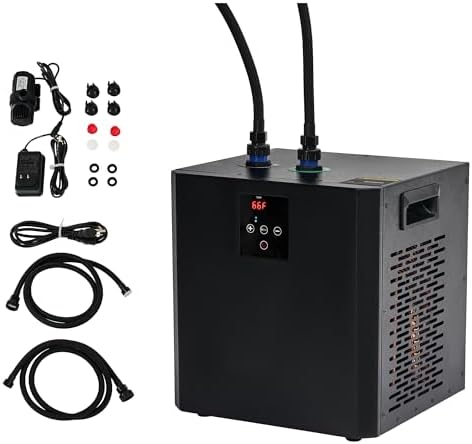
Prices across these 3 run from $169.99 to $329.99; each one has a full review here.
Beginners should start by learning how an aquarium water chiller works to understand the cooling process.


What happens if you under-buy or over-buy horsepower?
Under-buying compressor horsepower means the aquatic cooling unit lacks the mechanical strength to remove heat as fast as the environment adds it. If the compressor is too weak for the water volume, the unit will suffer from short-cycling, which occurs when the motor turns on and off rapidly to reach a target. This constant cycling causes excessive wear on the compressor motor, potentially leading to premature mechanical failure and unstable water temperatures.
Risks of over-buying compressor horsepower for small aquarium chillers
Over-buying compressor horsepower results in a unit that is capable of cooling the water much faster than necessary. While this might seem like a safety margin, a high-horsepower compressor in a small tank can cause the temperature to drop too quickly, leading to thermal shock for the inhabitants. Furthermore, a high-output motor often consumes more electricity even when it is only running at a low duty cycle to maintain the set point. It is like using a high-powered industrial air conditioner to cool a small walk-in closet; it works, but it is inefficient and may over-cool the space before it can react to changes.
For a deep dive into specific hardware, see our full GOSHET YSZY-02 Chiller review.
What is the most common mistake with compressor horsepower?
The most common mistake buyers make is assuming that a higher horsepower rating automatically translates to a faster cooling speed or a larger supported tank size. In reality, compressor horsepower is a measure of the mechanical power output of the cooling motor, not the final cooling capacity of the system. A high-horsepower motor is only useful if the heat exchange surface area and water flow rate are sufficient to move that heat into the surrounding air.
Why cooling capacity matters more than motor horsepower for fish tanks
You should optimize for cooling capacity rather than just the horsepower of the motor. Cooling capacity measures the volume of water the unit can lower by a specific temperature in a set timeframe. If you have a large tank, you need a system where the heat exchanger is large enough to handle the energy transfer. A powerful motor attached to a tiny heat exchanger will simply run constantly without ever reaching the target temperature, as the bottleneck is the physical surface area of the cooling coils, not the strength of the motor.
If you need a compact cooling solution, see our full 100W Aquarium Chiller review.
How does compressor horsepower interact with other specs?
Compressor horsepower interacts with the power output and the tank volume compatibility of the aquarium cooling system. While horsepower describes the motor’s strength, power output measures the total electrical energy consumed by the device. A high-horsepower compressor will naturally increase the total wattage of the unit, which you must ensure your electrical circuit can support.
How heat exchanger efficiency limits the cooling capacity of aquarium systems
The relationship between horsepower and tank volume compatibility is governed by the heat exchange efficiency. The maximum total water volume the device is designed to maintain depends on how effectively the heat exchanger can dump heat. If the heat exchanger is undersized, even a 0.33 HP compressor will fail to maintain a large tank’s temperature. Because the cooling capacity is the actual limit on performance, you must ensure the cooling rate matches your water volume. If the cooling rate is lower than the heat gain from your room, no amount of additional horsepower will stabilize the temperature.
Detailed specifications are available in our full Albott ACE001 Chiller review.
Why choosing cooling capacity over horsepower ensures proper aquarium temperature stability
We found that the range of available horsepower for these units is relatively narrow, with a median of 0.2 HP among the models we evaluated. This suggests that for most hobbyist needs, the difference between a 0.15 HP and a 0.25 HP unit is often less significant than the difference in the actual heat exchange surface area. When choosing, prioritize the cooling capacity that matches your specific gallon count over simply seeking the highest horsepower number available.
The other aquatic cooling unit guides we have published
- The Aquarium Water Chillers That Work Best for Freshwater Fish
- Which Budget Aquarium Water Chiller Prevents Algae Growth?
- Reliable Aquarium Water Chillers for Axolotls Compared
- Choosing the Best Budget Aquarium Water Chiller for Saltwater Reef Tanks
- The Aquarium Water Chillers That Work Best for Shrimp Breeding
- Which Small Aquarium Water Chiller Is Best for 20 Gallon Tanks?