Early Pricing is reader-supported: some links on this page are affiliate links, and as an Amazon Associate Early Pricing earns from qualifying purchases at no extra cost to you. Learn more.
Noise level for aquarium water chillers should range between 30 dB and 50 dB depending on the proximity of the unit to living spaces. You should aim for a 40 dB threshold if the aquatic cooling system sits in a shared room or a bedroom where sleep quality is a priority.
Recommended Noise Levels for Aquarium Water Chillers
| Use Case | Recommended Noise Level | Why this number |
|---|---|---|
| Bedroom or Nursery | 30 – 35 dB | Matches the sound of a whisper or a quiet library to prevent sleep disruption. |
| Home Office or Living Room | 35 – 45 dB | Comparable to a hum of a refrigerator or a steady dishwasher. |
| Garage or Dedicated Shed | 45 – 60 dB | Allows for higher mechanical output where ambient noise masks the chiller. |
| Industrial or Commercial Space | 60+ dB | Prioritizes high-capacity cooling over acoustic comfort in non-habitable areas. |
Aquarium Water Chillers covered by our own reviews
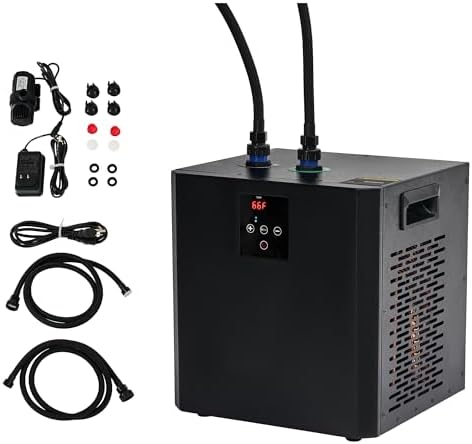
3 options shown here, $119.99 to $329.99, each with its own full review behind its name.
Small setups have unique requirements; find the best small aquarium water chiller for 20 gallon tanks to suit your space.


What happens if you go under or over on noise requirements?
The consequences of selecting a unit with a lower noise level
A lower noise level, specifically under 40 dB, often indicates a system designed with high-quality insulation or a low-speed compressor. While these units provide a quieter environment, they may have lower cooling capacity because the hardware is constrained by the need to remain silent. If you require a high-volume cooling rate for a large reef tank, a very quiet unit might struggle to maintain temperature stability during peak heat. You need to balance the desired decibel level against the total volume of water you intend to cool.
For larger setups, view our analysis of the best aquarium water chiller for 60 gallon tanks to ensure adequate cooling.
The costs of overbuying on noise level capacity
Overbuying on noise level capacity refers to paying a premium for a silent unit when the chiller is placed in a location where noise is not a factor. If an aquarium cooling system is installed in a detached garage or a basement, a unit producing 55 dB is perfectly acceptable. Spending extra on a 35 dB model in that same space is a waste of budget because the acoustic difference will be imperceptible. The cost of “silent” operation is often baked into the price of the motor and the housing materials, making it a luxury rather than a necessity for non-habitable spaces.
New hobbyists should start by learning how an aquarium water chiller works to understand the basic mechanics of cooling.
What is the mistake most buyers make with noise level?
The most common mistake is prioritizing a low decibel rating without first confirming the cooling capacity required for the specific tank volume. A chiller might be rated at a very quiet 35 dB, but if its cooling capacity is only 100 watts, it will be unable to keep a 200-litre tank cool in a warm room. This leads to a situation where the unit runs constantly at its maximum output to keep up, which can actually increase the perceived noise over time as the motor works harder. Instead of looking only at the dB rating, you should optimize for the cooling rate needed for your specific water volume first.
For specialized pet care, check out our full Usoraszkt Aquarium Chiller review for specific performance data.
How noise level interacts with other aquarium water chiller specs
The relationship between power output and acoustic output
Power output measures the amount of electrical energy consumed by the device, and there is a direct correlation between high power draw and noise. High-capacity chillers often require more powerful compressors, which generate more vibration and mechanical sound. If you need a high cooling rate, you may have to accept a noise level closer to 50 dB. A chiller with a 1,000-watt power draw will almost always be louder than a 200-watt unit because the motor must move more refrigerant or water to achieve that output.
This compact model is highly rated; see our full Poafamx 16gal Chiller review for the complete spec breakdown.
Why cooling capacity is the real limit for noise performance
Cooling capacity measures the volume of water the unit can lower by a specific temperature in a set timeframe. This is the most important metric for your setup. If your tank requires a cooling capacity of 500 watts, a chiller that provides this capacity but only produces 45 dB is an ideal find. However, if you choose a chiller with a 30 dB noise level that only offers 100 watts of cooling, it will fail to maintain your temperature. The noise level is a comfort metric, but the cooling capacity is the functional requirement that determines if the aquarium cooling system actually works.
High-capacity needs are covered in our full Poafamx 1/3 HP Chiller review regarding its cooling power.
How to check your environment for noise requirements
To decide on the right noise level, you must measure the ambient noise of the room where the chiller will sit. Stand in the intended location and record the decibel level during a normal day; if the room is already at 40 dB due to a television or fan, you can safely choose a chiller that produces 45 dB. If the room is silent, you should look for a unit that stays below 35 dB. How many decibels of background noise are currently in your room? If your room sits at 40 dB, a chiller rated at 45 dB will blend into the environment without being noticeable. If the room is under 30 dB, any chiller above 40 dB will be a constant distraction.
You can find a detailed analysis of the DYRABREST Water Chiller review to see how it handles specific loads.
A practical example of noise in a home office
Consider a home office where an aquarium cooling system is placed on a desk next to a computer. In this setting, a unit producing 50 dB would be as noticeable as a loud air conditioner running in the same room. To avoid this, a buyer would need to select a unit specifically rated for 35 dB or lower. This ensures that the constant hum of the compressor does not interfere with concentration or phone calls during the workday.
Where to go next in our aquatic cooling unit coverage
- Which Small Aquarium Water Chiller Is Best for 20 Gallon Tanks?
- Best Quiet Aquarium Water Chillers for Home Use
- Aquarium Water Chillers for 60 Gallon Tanks Compared
- Choosing the Best Aquarium Water Chiller for Hydroponic Cooling
- The Aquarium Water Chillers That Work Best for Freshwater Fish
- Which Budget Aquarium Water Chiller Prevents Algae Growth?