Early Pricing is reader-supported: some links on this page are affiliate links, and as an Amazon Associate Early Pricing earns from qualifying purchases at no extra cost to you. Learn more.
Aquarium water chillers come in three primary types defined by their heat exchange method: compressor-based, thermoelectric, and industrial-grade systems. A buyer needs to match the cooling capacity to the specific volume of water and the ambient temperature of the room to prevent the system from short-cycling. You should first measure the total volume of your water body in litres to determine the necessary cooling rate before selecting a unit.
Compressor-based Aquarium Water Chillers
Compressor-based aquarium water chillers use a closed-loop refrigeration cycle, similar to a household refrigerator, to move heat from the water to the outside air. This method is the standard for maintaining stable temperatures in large volumes because the compressor provides high cooling capacity and high energy efficiency. These units are designed for users who require consistent temperature control for large aquatic environments where the heat load from lighting and livestock is significant.
How compressor systems handle high-capacity cooling with moving parts
The primary advantage of a compressor system is its ability to handle high-capacity cooling without excessive power draw. Because the refrigerant gas moves heat efficiently, these units can maintain a steady temperature even when the ambient room temperature rises. The main compromise is the physical footprint and the presence of a moving mechanical part, which requires periodic maintenance to ensure the refrigerant lines remain clear and the compressor remains lubricated.
New hobbyists can start by learning how an aquarium water chiller works to understand the basic cooling mechanics.
Why compressor systems are the standard for large water volumes
These systems typically sit in a mid-to-high price band relative to other cooling methods. They are the standard choice for reef tanks and large freshwater displays where a failure to maintain temperature could lead to rapid environmental shifts. If the water volume exceeds 500 litres, a compressor system is often the only viable method to prevent the unit from running constantly without reaching the target temperature.
Where these choices show up in our reviews
Prices across these 3 run from $169.99 to $329.99; each one has a full review here.
If your budget is limited, you might want to explore the alternatives to an aquarium water chiller for cooling your tank.


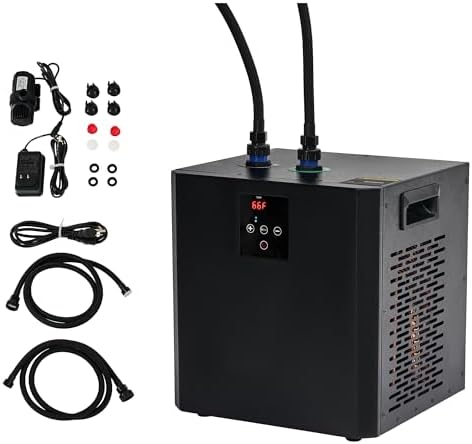
How Thermoelectric Aquarium Cooling Units Use Semiconductor Plates
Thermoelectric aquarium cooling units, also known as Peltier chillers, use electricity to create a temperature difference between two surfaces of a semiconductor plate. This method is most effective for small, localized cooling tasks where the total volume of water is low and the required temperature drop is modest. These units are ideal for small desktop tanks or specific point-of-use cooling where a large compressor is impractical.
Compact size and limited cooling capacity of thermoelectric units
The main advantage of a thermoelectric unit is its compact size and lack of moving parts, which simplifies the internal mechanics. Because they are solid-state, they are often easier to integrate into small spaces. However, they give up significant cooling capacity and energy efficiency. They require a large amount of power to move a relatively small amount of heat, making them less effective as the water volume increases or as the difference between the water and air temperature grows.
Low cost and power limitations of thermoelectric aquarium chillers
Thermoelectric options sit in the lowest price band of the category. They are suitable for small hobbyist setups but may struggle to keep a large tank cool in a warm room. If a user selects a thermoelectric unit for a large volume, the unit may run 100% of the time without ever reaching the set point, leading to a high electricity bill and potential hardware failure.
To protect your investment, be sure to examine aquarium water chiller warranties to understand the manufacturer’s coverage limits.
How Industrial Grade Chillers Provide Reliability and Precision
Industrial grade chillers, such as those produced by Hailea or EcoTech, serve as the benchmark for reliability and precision in the aquatic cooling industry. These units are designed for high-capacity, continuous operation and often feature heavy-duty construction and advanced controls. They are intended for professional installations, large-scale public displays, or high-value aquatic environments where temperature stability is non-negotiable.
Extreme durability and precision of industrial grade chillers
The primary advantage of an industrial grade chiller is its extreme durability and precision. These units are built to withstand long-term operation under heavy loads, often featuring larger heat exchangers and more robust compressors than consumer-grade models. The trade-off is the significant size and the high cost associated with industrial-grade components and manufacturing. These units are often used in situations where the cost of a temperature spike outweighs the high initial investment in hardware.
This compact unit is highly rated, so see how the 100W Aquarium Chiller performs in our detailed analysis.
High cost and high-capacity output of industrial cooling units
Industrial chillers sit at the highest price point in the category. While consumer-grade models provide adequate cooling for standard home use, industrial units provide the redundancy and capacity needed for large-scale systems. They are the reference point for performance; while the other models on this page may provide sufficient cooling for smaller volumes, they do not offer the same industrial-grade longevity or high-capacity output found in these benchmark units.
Aquarium Water Chiller Comparison
| Type | Best-fit Buyer | Main Advantage | Main Compromise |
|---|---|---|---|
| Compressor Chiller | Large reef or freshwater tanks | High cooling capacity | Larger footprint |
| Thermoelectric Unit | Small desktop tanks | Compact size | Low cooling capacity |
| Industrial Chiller | Professional/Large-scale displays | Extreme reliability | High cost |
Which Aquarium Water Chiller Type Suits Your Needs?
You should choose a compressor-based aquarium water chiller if your total water volume exceeds 300 litres or if you are maintaining a reef tank with high-intensity lighting. These systems provide the necessary heat removal capacity to keep large volumes stable without constant operation. If you have a large volume but choose a lower-capacity unit, you risk short-cycling, where the unit turns on and off rapidly, leading to compressor burnout and unstable water temperatures.
When to select a thermoelectric unit for small aquarium tanks
You should select a thermoelectric aquarium cooling unit if you are managing a small tank under 50 litres and only need to lower the temperature by a few degrees. These units are best for situations where space is limited and the heat load is minimal. If you use these for large volumes, you may find the water temperature never reaches the desired level, wasting electricity and failing to protect your aquatic life.
Owners of these unique pets can see our full Usoraszkt Aquarium Chiller review to see how it handles specific heat loads.
Why industrial grade chillers suit professional-grade aquatic displays
You should consider an industrial grade chiller if you are running a professional-grade display or a system where even a 1-degree fluctuation is unacceptable. These units provide the highest level of precision and are built for 24/7 operation under heavy loads. If your requirements involve high-volume water and extreme reliability, the industrial benchmark provides the necessary infrastructure that consumer units cannot match.
What Happens if You Choose the Wrong Cooling Capacity?
Selecting a chiller with a cooling capacity lower than your water’s heat load results in a system that runs constantly but fails to lower the temperature. This leads to a high electricity bill and premature hardware failure due to constant operation. If the unit is too small, the water temperature will fluctuate wildly as the chiller struggles to keep up with the ambient heat.
For high-capacity cooling needs, check out our full Poafamx 1/3 HP Chiller review for a complete spec breakdown.
Steps to measure tank volume and select the correct chiller
A user starts by measuring their tank volume and calculating the heat load from lights and heaters. They then select a chiller based on the recommended cooling rate for that volume. Finally, they install the unit and monitor the temperature stability over a 24-hour cycle to ensure the system is sized correctly for their environment.
If the water feels warm despite the chiller running, the unit is likely undersized for the volume of water. You must then determine if the issue is the cooling capacity of the unit or if the ambient room temperature is too high for the heat exchanger to dissipate heat effectively.
Browse our other aquarium chiller pages
- Which Budget Aquarium Water Chiller Prevents Algae Growth?
- Reliable Aquarium Water Chillers for Axolotls Compared
- Choosing the Best Budget Aquarium Water Chiller for Saltwater Reef Tanks
- The Aquarium Water Chillers That Work Best for Shrimp Breeding
- Which Small Aquarium Water Chiller Is Best for 20 Gallon Tanks?
- Best Quiet Aquarium Water Chillers for Home Use