Early Pricing is reader-supported: some links on this page are affiliate links, and as an Amazon Associate Early Pricing earns from qualifying purchases at no extra cost to you. Learn more.
Aquarium water chillers are systems that remove heat from aquatic environments to maintain stable temperatures. You need a chiller when your aquarium’s ambient temperature exceeds 28°C (82°F) or when your specific livestock requires a consistent range that your current cooling method cannot provide. Before purchasing, you must measure your total water volume in liters or gallons to ensure the unit’s cooling capacity matches your needs.
If you are on a tight budget, see our list of budget reef tank chillers.
Choosing Between Compressor and Thermoelectric Systems
The cooling method determines how the aquarium cooling system manages heat and how much electricity it consumes. Most hobbyists assume all chillers work the same way, but the internal mechanics create a significant divide in performance and cost.
Larger setups require more power, so view our comparison of 60 gallon tank chillers.
- Compressor – This method uses a sealed refrigeration cycle to move heat from the water to the outside air; a larger horsepower (HP) rating indicates a more powerful motor capable of cooling larger volumes of water quickly.
- Thermoelectric (Peltier) – This method uses electricity to create a temperature difference between two ceramic plates; these are often smaller and quieter but are generally less efficient than compressor units for large tanks.
- Heat Exchanger – This component transfers heat from the water to the cooling medium, such as a refrigerant or a water circuit; a larger surface area allows for faster heat transfer.
- Condenser Coil – This part of the system dissipates heat into the surrounding air; its placement determines how much ventilation the room needs to prevent the unit from overheating.
- Evaporator Coil – This component absorbs heat from the circulating water; its efficiency is tied to the flow rate of the water passing through it.
Where these choices show up in our reviews
Each of the 3 shown here has its own full review on this site; they run from $119.99 to $329.99.
Before buying, you should learn about the different types of aquarium chillers.

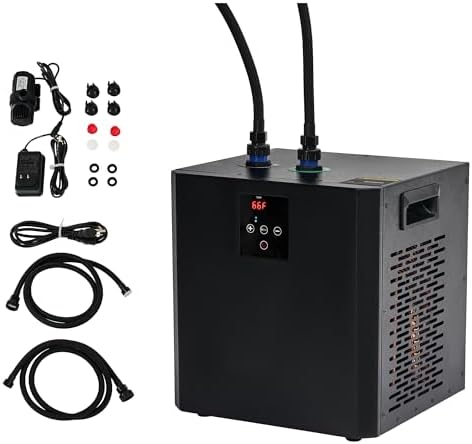

Closed Loop vs. Open Loop Configurations
The configuration of an aquarium cooling system dictates whether the unit sits inside your tank or stays on a nearby shelf. Each setup changes the physical footprint and how you manage the water flow.
Beginners can start by learning how an aquarium water chiller works.
- Open Loop – This setup connects the chiller to the aquarium via external hoses and pumps; it allows you to place the unit away from the tank, which is useful for managing heat dissipation in small rooms.
- Closed Loop – This system is often submerged or integrated directly into the water path; it simplifies the plumbing but requires the unit to be physically near or inside the water source.
- External Water Pump – This device circulates water from the tank to the chiller; you must ensure the pump’s flow rate (liters per hour) meets the requirements of the chiller’s evaporator coil.
- Inlet and Outlet Hoses – These connect the aquarium to the cooling unit; you must verify the diameter of these hoses matches the ports on the chiller to ensure a leak-proof fit.
- Temperature Controller – This device automates the power cycle based on real-time readings; a high-precision controller prevents the temperature from swinging wildly between “on” and “off” states.
Understanding Cooling and Power Specifications
Technical specifications tell you how much work the aquarium water chiller can do and how much it will cost to run. You should prioritize the capacity figures over the brand names to ensure the device can handle your specific environment.
If a chiller is too expensive, explore the alternatives to an aquarium chiller.
Safety is paramount, so review the chiller certifications and safety standards.
- Cooling Capacity – This measures the volume of water the unit can lower by a specific temperature in a set timeframe; a higher number means the unit can handle a larger tank or a hotter environment.
- Power Output – This measures the electrical energy consumed by the device, often stated in Watts; a lower wattage for the same cooling capacity indicates a more energy-efficient unit.
- Tank Volume Compatibility – This is the maximum total water volume the device is designed to maintain; you must ensure your total tank volume, including substrate and decorations, stays below this limit.
- Compressor Horsepower – This measures the mechanical power output of the cooling motor; a higher HP rating generally allows the unit to reach target temperatures faster in high-heat conditions.
- Hose Length – This is the length of the included tubing; if the stated length is shorter than the distance between your tank and your intended chiller location, you will need to purchase additional tubing.
- Circulation Function – This indicates if the unit moves water internally; if a unit lacks this, you must provide a separate pump to move water through the heat exchanger.
- LED Indicator – This provides a visual status of the unit’s operation; it does not affect cooling performance but helps you monitor if the unit is currently active.
Terms That Often Cause Confusion
Several terms in the aquarium cooling industry sound similar but describe very different physical properties or capabilities. Understanding these differences prevents you from buying a unit that cannot handle your tank’s specific requirements.
For a specific unit analysis, see our full GOSHET YSZY-02 Chiller review.
Cooling Capacity vs. Power Output
Cooling capacity describes the actual work done on the water, while power output describes the electricity the machine pulls from your wall. A unit can have a high power output but a low cooling capacity if the heat exchanger is poorly designed. You should prioritize cooling capacity for your tank size and use power output to estimate your monthly electricity costs.
You can find more data in our spec breakdown of the 100W Aquarium Chiller.
How Horsepower and Watts differ in aquarium chiller specifications
Horsepower refers specifically to the mechanical strength of the compressor motor, whereas Watts measure the total electrical consumption of the entire device. A 0.2HP compressor does not mean the unit uses 200 Watts; it only describes the size of the cooling motor. You need the Horsepower figure to determine if the motor is strong enough for your volume, and the Wattage to understand your power bill.
Axolotl owners can find a full review of the Usoraszkt Aquarium Chiller.
Open Loop vs. Closed Loop
Open loop refers to the plumbing layout where hoses carry water to a separate unit, while closed loop refers to a system where the cooling happens within a self-contained circuit. If you have limited space near your tank, an open loop system is usually the better choice because it allows you to place the chiller elsewhere. If you have a very large setup where plumbing is difficult, a closed loop system might be more practical.
Check out our full DYRABREST Water Chiller review for more details.
Browse our other aquarium chiller pages
- Aquarium Water Chillers for 60 Gallon Tanks Compared
- Choosing the Best Aquarium Water Chiller for Hydroponic Cooling
- The Aquarium Water Chillers That Work Best for Freshwater Fish
- Which Budget Aquarium Water Chiller Prevents Algae Growth?
- Reliable Aquarium Water Chillers for Axolotls Compared
- Choosing the Best Budget Aquarium Water Chiller for Saltwater Reef Tanks